The Neolithic period in Britain and Ireland is made famous by monuments like Stonehenge, Newgrange, and Long Meg and her Daughters. These surviving structures provide tantalising clues to prehistoric life and are key to archaeological research. But what makes a monument distinctly Neolithic? And what do archaeologists look for when studying them?
The Neolithic period, or the New Stone Age, began in Britain around 6000 years ago. It lasted from around 4000 BC to 2200 BC and is characterised by a dramatic shift in how people lived.
During this time, communities transitioned away from seasonally nomadic lifestyles relying on hunting and gathering and moved towards permanent settlements supported by farming and animal domestication.
However, the most remarkable aspect of the Neolithic period was the emergence of monument-making. Communities began undertaking large-scale building projects, constructing stone and earthen structures requiring extraordinary levels of coordination, resources, and labour.
These monuments took many forms, from large earthen mounds enclosing chambered tombs to imposing circles made of freestanding stones, to massive earthworks of banks and ditches. Thousands of these monuments survive today and remain prominent features in Britain’s landscape.
Neolithic monuments in the Boyne Valley

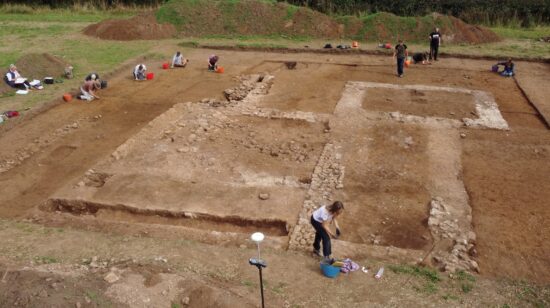
The dig team on site at Boyne Valley 2024
DigVentures is investigating two potential Neolithic monuments in the Boyne Valley, near the UNESCO World Heritage Site of Brú na Bóinne—home to the iconic monuments of Newgrange, Knowth, and Dowth.
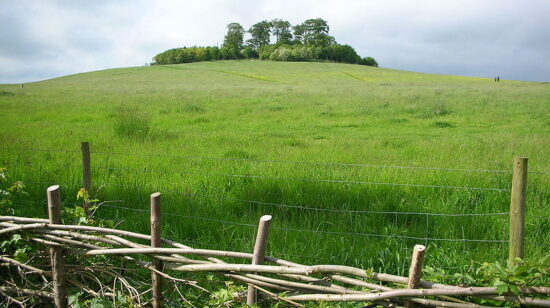
While previous research has centred on these famous monuments north of the River Boyne, recent LiDAR, satellite, and palaeoenvironmental surveys have revealed a hidden prehistoric landscape to the south. Our investigation aims to determine the age and purpose of two of these newly discovered monuments.
Curious about ancient monuments? We’ve created a guide to help you identify 5 quintessential Neolithic structures across Britain and Ireland.
Barrows

West Kennet Long Barrow, Wiltshire. Photo: Dave Archer
Barrows are burial mounds that can take many different forms. Some contain elaborate internal chambers covered with earth, while others are simply earthen mounds built to cover human remains.
There are more than a dozen classifications of barrow depending on their shape, date of construction, and function, and most people will be familiar with long barrows or round barrows.
Long barrows are some of the earliest earthworks known in Britain, with most dating between 3800 BC and 3500 BC.
Round barrows start popping up at the end of the Neolithic, around 2200 BC. With over 10,000 surviving round barrows in Britain, they are one of the most common prehistoric monument types in the landscape.
Excavations have shown that barrows were often reused and modified for centuries after their original construction, with features such as chambers, cultural material, and burials from different periods added over time.
Appearance
Long barrows are monumental burial mounds that are longer than they are wide. Ranging in shape from rectangular, to lozenge, to oval, long barrows typically measure around 50m long and up to 25m wide.
Long barrows often contained stone or timber chambers that could accommodate multiple burials. These structures vary in complexity, from simple timber constructions to more elaborate stone chamber designs. After constructing the burial chambers, the builders would cover them with an earthen mound.

Inside the West Kennet long barrow burial chamber. Photo: Adam Stanford
Round barrows can vary in style and construction and are subdivided into several types including bowl, bell, disc, pond, and saucer. They range dramatically in size, from diminutive 6-meter structures to massive monuments 40 meters in diameter.
Often found in groups that may contain different types, some barrows have platforms, enclosures, or ditches.
What to look for
Barrows can be difficult to spot as they may have been ploughed over and look relatively flat.
Long barrows:
- Longer than they are wide.
- A front end which is usually higher and wider than the back
- Orientation which is usually east-west
- Traces of ditches along the sides flanking the mound or encircling it by continuing around the back
Round barrows:
- Traces of a surrounding ditch
- Orientation with other nearby barrows or prominent natural landscape features
- If excavated previously, there are likely to be depressions on top of the mound

A collection of Neolithic and Bronze Age round barrows at Normanton Down, near Stonehenge. Photo: Historic England.
Causewayed enclosures
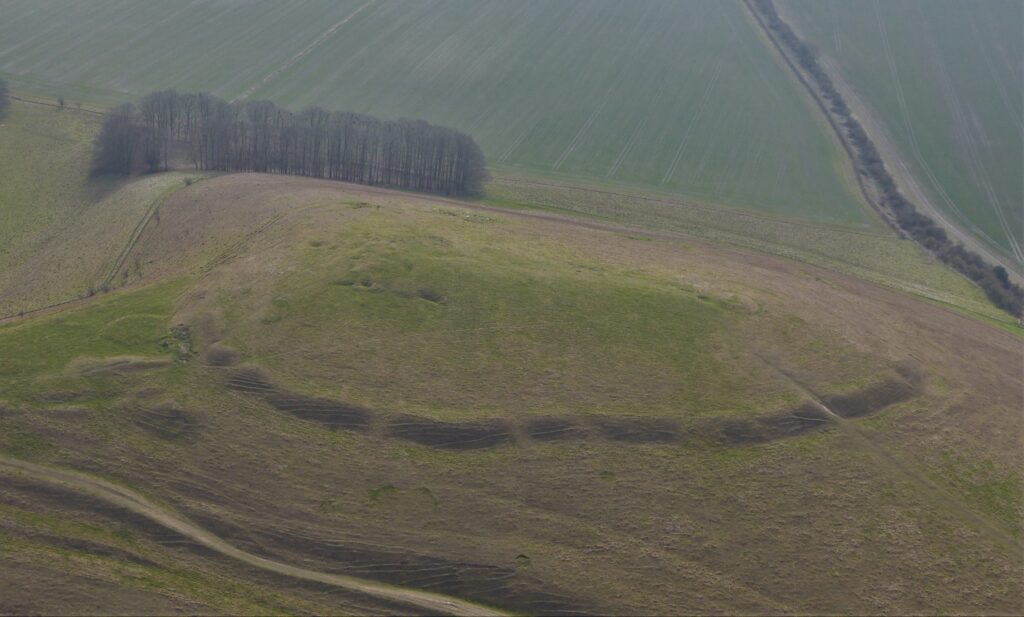
Knap Hill, a causewayed enclosure in Wiltshire. Photo: Laurence Davies; Pilot: Tony Hughes.
Causewayed enclosures are large earthworks encircled by banks and ditches with raised tracks or causeways crossing the ditches at multiple locations. The corresponding banks are often, but not always, interrupted by the causeways.
These are the earliest known type of enclosure earthworks, dating to the first half of the Neolithic Period (4000-3300 BC). Their function is not entirely understood, but excavations suggest they likely saw only occasional, perhaps ceremonial, use and wouldn’t have been settlement sites (despite their size).
Appearance
Causewayed enclosures are usually oval, circular, or nearly circular and made up of at least one encircling bank and ditch – with some having two or three concentric banks and ditches. Originally, these ditches would have been as deep as 3m and the banks as high as 2m.
Unlike hillforts, causewayed enclosures are positioned in the landscape just off the summit of nearby high ground. Although they would have originally been sizeable in scale, causewayed enclosures are not often visible in the landscape today and tend to be detectable in cropmarks rather than standing earthworks.
What to look for
- Normally roughly oval in shape enclosing between 0.4-10ha
- One or more circuit of banks and ditches
- Usually multiple, wide breaks in ditch circuits (the causeways)
- Regularly located near other Neolithic earthworks like barrows
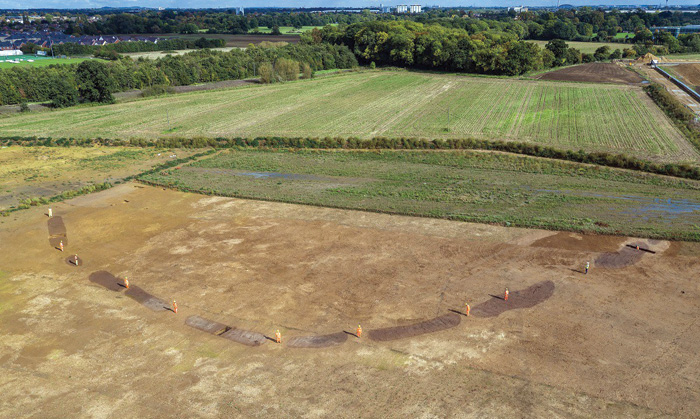
Dachet causewayed enclosure in Berkshire. Photo: Wessex Archaeology
Passage tombs
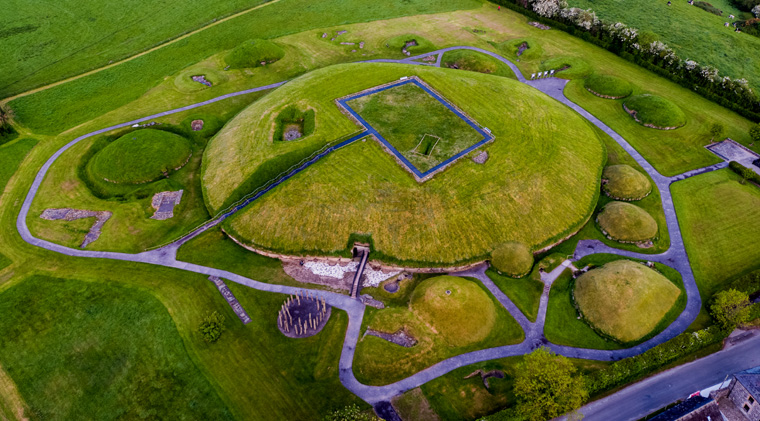
Knowth passage tomb in the UNESCO World Heritage Site of Brú na Bóinne. Photo: knowth.com
Passage tombs are burial mounds with long entrance passages leading to a burial chamber or tomb. With over 200 identified in Ireland alone, they are iconic markers of prehistoric life on the island. Passage tombs are unique for their long period of use, with evidence showing some were active burial sites for multiple centuries after their initial construction. Many passage tombs are also believed to be aligned with celestial bodies, demonstrating a high level of complex ritual and ceremonial significance.
Appearance
Aptly named, passage tombs have a long, narrow, often stone-lined entrance leading to a central burial chamber or multiple chambers. During construction, the passage and chambers were covered beneath a mound of earth or stone. Their steep sides and domed tops create distinctive profiles that stand out on the landscape. Passage tombs range in size and design, from small and simple to massive and elaborate.
To an unfamiliar eye, round barrows and passage tombs may appear similar from the outside. However, passage tombs are a distinctly unique category of monument. They’re more architecturally sophisticated, incorporating elaborate stonework like corbelled roofs to achieve an arched appearance, can contain intricate petroglyphs (stone-carved artwork), and often have multiple burial chambers.
What to look for
- Mounds of earth or stone containing a long entrance passage
- One or more burial chambers
- Alignment with celestial bodies
- More complex stone architecture
- May contain artwork (petroglyphs)

Neolithic art (petroglyphs) at the entrance of Newgrange passage tomb in the UNESCO World Heritage Site of Brú na Bóinne. Photo: Ron Cogswell
Cursus

U-shaped cursus next to Newgrange passage tomb. Photo: Matthew Kelly
Unique to Great Britain and Ireland, curses are elongated rectangular or ovoid enclosures with parallel banks and external ditches. They are among the earliest monuments in Great Britain and Ireland, dating to the early to mid Neolithic (4000 – 3300 BC).
The term cursus comes from the Latin word for ‘course’ (as in racing course) when William Stukeley, an 18th-century English physician and antiquarian, thought the elongated rectangular shape of these monuments resembled a Roman racing track.
Cursus are not believed to be built for defensive purposes. As these earthworks are often aligned with nearby funerary monuments and celestial bodies, they may serve a ceremonial or ritual function as part of a processional route or ceremonial pathway.
Appearance:
Cursus vary dramatically in scale. In length, they can range from 40 meters to nearly 10 kilometres. In width, they span from 20m to 150 meters. Despite their varying dimensions, these ancient earthworks are characterised by parallel banks that run the length of the monument, with ends that could be gently rounded, squared-off, or even open in some rarer examples. Cursus are also typically surrounded by an exterior ditch. While their interiors were generally flat, some cursus contain evidence of possible internal ditches or smaller monuments.
Today, most cursus have been largely erased by centuries of agricultural activity, particularly ploughing. This makes them challenging to identify at ground level, with smaller examples being particularly difficult to distinguish from long barrows or other prehistoric enclosures. As a result, these monuments are now most often detected through aerial photography and cropmarks.
What to look for
- Long, parallel(ish) sides defined by banks
- External ditch
- Flat bottom interiors
- May be aligned with a long barrow or incorporated a long barrow into their construction
- May have a gap in the banks and a pause in the ditch to allow for entering/exiting
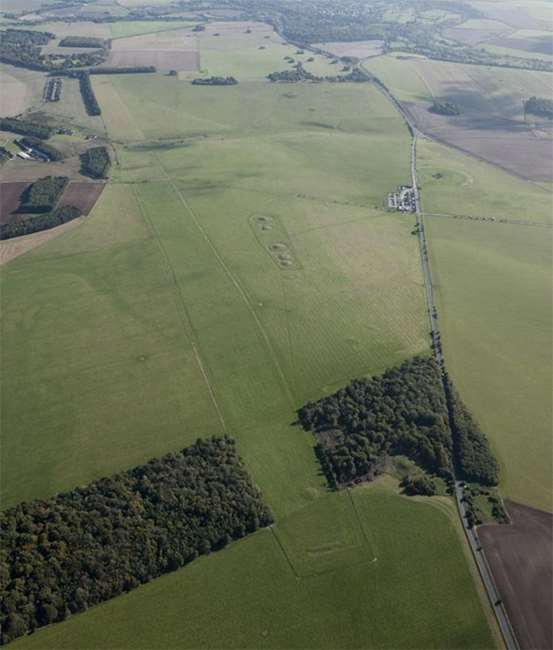
Greater Stonehenge Cursus. Photo: Historic England
Henges

Neolithic henge in Bodmin, Cornwall. Photo: Historic England and Cornwall Archaeological Unit
Henges are circular enclosures formed by at least one ring-shaped exterior bank and a ring-shaped internal ditch, with at least one causeway (or opening) leading to a flat, circular, central area.
Though Stonehenge is synonymous with henge monuments, it isn’t actually a proper henge – its ditch lies outside the bank.
The term ‘henge’ is thought to come from the Old English word meaning either ‘hanging’ or ‘hinge,’ referring to how Stonehenge’s horizontal (lintel) stones balance on upright stones.

Stonehenge lintels (trilithon: two upright stones that support a third stone laid across the top)
While the broad term may come from the world-famous monument, archaeologists use the term ‘henge’ to describe circular prehistoric monuments with an external bank and internal ditch.
Henges typically date to the late Neolithic (ca 2900 – 2100 BC). Though their exact function is still unclear, they are believed to be a part of a ritual landscape, as many henges are associated with long barrows, cursuses, and other Neolithic monuments.
Appearance
Henges vary in shape and can be circular, near circular, or oval. However, you will always find a ring-shaped bank (external) and a ring-shaped ditch (internal) with at least one causeway (entrance). Henges can have multiple causeways and several banks and ditches.
The central area of a henge is typically flat and circular, sometimes featuring standing stones or circles made of stone or timber. Archaeological excavations often reveal earlier traces of human activity within this space, including postholes, pits, and burials that predate the henge itself.
Aside from a few exceptions like Avebury (347m) or Stanton Drew (135m), most henges range in diameter from 20m – 110m.
What to look for
- Earthworks that are circular, near circular, or oval in shape
- Exterior ring-shaped bank and an interior ring-shaped ditch (there may be several bank-and-ditches)
- At least one causeway (entrance), but there may be more
- Usually flat central interior
- May find evidence of standing stones, stone circles, or timber circles
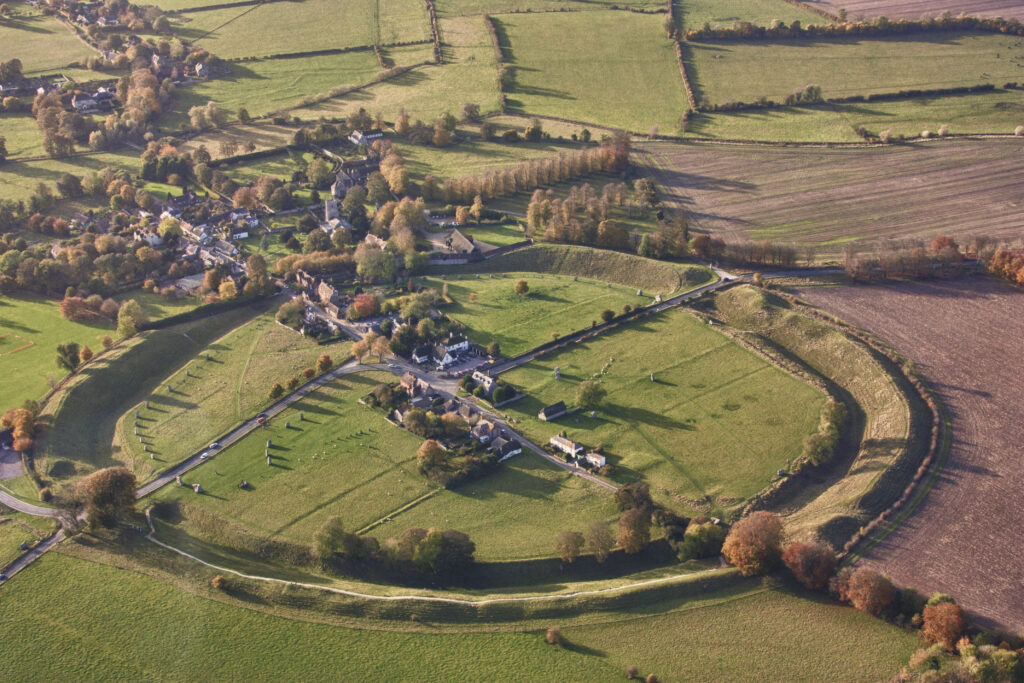
Avebury henge and stone circles in Wiltshire.



There are no comments on this post yet. Be the first!