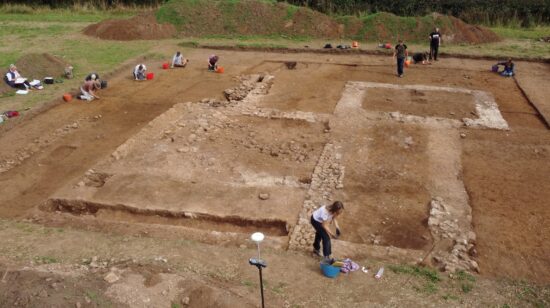
This July marks our first season of crowdfunded digging at Lytham Hall in Lancashire. After an exciting weekend excavating test pits in 2025, we’re heading back this summer to uncover what secrets may lie beneath this remarkable Georgian country house and its historic parkland.
From early medieval roots and a Benedictine priory to lost gardens, an 18th-century ice house and the boom of Victorian seaside tourism, Lytham Hall is packed with layers of history. Beneath its lawns lie traces of these changing times, and they’re waiting to be rediscovered.
But before we dust off our trowels, let’s explore the people and events that shaped Lytham Hall’s past, and why they make its archaeology so promising…
Long before Lytham Hall
The area around Lytham has been in significant use for thousands of years. Lancashire’s Fylde Coast has been inhabited since the Bronze Age, and the first recorded settlements in the town we know as Lytham date to around 600 AD, possibly deriving from the Old English “hlith”, meaning “(place) at the slopes”.
Around 900 AD, Vikings facing defeat in Ireland crossed the Irish Sea to the Fylde Coast, with many settling across Lancashire and Cumbria, establishing fishing, farming and trading communities that left a lasting mark on the landscape.
Lytham itself appears as “Lidun” in the Domesday Book of 1086, listed alongside over 50 other Fylde settlements in the “Hundred of Amounderness”, one of historic Lancashire’s six county subdivisions.

The Domesday Book, incorporating two separate volumes (Little Domesday, which covers Norfolk, Suffolk and Essex, also featuring Lancashire) and Great Domesday (covering much of the remainder of England). Credit: nationalarchives.gov.uk
A higher calling?
The Viking settlers who inherited local control seemed to have largely adapted to Norman rule over time, adopting Anglicised names in the process. Among them was Richard Fitzroger, who was granted the site of Lytham by King John around 1199. He later gifted some of his land to the Benedictine monks of Durham, to establish a small priory.
According to local tradition, his generosity was inspired by a divine miracle. At one stage gravely ill, Richard was carried to nearby St Cuthbert’s church, only to make an unexpected recovery. Believing St Cuthbert had saved him, Richard travelled to Durham to offer prayers of gratitude, and granted some of his land to the Benedictine Order.
The subsequent priory was essentially a working manor house, complete with a hall, brewhouse, granary, horse mill and other outbuildings. Monks provided religious services to the community, whilst sustaining themselves through farming. They were effectively the local landlords, and the people of Lytham their tenants.
The next 300 years of priory accounts reveal the quirks of medieval rural life, from disputes with neighbours to storms, flooding and even plagues like the Black Death. Despite these upheavals, the centuries here passed relatively peacefully, benefitting greatly from Lytham’s seclusion on the coast.
If any traces of these buildings survive beneath the Hall’s grounds today, they’re exactly the kind of features archaeology can uncover – and this summer, we might find out!
Enter the Cliftons
The priory was dissolved in 1539 by Henry VIII, and its land passed to the Crown. Several interim owners later, Cuthbert Clifton of nearby Westby Hall purchased Lytham Manor in 1606, and developed a new building at the site of the priory.

Sir Cuthbert Clifton. Credit: lythamhall.org.uk
As Catholics in a period of religious persecution, the Cliftons had long kept a deliberately low profile, quietly expanding their landholdings across the Fylde Coast, and avoiding any displays of grandeur that might draw unwanted attention.
For a while, it worked – but their strategy was later shattered by the English Civil War, which cost the family dearly, with several family members lost in battle, their estates confiscated, and the threat of financial ruin narrowly avoided by the Restoration of the Monarchy. Their misfortune didn’t end there, however, as their continued support of King James II led to even further losses within the family and the local area, during the Glorious Revolution of 1688 and later Jacobite Rising of 1715.
Splashing out
By the mid-18th century, societal attitudes towards Catholicism were changing. After generations of restraint, Thomas Clifton decided it was time to think bigger, and commissioned a bold new hall designed by celebrated architect John Carr of York, which was completed in 1764. With so much change during this period, it’s hard to imagine that there aren’t traces of Thomas’s ambitious vision still to be found (and we’d love you to join us as we explore them).

Thomas Clifton. Credit: lythamhall.org.uk
With a grand new hall and improving fortunes, the Cliftons decided to turn their attention outward. From the late-18th century onwards, they led the transformation of Lytham from a quiet fishing village to a booming seaside resort – a shift accelerated dramatically by the arrival of the railway in 1846, and the fashion for sea bathing and “taking the waters”.
Meanwhile, the Industrial Revolution was rapidly expanding Lancashire’s towns and swelling its population, creating a new class of wealthy manufacturers who came to Lytham for their health, returned for their holidays and stayed for their retirement. The poor-quality farmland and sand dunes that had lined the coast for centuries (and produced little income for anyone) were levelled to create streets and houses, and by the 1870s, this process had developed the entirely new resort of St Annes-on-Sea, and the Lytham St Annes we know today.
A new chapter for Lytham Hall
After years of prosperity, the 20th century brought further hard times for the Clifton dynasty. John Talbot Clifton, a passionate traveller and extravagant spender, died on an expedition to Timbuktu in 1928, leaving his wife Violet as the last resident of Lytham Hall. Their son Henry (known as Harry) shared his father’s indulgent tastes, and spent much of the family’s remaining wealth. His story was even believed to have inspired the character of Sebastian Flyte in Brideshead Revisited, following author Evelyn Waugh’s visit to Lytham Hall in the 1930s.
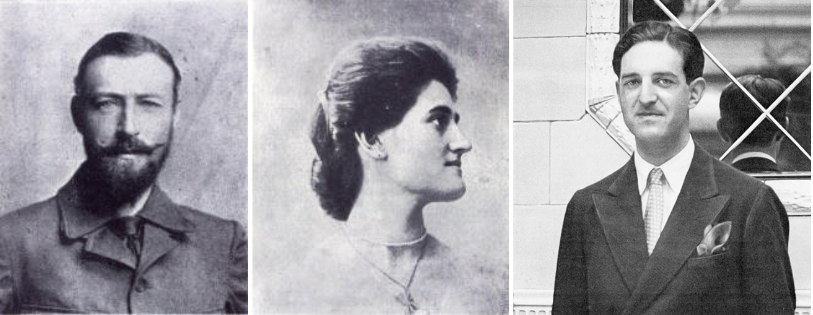
John, Violet and Henry. Credit: amounderness.co.uk / greatbritishlife.co.uk
By 1963, Lytham Hall had passed out of the family’s hands, and into those of the Guardian Royal Exchange Assurance, who used it as their headquarters until 1996, when they put it up for sale. Following a donation from aerospace company BAE Systems, the asking price was covered, and the Hall moved under the care of charitable Lytham Town Trust in 1997. Since 2000, it’s been managed as a visitor attraction by the Heritage Trust for the North West on behalf of the Town Trust, preserving the Hall and its grounds for future generations.
Beneath the layers of Lytham
The Clifton family shaped Lytham for centuries, and their time at the Hall offers a fascinating front-row seat to how sweeping national events, from the English Civil War to the boom of Victorian seaside resorts, were navigated at a local level.
Today, Lytham Hall’s in the care of a charitable trust, but the secrets buried beneath its lawns are far from lost, and we’re excited to play a part in uncovering them this year. From whether Cuthbert Clifton’s home really was built in the ruins of the Benedictine priory, to the finer details of Thomas Clifton’s ambitious new Hall, every find we make could add new colour to the estate’s layered history – and you can help us discover them.
Header image: Lytham Hall



There are no comments on this post yet. Be the first!