Ancient Ireland and the Boyne Valley
30 June - 12 July 2026
DigVentures is crowdfunding a dig to investigate newly discovered Neolithic and Bronze Age monuments in the Boyne Valley. Help make the dig happen - alongside our archaeologists.
The Boyne Valley is home to some of Ireland’s most iconic ancient landmarks; Knowth, Dowth, and Newgrange. Located on the north side of the River Boyne, just one hour from Dublin, they form part of the renowned World Heritage Site of Brú na Bóinne.
At over 5,000 years old, these incredible structures were clearly built with a sophisticated knowledge of astronomy and engineering. Together they contain the largest collection of megalithic art in Western Europe.
But they are not alone.
On the south side of the river, just on their doorstep, geophysical survey has revealed another long-forgotten landscape of buried monuments.
No longer visible on the surface, evidence suggests there is a rich tapestry of multi-phase settlement activity which may include henges, enclosures, settlements, ring ditches, a vast post alignment and many other intriguing features all waiting to be investigated. But, we know very little about them beyond their outlines on the survey imagery.
How old are they? Do any of them predate the monuments on the north side of the river? How well preserved are they? Do they hold evidence about who built them, and why? Could new discoveries in this renowned Neolithic landscape change our understanding of Irish prehistory forever?
In 2023, we began the first archaeological research project to investigate these sites.
We’ve returned every year since then, and our discoveries keep getting bigger, raising evermore profound questions about the dawn of Neolithic monument-building in Ireland. We are on the tip of an archaeological iceberg, and there is plenty more to find out.
Help us reach our goal to make this year’s dig happen, and together we can begin to unearth new chapters in Ireland’s prehistoric story.
Our dig sites


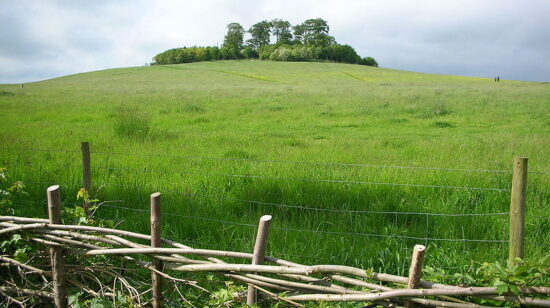
Located near Donore, less than an hour from Dublin, the Boyne Valley is one of the most significant Neolithic landscapes in the world. It includes the UNESCO World Heritage Site of Brú na Bóinne.
Our dig site sits within the buffer zone of this monumental landscape, on the south side of the River Boyne. Unlike the famous monuments on the north bank, these sites have never been explored before and have the potential to radically change our understanding of the Neolithic in the Boyne Valley.
By crowdfunding the dig you’ll help us investigate:
Area 1: A vast post alignment or timber avenue


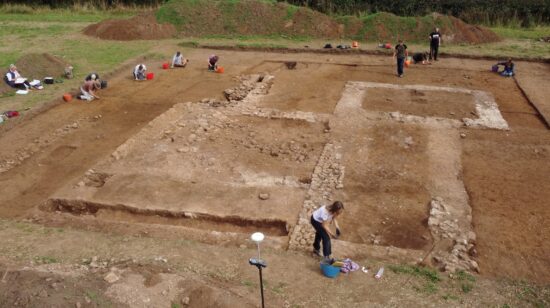
Our first area of investigation is a cluster of monumental features, located on a prominent rise in the landscape, with a majestic view down onto Brú na Bóinne and Newgrange. This cluster includes a small enclosure, a possible funerary monument, and a double row of massive postholes which appear to perfectly align with Dowth Henge – like a timber passageway or avenue.
But is it a ceremonial avenue, or an enclosed space? How was it used? How does it relate to the other, smaller monuments nearby? Which other monuments or solar and celestial events in the wider valley does it align with? And can the dating evidence we collect tell us when it was built, and which monuments it was contemporary with?
Only one other comparable monument has been discovered in Ireland, near Tralee, making the answers to these questions of national, if not international, significance.
Area 2: A Neolithic causewayed enclosure


Our second site of investigation is a causewayed enclosure, a type of monument thought to represent the earliest known enclosure of open space in European prehistory.
It’s one of only a handful to have been discovered in Ireland, making it a site of huge international significance. The majority of causewayed enclosures so far identified are found in England south of the River Trent, with a few outliers in Ireland, Wales, Scotland, and Cumbria. More importantly, recent research suggests that this type of monument was being constructed as early as 3650 BC, around the same time as the arrival of agriculture, pottery manufacturing, and animal domestication in the region.
Could it be older than many of the more famous monuments to the north of the River Boyne? And could it even turn out to be one of the oldest monuments ever discovered in the valley? So far, all our discoveries are pointing in the right direction…
We’ve spent three seasons investigating this site and learning about the monument itself. This summer, we’re shifting our attention to Area 3, in an attempt to answer an even more fundamental question about this area: Why did they build it here? And could there have been something even older here before it?
*NEW* Area 3: An ancient springside settlement


What led Neolithic people to build another cluster of monuments right here on the south side of the River Boyne? Our third and newest area of investigation could take us straight to the source.
Geophysical survey has revealed evidence of what looks like a prehistoric settlement located right next to a spring. Although the latest phase seems to be Bronze Age, our goal is to find out how far back it goes: does it date all the way back to the Neolithic? And are there any traces of votive activity associated with the spring?
Evidence shows that many Neolithic monuments are located next to springs, while some even incorporate them into the monument itself, underscoring a deep connection between Neolithic societies, their monuments, and these sacred waterways. Could this spring be what drew our monument-builders to this very spot? And what kept people here all the way through to the Bronze Age?
The discoveries so far


In partnership with UCD, we launched our first crowdfunded dig here in 2023. Our goal was to field-check the geophysical survey results, and establish how much of these long-lost monuments survived below ground and learn whether they could provide us with evidence to help unlock their secrets.
The results were even more astonishing than we could ever have anticipated, and are already set to change our understanding of ancient monuments in the Boyne Valley and beyond.
Remarkably, our latest dig has revealed that the post alignment was constructed with an internal double row of substantial postholes, flanked on the exterior by two additional rows of smaller postholes on both sides, rather than the single row that had been shown on the geophysics. Their size and depth suggest that this must have been an enormous monument, visible for miles across the landscape, and apparently aligned with the other famous monuments of the Boyne Valley.
Plus, the causewayed enclosure has produced some compelling artefacts, including a single hand-made bead, an early Neolithic jar, a polished stone axe, a flint arrowhead, and a collection of quartz debitage, meaning they were working with crystal on site.
Most importantly, soil samples collected for radiocarbon dating are beginning to suggest that it could be one of the very oldest monuments in the valley…
What we’re looking for


Neolithic archaeology isn’t like other archaeology. On the one hand, you’re excavating huge monuments the size of multiple tennis courts. On the other hand, you’re searching for the tiniest fragment of bone, pottery, flint, or charcoal – because when things are this old, the smallest clue can make the biggest difference.
This year, our focus will be on the post alignment and the springside settlement.
In Area 1, our goal will be to continue characterising this monument. How big is it? How well do other areas we haven’t yet investigated survive? Are there nearby features that are related to it? And are there any clues that can help us understand why it was built or how it was used?
In area 3, we will be investigating the remains of a possible settlement. The features on the geophysics look characteristically Bronze Age, but we want to know if there may be earlier phases. The first question to answer is whether our analysis of the geophysics is correct and if this area is indeed a settlement. Then we can start to investigate how old the site is, who the people who lived there were, why they chose this location and whether the origins of the settlement are contemporary with our Neolithic monuments.
At both sites, we will be working to find additional dateable evidence (like fragments of bone or charcoal) that can be sent for radiocarbon dating to help us confirm exactly how old the monuments are, how long they were in use, and how they fit into the wider story of the Boyne Valley.
Does the timber avenue really line up with Dowth Henge? What were they doing there? Why did people go to such extraordinary efforts to build these monuments? And will the springside settlement point us to the source of all this activity?
Whether it’s personal artefacts, stone tools, the footprints of the monuments themselves, charred seeds and plant remains, animal bones, or the stratigraphic layers that can unlock the sequence and chronology of events, we’ll be looking for any archaeological evidence that can add to the story of the Boyne Valley’s Neolithic monument builders.
And with your help, we can find it.
Why we want you to get involved


Archaeology doesn’t have to be about watching documentaries on TV, visiting museums, or reading articles in the news. It can also be about getting involved and helping to unearth the stories that matter to you.
Across the world, there are hundreds of archaeological sites with incredible stories to tell that can change our understanding of how human history has unfolded. At the same time, there are thousands of people like you who love history and want to get involved.
South of the River Boyne, there’s an ancient landscape that contains a buried world of Neolithic monuments with the potential to reshape what we know. These stories deserve to be unearthed so that they can contribute to ground-breaking new knowledge about Neolithic Ireland. With your support, we know that we can uncover and share them with the rest of the world.
But that can only happen if you get involved. It’s archaeology in your hands!
Crowdfund the dig to help make it happen


Whether you love Irish history, are fascinated by Neolithic archaeology, or just want to try something new, you can:
- Dig with our team in Ireland
- Support the dig from a distance
- Fund a radiocarbon date
- Get a DigVentures t-shirt
- Join a livestream during the dig to meet our archaeologists
However you choose to get involved, you’ll be contributing to globally significant research and making a real difference to what we know about Ireland’s ancient monument-builders.
To show our appreciation, we’ll invite you to a livestream where you can meet our archaeologists during the dig, send you updates whenever we make an exciting discovery, and acknowledge you as an official contributor in our Dig Report. We’ll even send you a digital copy – with your name in the credits!
Plus, we make sure that all the results and discoveries from the dig are freely available to examine online.
Through our work and collaboration with other experts in the field, it will make a real contribution to our knowledge of prehistoric Ireland.
And by taking part, you can too.
Join us on the Dig Team!

You'll learn how to excavate

Explore monumental Neolithic features

Recover important samples for the lab
This two-week dig is open to anyone who wants to build their archaeological field skills and contribute to world-class scientific research. How old are these monuments? How will they change our understanding of how Ireland’s most famous Neolithic landscape developed? And what can we learn about the people who built them?
You’ll need to be up for a challenge because this is no ordinary site; it is one of the most exciting sites we’ve ever dug, but also one of the most complex. Even experienced pros would trade in their favourite trowel for an opportunity like this!
So, you’ll need to make sure you have a basic understanding of core archaeological fieldwork principles before you arrive (see Crowdfunding FAQs for details). But once you’re here, we’ll make sure you learn everything you need in order to be right at the heart of the archaeological action with our team.
The effort will be well worth the reward. Our digs are organised like world-class fieldschools, and you’ll learn how to excavate, identify archaeological layers and features, work with complex features, lift delicate artefacts, and how to record and interpret your discoveries like a pro.
Join us for one week and you’ll gain a solid introduction to Irish Neolithic archaeology, and the unique suite of archaeological skills, techniques, and contextual understanding that goes with it.
Join us for two weeks and you’ll have extra time to try different excavation challenges across both monuments. There will be plenty of opportunities to consolidate your skills and understanding of this unique type of archaeology so that you can walk away with the confidence to use them, wherever your archaeological journey takes you next.
The archaeology you do will be real, hands-on, and just a little bit dirty. Our friendly team will be on hand to guide your search for evidence every step of the way. So, whether you’re relatively new to archaeology or are a seasoned digger who wants to push your skills to the next level, this is your chance to do something truly exceptional.
You can read more about the skills you’ll use in the Crowdfunding FAQs, but rest assured that we’ll teach you everything you need to know to be right at the heart of the archaeological action. You’ll be heading home having experienced what it’s really like to be part of a team of archaeologists making ground-breaking discoveries about the past.
It’s a fantastic opportunity for anyone who wants to advance their field skills and learn what’s different about digging the Neolithic – while making an enormous contribution to our understanding of one of the most important ancient landscapes in the world.
Support the dig – from a distance

Join our livestream from site

Wear one of our famous t-shirts...

or fund a radiocarbon date!
Your support is just as important as the people who join us on site. It helps us carry out more in-depth analysis of our discoveries.
From radiocarbon dates to examination by specialists, making sense of what we’ve found requires lots of detailed work over the winter months. Plus, it all needs to be conserved – and this is where your contribution really counts.
You can choose to help us analyse one of the rare and unique artefacts we discover, or even fund an entire radiocarbon date!
To show our appreciation, we’ll invite you to a livestream where you can meet our archaeologists during the dig, send you updates whenever we make an exciting discovery, and acknowledge you as an official contributor in our Dig Report – with your name in the credits.
We’ll even send you a digital copy of the results of any radiocarbon dates you decide to fund. Imagine finding out exactly how old these monuments are… and knowing that you’re the person who made it possible.
Plus, we’ll make the results of the dig you’ve supported freely available to see online, with reports and open-access data for others to study and ensure that they make a real contribution to knowledge about Neolithic Ireland through our work and collaboration with other experts in the field.
Whichever level you choose, you’ll be helping to unearth the mysteries of ancient Ireland. Your support makes all the difference to what we’re able to unearth…
If you’ve ever wanted to feel like part of a team who are making ground-breaking discoveries about the past, this is your chance to make it happen.
Choose a crowdfunding level
Follow our progress
Follow the latest archaeology action from our Boyne Valley site as it happens.