Live Updates
Follow the archaeology action from on site as it happens

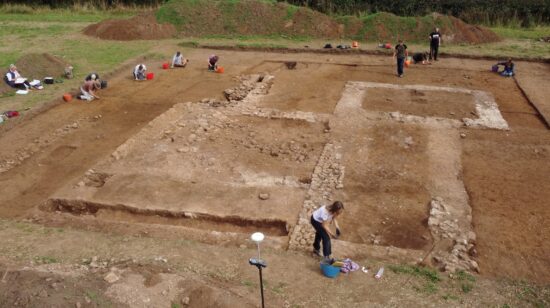
Is it a scene from Dune? No - it's Team DV at Earth Trust!
With all the dust, you’d be forgiven for thinking otherwise, though.
Here are our Day Two Crew busy cleaning back in Trench 1!

More clues from the Clumps await!
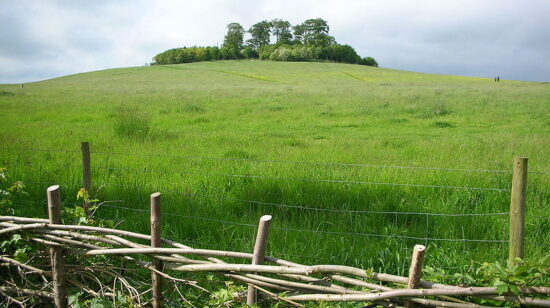
For our final dig of the year, we’re back at the Earth Trust in Oxfordshire to continue exploring a Roman aisled hall-style building and the even earlier Iron Age settlement beneath it, at the foot of the iconic Wittenham Clumps!
This year, we’re extending our main trench into two new areas to find out more about the story of this site, looking for clues to a possible earlier building that could predate our existing Roman structure, as well as traces of the Iron Age settlement that came before it.
What more can we uncover to help piece together the story of this site, from the Iron Age to the Roman period?
Will we learn more about our Roman building? Find clues to an even earlier structure? And what other traces of Iron Age life might emerge? We can’t wait to find out!

And for those of you who prefer a bird's-eye (and all other!) angle of things...
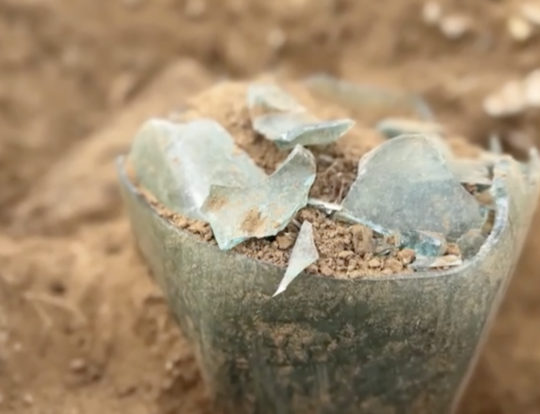
Here’s our 3D model of the glass vessel, before full excavation!
See you later, Sacrewell!
Our very first season of excavation at Sacrewell has come to an end for the year – and what an exciting introduction it’s been!
The support of our incredible community meant we could head to Cambridgeshire to explore what was happening around this Roman villa – last investigated 50 years ago – and its surrounding farmland, and to investigate what more this site might have to share about life in the Nene Valley almost 2,000 years ago.
And we couldn’t sign off from Sacrewell for the year without swooning over the dig’s star find, our incredible and enormous Roman glass vessel!
When we caught a flash of broken glass, we had no idea it would be the start of a discovery quite like this!
The enormous turquoise Roman glass vessel you can see above is one of the most exciting finds we’ve made in Trench 1.
Its distinctive hexagonal shape suggests it may date to around the 2nd century AD – so roughly 1,800 years ago – and we think it may contain a cremation, as it was common for large pots to be reused as cremation urns during this period. We also found a number of iron nails nearby, which are likely to be all that’s left of the wooden box this vessel would’ve originally been placed inside.
Buried alongside this vessel, we also uncovered a ploughshare (the iron blade used to cut through soil when a field is ploughed) that we suspect could be a grave good – buried alongside the remains of this person to represent the kind of life they may have lived.
The trench this discovery was made in investigated a series of ditches, and we think the ditch we made this discovery in may have marked the boundary of a small cemetery serving the nearby villa, as it wouldn’t have been uncommon for a large villa estate in the Roman period to have its own small cemetery.
So, could this burial be associated with the villa? Perhaps the owner? Part of their family? Or even someone wanting to be buried with tools that reflected their life?
The vessel is now in the (very careful!) hands of our specialists for micro-excavation, to find out if this is indeed a cremation burial. We can’t wait to share what they find with you!
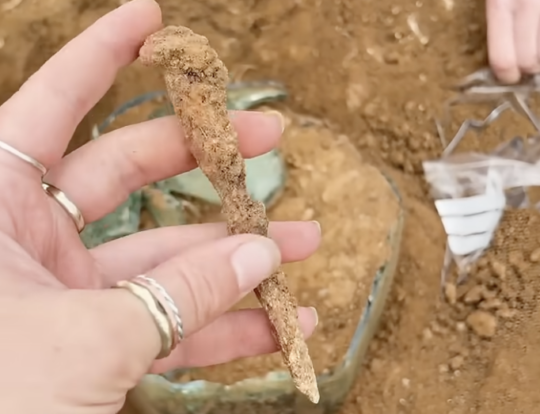

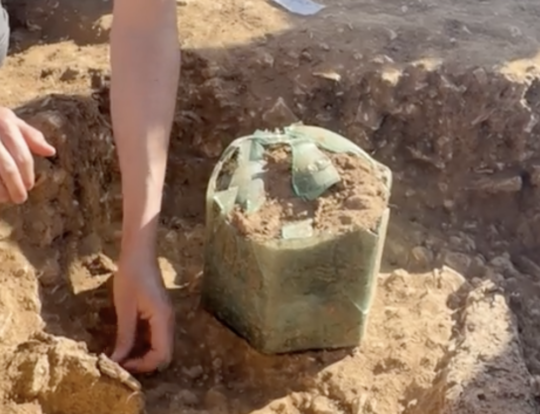
Massive Roman Glass Jar Unearthed!
We were going to eke this discovery out, but you guys REALLY wanted an update – so here’s part two!
Where are we? What else have we found at this site? And the question we know you really want the answer to – what’s the deal with this enormous glass vessel?
Watch on to find out!
Well..we weren't expecting to find THIS!
Who knew that a glimpse of glass would become one of our most fascinating finds of the season?
So…what exactly do we have on our hands here at Sacrewell? Any ideas?
Keep your eyes peeled for our next update to find out!
Another Archaeological Huddle™...what has got everyone gripped?!
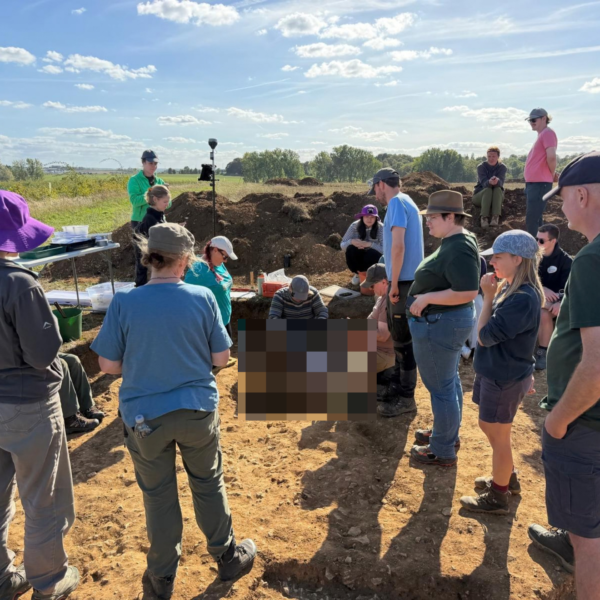
We're potty for pottery today!
And shortly afterwards, Jo found an even bigger pot base!


Getting to the bottom of it!
In Trench 2, Hannah has found the base of a pot!
More Samian at Sacrewell!
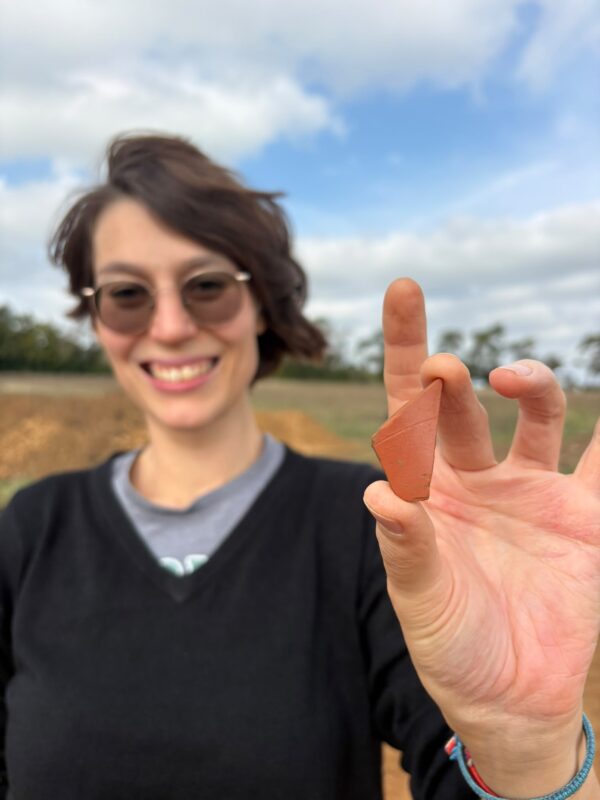
We’re back on site today for our second week of exploration here at Sacrewell – and what a welcome back, in the shape of this fab sherd of Samian ware, found in Trench 3!
Samian ware is always an exciting discovery to make when its rich red tones catch your eye in the ground, and it’s one of the most common high-quality wares found on sites like this. This popularity means its changing styles over time make it a really useful dating tool, helping us to pin down when other features and discoveries were made.
This is our second piece so far here at Sacrewell – and hopefully not the last!

September has been a great month for Hadrian's Wall!
Our mission dataset has now grown to include over 15,000 polygons representing archaeological and landscape features, and the map is 35% complete.
One of the most interesting patterns emerging from the data is how much of it sits outside the existing Historic Environment Record (HER).
Only around one in five of our records match a known monument – but that doesn’t mean we’ve uncovered thousands of brand-new sites! Some are known sites that simply aren’t consolidated in the HER. The HER wasn’t designed to record Landscape Intelligence Features – and just under 4,000 of the features we’ve recorded fall into this category!
That’s where bringing everything together in one place gets really interesting. Pastronauts are helping to build a single, joined-up picture of the landscape, bringing archaeological and landscape information together in a way that wasn’t available before.
The power of Deep Time!
If you haven’t joined the mission yet, you can start training and join the mission today.
DigCamp discoveries
Today, more budding archaeologists are back in Trench 3 for Trowelling 101 with DigCamp!
Here’s Steph with a lovely little clothes pin, possibly used to fasten an item to a piece of clothing – and Max, who found this fab flake from worked flint. Could this predate the Roman activity on this site?
We’ve got a day off from digging tomorrow – but we’ll be back on Tuesday, and raring to go!

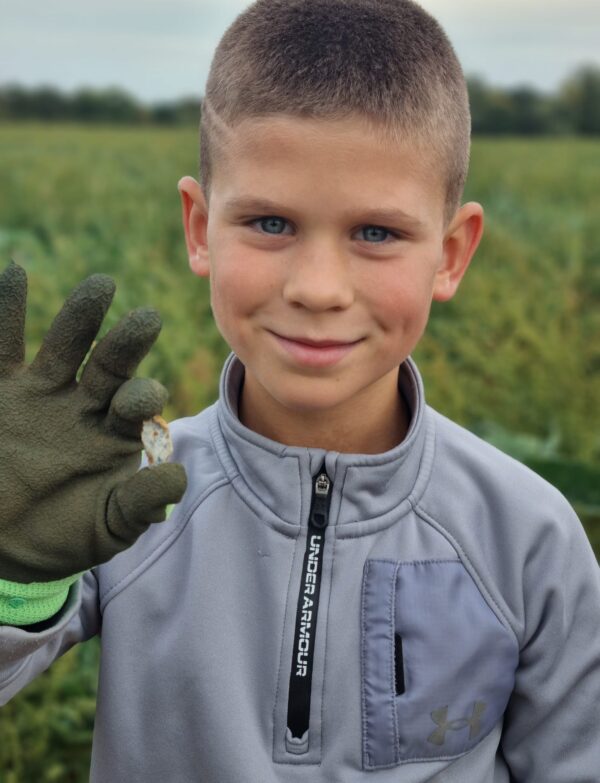
You're never too young to find something great!
We’re big believers in this – and this morning’s DigCampers have given us even more reason to…
Here are Elizabeth, Edward and their dad James – who found this fabulous piece of Roman box flue tile in Trench 3!

How do you know when archaeologists have found something?
There’ll be signs…
Like the Archaeological Huddle™!
Over the last few days, we’ve been carefully excavating something very interesting…stay tuned to find out more!

Levelling up at DigClub!
Here’s Kristian, who’s been joining us for our young archaeologist sessions since he was small!
Now with over 30 (!) digs under his belt with us here at DV and his local YAC club, Kristian is a seasoned pro at trowelling and mattocking – so we thought it was time he added some new skills to his repertoire.
Here he is with Ben, learning how to conduct geophysical survey!

Don't mind if we do!
Today, this oyster shell emerged – and could be a useful clue for establishing what people at this site may have been eating once upon a time…bottoms up!

Getting warmer...?
Over in Trench 2, where we’re investigating an absolutely huge ditch that could be the enclosure for the main farm building, we’ve found some box flue tile!
The Romans liked throwing their rubbish away in ditches, especially in ditches on the edges of their settlements, like this one – so we can learn a lot from them!

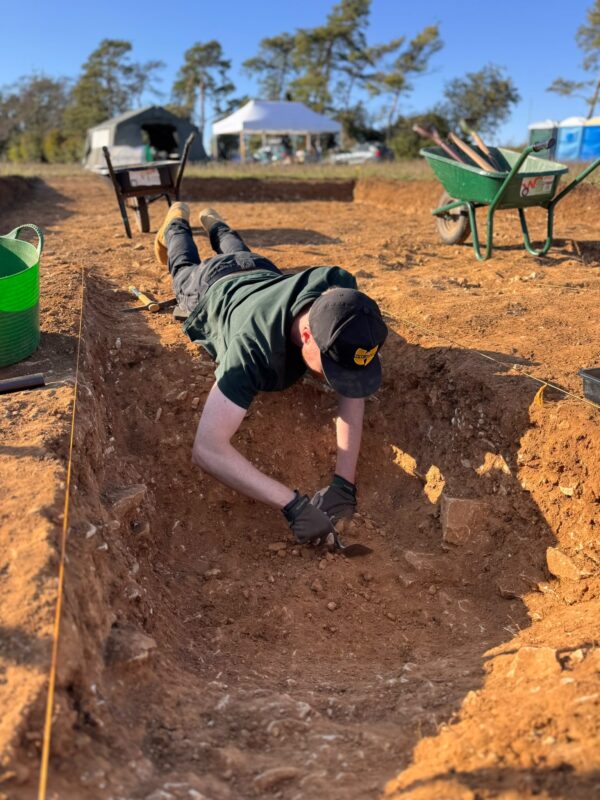
The things we do for our ditches...
Remember the magnetic anomaly from Trench 3...?
We’ve now identified it – and it turned out to be…
This hefty post-medieval horseshoe, likely once worn by a heavy draught horse in the 18th or 19th century.
This discovery is yet more evidence that archaeology is full of surprises – and you never know what you’re going to get, until you dig!

Small but mighty!
Jeanette’s had some wonderful variety in her discoveries this week – including this teeny, tiny sherd of Roman glass!