Stretching over 100 miles from Northamptonshire’s Arbury Hill to The Wash in Lincolnshire, the Nene Valley has been a hub of human activity for millennia. Its fertile land and the reach of the River Nene attracted settlers as far back as the Neolithic period, but it was during the Roman era that the valley truly came into its own, as a hotspot of industry, trade and connection.
This autumn, we’re heading straight to its heart to uncover what more a long-lost site in Sacrewell could tell us about life in Cambridgeshire 2,000 years ago. But why here?
Half a century ago, archaeologists uncovered the remains of a Roman villa, with several furnaces, tiled floors, painted walls, evidence of metalworking at large scale and even earlier hints of Bronze Age and Iron Age activity. But these excavations didn’t unearth the full villa, leaving the story of its inhabitants and their place in the wider Nene Valley untold.
September will see us heading to Cambridgeshire to retrace the steps of these archaeologists as we resume the dig, inviting a new generation of participants to help us explore what fresh insights could be uncovered about life at the heart of the valley.
The Nene Valley
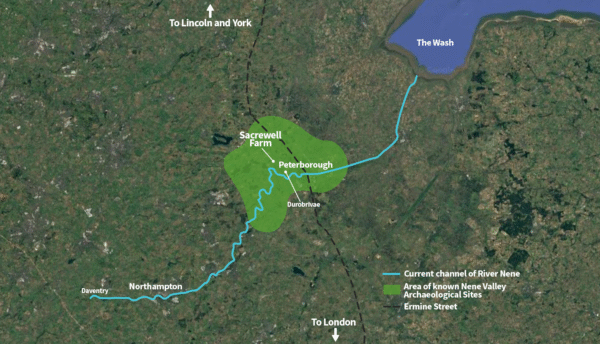
Map of the Nene Valley. Credit: DigVentures
During the Roman era, the Nene Valley was one of Britain’s most important and dynamic landscapes. Peterborough and its surrounding region were a major hub of Roman industry and agriculture, including major settlements like Durobrivae, a walled town that stood near modern day Water Newton. Strategically located on the Roman road of Ermine Street, Durobrivae connected the valley with trade networks across Britain stretching to London, Lincoln and York, just miles from where excavations in the 1970s would uncover the Water Newton Treasure – a remarkable hoard of 4th century Roman silver, hinting at the wealth and status inhabitants of the region may have acquired as the valley grew in prominence.
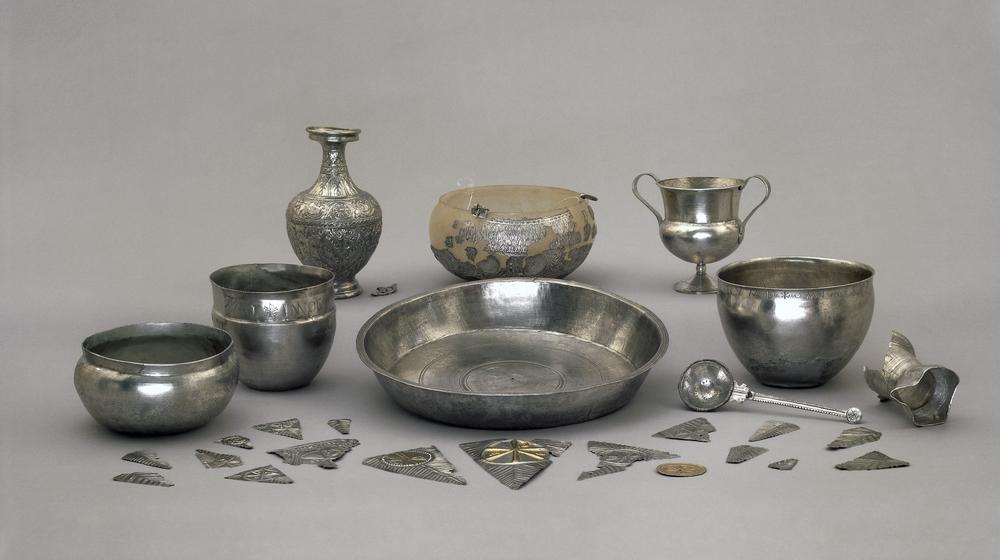
The Water Newton hoard. Credit: The Trustees of the British Museum
The valley was particularly famous for its pottery industry, with the production of distinctive Nene Valley colour-coated ware (often decorated with hunting scenes, religious motifs and human figures) and imitation Samian ware by local kilns for use locally and trade widely securing the valley’s commercial reach and cultural influence.
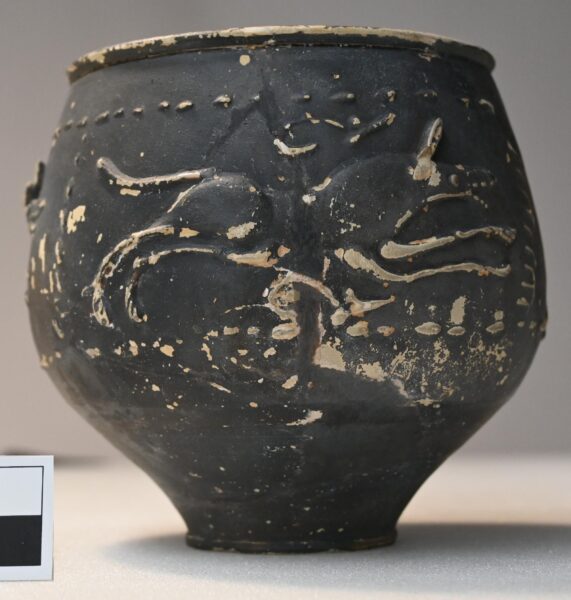
A complete bag-shaped Nene Valley colour-coated ware beaker, decorated with a clay slip hunting scene, found in Stonea, Cambridgeshire. Credit: The Trustees of the British Museum
Pottery wasn’t the only industry here, however, with large-scale ironworking, multiple villa estates taking advantage of the fertile farmland, and earlier strategic military sites like Water Newton Fort all demonstrating the Nene Valley’s significance as a site of production, transport and trade.
Sacrewell’s hidden secrets
With the area’s rich history in mind, perhaps it shouldn’t be a huge surprise that engineers cutting a water pipeline across Sacrewell Farm in the 1970s would hit some Roman archaeology in the process. Their discovery wasn’t just any Roman archaeology, however – but a substantial Roman villa and industrial site on the north bank of the River Nene, just five miles from the site of Durobrivae, hinting at just how much more could be waiting beneath the soil.
These earlier investigations at Sacrewell revealed a remarkable range of discoveries that show this landscape has been important for thousands of years, long before the Romans arrived, and long after they left – from Bronze Age barrows and ring ditches, to Iron Age pit alignments and even early Medieval sunken-featured buildings.
Roman discoveries to date paint the picture of a site where domestic life, industry and ceremony took place side by side. Trademarks of a Roman villa include limestone floors, painted wall plaster and roof and flue tiles, with evidence of charred flooring and rebuilt walls showing that the villa was lived in, adapted and maintained over time. A kiln-like chamber that could’ve been used for malting or drying grain, and several iron-smelting furnaces complete with slag, fired clay and raking areas also indicate that this was no small-scale operation.
While high-status Roman finds like Samian ware and mosaic tesserae add richness to the story of the site, some objects raise more questions than they answer, like the small yet striking fired terracotta head below. Made from a deep pink clay similar to roof tiles found nearby, it was likely crafted locally. An irregular break at the neck suggests it once belonged to a full-length sculpture, an its almost cartoonish features (asymmetrical eyes, a gaping mouth, incised lines for hair and the remnants of what may’ve been a hat) leave us guessing. Was it a playful caricature? Someone trying their hand at sculpting? Or something else entirely?
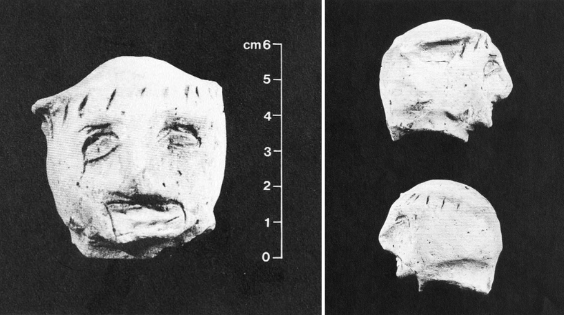
The terracotta head found at Sacrewell Credit: The Nene Valley Research Committee
Join us in Cambridgeshire this autumn
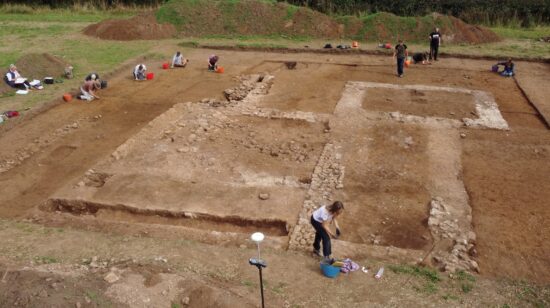
This year, our dig will focus on uncovering more of this site’s layered history, aiming to relocate and map the villa, its associated buildings and activity, to understand its phases of construction and how the nearby furnaces were connected to it. Exploring ditches and other hotspots may reveal evidence of occupation and activity, while taking samples of soil and slag will help us to analyse the Roman metalworking techniques in use here at the time.
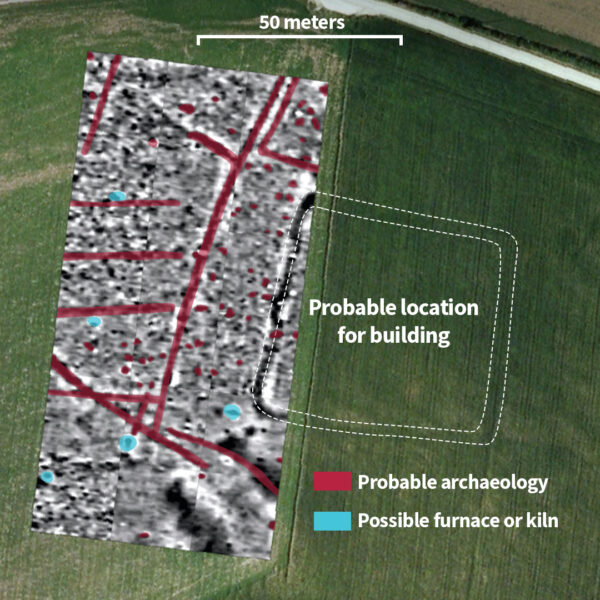
Credit: DigVentures
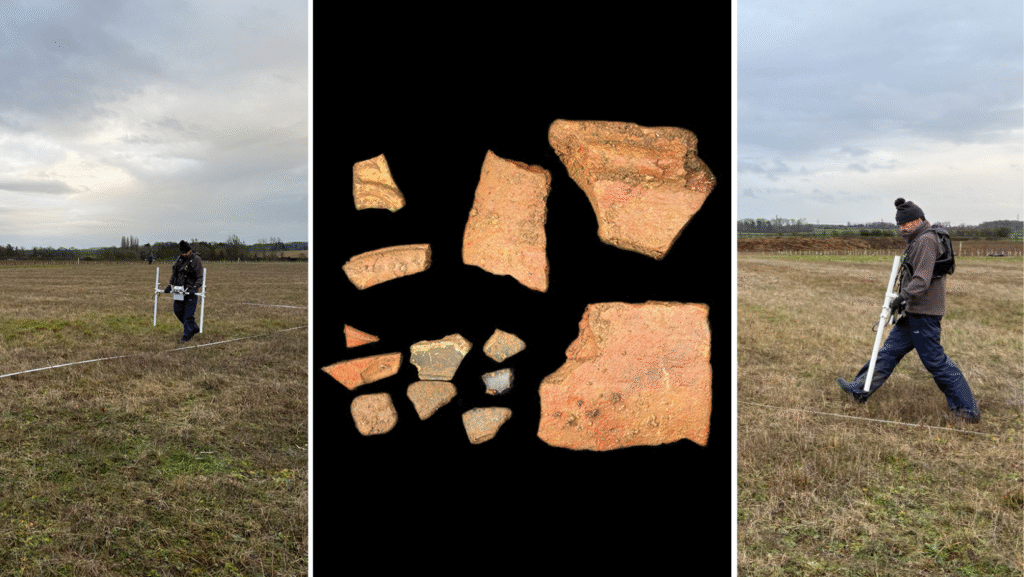
DigVentures’ Ben doing a geophysical survey of the site, and some of the Roman pottery found. Credit: DigVentures
Through this work, we’re hoping to answer some crucial questions: how large was the villa, who was likely to have lived here, and how did industry and agriculture interact at this location? What role did Sacrewell play in the wider Nene Valley economy, and how did the landscape evolve before and after Roman occupation? Could we uncover another furnace, another part of the villa or even something older lurking beneath the Roman layers?
Every discovery brings us closer to understanding how this landscape was lived in, worked and reshaped over millennia, and we’d love to bring you on this journey with us. Whether you know your way around a trowel or have never held one in your life, our dig at Sacrewell is the perfect opportunity to get hands-on with 2,000 years of history right at the heart of one of Roman Britain’s most fascinating landscapes.
Crowdfund the dig to help make it happen, and help us write a brand new chapter of the Nene Valley’s story.
Header image: Philip Jeffrey




There are no comments on this post yet. Be the first!