Quiz: Archaeology Dating Game!

Nevermind chocolates and roses, this Valentine’s Day the perfect date for us archaeologists is a radiocarbon date!

If you want to become an expert in dating techniques just like us, you can read our guide to archaeological dating methods, and then test your dating prowess with this handy quiz.

Plus, we’re playing matchmaker with the past. We’ve got three crowdfunded archaeological sites all looking to find their perfect date. If you like their profile, will you be the one to give them a (radiocarbon) date?

Ready to play the archaeology dating game? Let’s go!

1. Which are types of archaeological dating?

A
B
C
D
Relative dating
Correct - using stratigraphy, deducation, and recogniseable artefacts, you can build a relative chronology.
A
B
C
D
Radiocarbon dating
Correct! You can use radiocarbon dating on organic materials like bone, charcoal, wood, leather, textiles and more.
A
B
C
D
Typology
Correct! The form, style, material, and technology of the things we make change over time. You can compare artefacts to other known examples to identify when it was made - a bit like fashion.
A
B
C
D
Going on a 'Dirty Weekend'
Nope! That's a different type of date... but going for a Dirty Weekend of 'good clean fun' on one of DigVentures' digs is definitely a great way to spend time with someone you love.

2. You're on an archaeological dig and you've just found a chunk of charcoal in the pit of an ancient monument. What's your go-to dating method?
A
B
C
D
Typology - I'll compare it to other charcoal artefacts to find similarities
Nope - this technique is more effective on artefacts where changes in style or material can be seen over time, a bit like fashion.
A
B
C
D
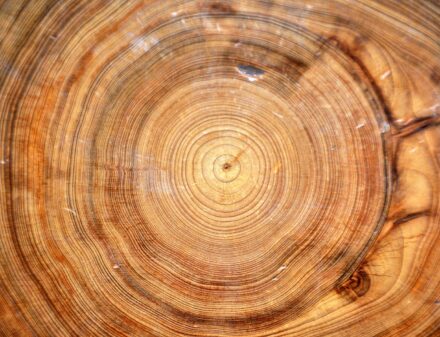
Dendrochronology - I'll count the tree rings
Nope - this technique works when you have a larger sample of preserved wood where tree rings can clearly be seen, measured, and counted.
A
B
C
D
Thermoluminscence - I'll heat it up and try to measure how much light is emitted
Nope - this technique is best used on other (non-organic) materials that have been fired, like pottery or flint
A
B
C
D
Radiocarbon dating - I'll pop it in the Accelerator Mass Spectrometer
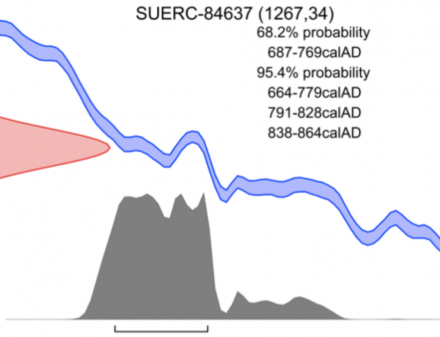
Correct! You can radiocarbon date organic material from before 1939.

3. A beautiful ceramic vessel appears in your trench. It's shiny, red, and has distinctive patterns on it. What's your go-to dating method?
A
B
C
D
Radiocarbon dating
Nope - radiocarbon dating only works on organic materials like wood, charcoal, and bone. But if you happened to find charcoal in the soil that the vessel was buried in, you could radiocarbon date that!
A
B
C
D
Archaeomagnetic dating
Maybe - this might work if the the clay the vessel is made of contains enough magnetic material. But there are probably other (more affordable) methods to use on such distinctive pottery!
A
B
C
D
Asking my site supervisor
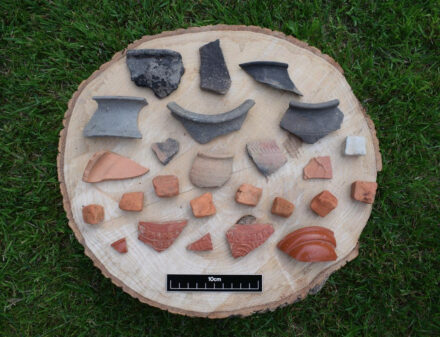
Maybe - your supervisor can probably identify the broad period and will recognise that this 'smooth, shiny, red and decorated' pottery is probably Samian Ware dating to 1st - 3rd centuries AD. But you'll still need an expert to narrow it down more precisely.
A
B
C
D
Typology
Correct! A pottery specialist could use typological dating to compare the vessel to other known examples. For example, they might recognise the work of Divixtus - a pottery producing its own designs from 145–175 AD.

4. You've uncovered a medieval lime kiln on Lindisfarne. How could you tell whether it's early or high medieval?

A
B
C
D
Typology
Maybe - you could compare the form of the kiln to other kilns that have been dated. However, technologies like this often changed very slowly over time, which means you need additional evidence (like a scientific date) to narrow it down.
A
B
C
D
Archaeomagnetic dating
Correct! You can use archaeomagnetic dating to determine when the kiln was last fired up. Using this technique, DigVentures dated the kiln to the late 11th and early 12th century.
A
B
C
D
Stratigraphic dating
Maybe - if the layers above and below the kiln contain dateable artefacts, you can estimate a rough period in which the lime kiln may have been in use.
A
B
C
D
Radiocarbon dating
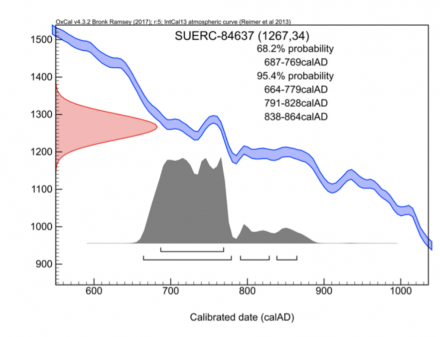
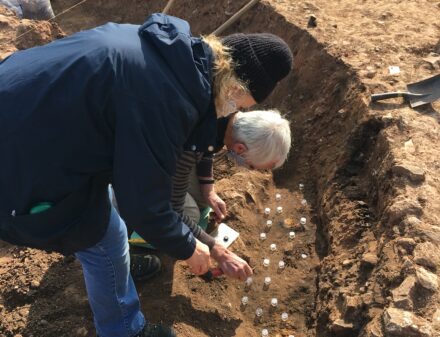
Correct! You can use radiocarbon dating to determine the kiln's age from charcoal in soil samples in the kiln. DigVentures used this technique to confirm the dates provided by archaeomagnetic datic.

5. Which of these famous artefacts did archaeologists date using radiocarbon dating?
A
B
C
D
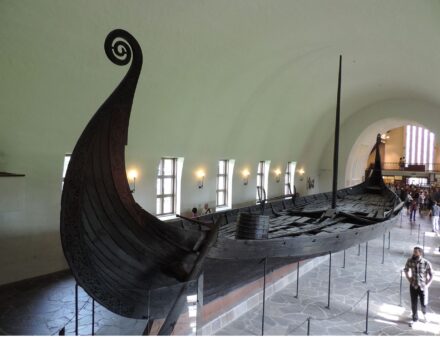
The Oseberg Ship Burial
Nope - although it is possible to radiocarbon date wood, archaeologists used primarily used dendrochronology, matching the tree ring patterns in the wood to known sequences to conclude that it must have been buried no earlier than 834 AD.
A
B
C
D
Australia's oldest known rock art
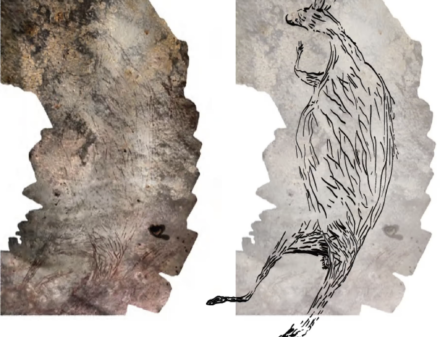
Sort of - archaeologists didn't radiocarbon date the ochre paint itself. Instead, they dated the remains of a wasp's nest that formed over the painting, revealing that the 'Kimberley Kangaroo' must be at least 17,300 years old.
A
B
C
D
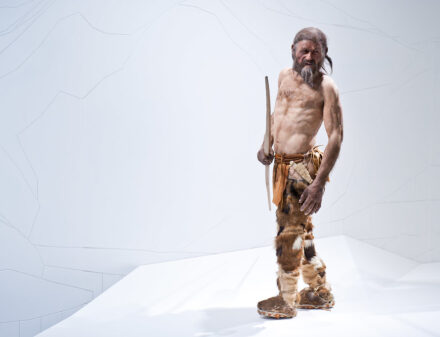
Ötzi the ice man
Yes - archaeologists radiocarbon dated his remains, finding that he died around 5,300 years ago.
A
B
C
D
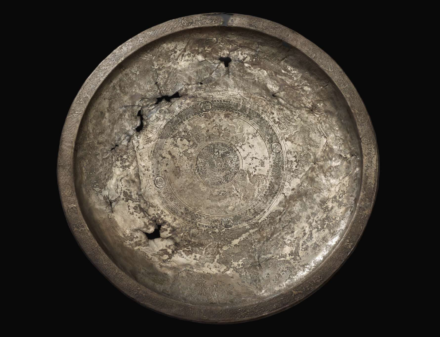
The Anastasius Platter
Nope - this impressive artefact from the Sutton Hoo ship burial was dated using a different clue: a stamp on the back shows that it was made during the reign of Emperor Anastasius I, revealing that it was already a century old when it was buried at Sutton Hoo.

6. Which scientific dating technique can be used to tell how long ago a sediment was last exposed to sunlight?

A
B
C
D
Radiocarbon dating
Nope - this technique uses the decay of carbon 14 to identify how long ago an organism (animal, plant etc) has died.
A
B
C
D
Archaeomagnetic dating
Nope - this technique analyses the magnetic field recorded within materials like fired clay or stone, which reflects the Earth's magnetic field at the time the material was last heated, like a magnetic "fingerprint" it holds from when it was last fired or heated significantly.
A
B
C
D
Optically Stimulated Luminescence dating
Correct - this technique can determine the age of sediments by measuring the amount of stored energy within mineral grains like quartz, which is released as light when stimulated by light, essentially revealing how long ago the grains were last exposed to sunlight or significant heat, effectively marking the time since their burial or deposition. Perfect for dating things like ramparts!
A
B
C
D
Dendrochronology
Nope - this technique is based on the growth rings in trees. Conditions like climate and weather (e.g., a drought) can effect each growth ring, and builds a fingerprint that can be compared to established timelines.

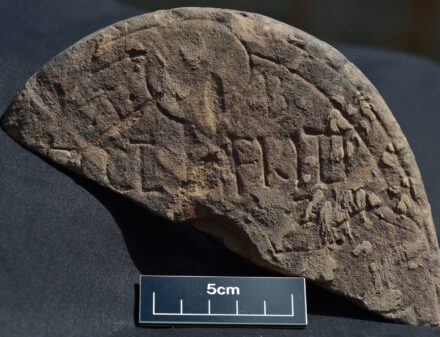
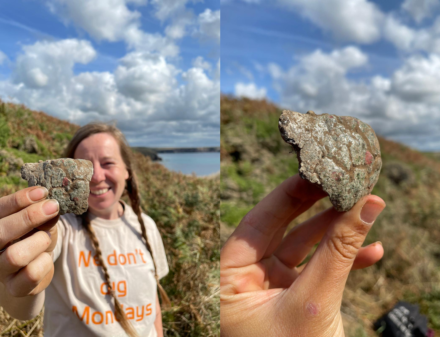
7. Which technique did DigVentures use to date each of these discoveries? (for bonus points, can you guess how old they turned out to be?)
A
B
C
D
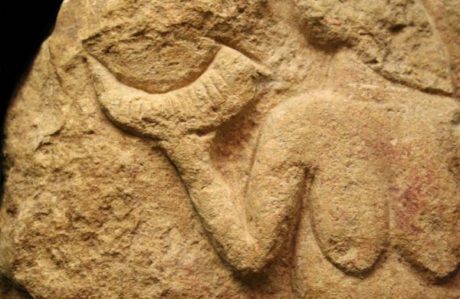
Ythfrith's namestone
Typology - namestones are a unique type of artefact from one specific region. The style, lettering, and type of artefact has enabled us to date it to the early medieval period.
A
B
C
D
A crucible from Caerfai
Radiocarbon dating - the materials for making crucibles didn't change for centuries, making it hard to tell whether this example was Iron Age or Roman. But radiocarbon dating on soil samples from where it was buried gave us the answer: it's Iron Age!
A
B
C
D
Pottery from the Boyne Valley
Typology AND radiocarbon dating - our pottery specialist identified it as an Early Neolithic carinated bowl. Radiocarbon dating of charcoal from the soil it was buried in confirmed she was right!
A
B
C
D
Oldbury Hillfort
OSL (Optically Stimulated Luminscence) - it can be hard to tell when monuments were built, although clues like artefacts can help. OSL dating measures when a sediment was last exposed to sunlight, confirming that the ramparts were constructed approximately to 60-10 BC.

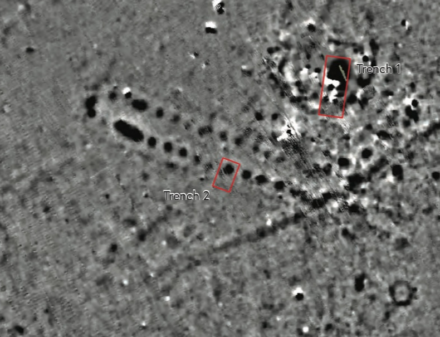
8. Which of these sites would you most like to radiocarbon date?
A
B
C
D
This ancient monument in Ireland's Boyne Valley
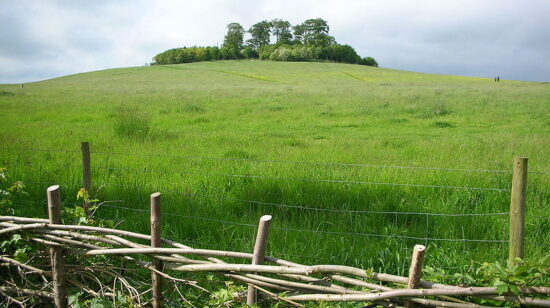
Great choice! This ancient monument looks like a ceremonial avenue, aligned with other monuments in the Boyne Valley. But how old is it? And how long did it stay in use for? Radiocarbon dating from one sample suggests it is Late Neolithic. Will additional radiocarbon dates confirm this?
A
B
C
D
A possible Roman shrine in East Yorkshire
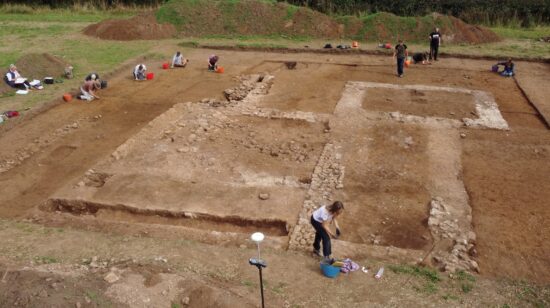
Great choice! Our dig revealed multiple votive offerings containing animal bone and artefacts. While some contain dateable artefacts like coins, others don't. Radiocarbon dating the animal bone could establish whether all the offerings were made around the same time or not, helping us understand how long the site was in use for.
A
B
C
D
A cemetery on Lindisfarne
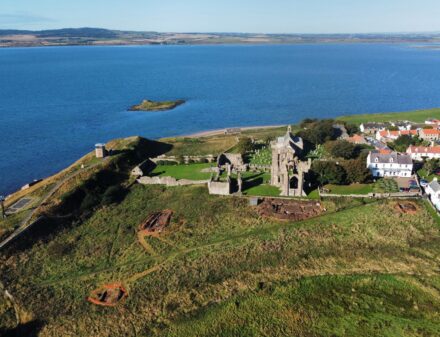
Great choice! Raided by Vikings, Lindisfarne is one of the most iconic early medieval sites in the UK. Radiocarbon dating the site - including early buildings and parts of the cemetery - can help to create a detailed chronology of who lived on the island before, during, and after the raids.

Congratulations!

If you enjoyed the archaeology dating game, why not play it for real? On each of our crowdfunded sites, you can sponsor a radiocarbon date or help us analyse an artefact. Just choose your site and pick ‘Analyse an Artefact’ or ‘Radiocarbon Rockstar’.

In return, we’ll send you the dating results – along with updates, a credit in the official report, and the satisfaction that you’ve directly helped us to better understand an ancient site.

It also makes the perfect present for anyone who loves the past!

Archaeology in your inbox?!

Want to join a dig? Learn more about archaeology? Join our email list for a monthly digest of our most popular stories, plus alerts for any digs, events, or courses you can join.

Join the list

Written by DigVentures

Fascinated by archaeology? DigVentures runs excavations that anyone can be part of. From Roman ruins and medieval castles, to Bronze Age monuments and industrial heritage, you can choose to dig alongside our team, help out in the Finds Room, take an online course, or become a Subscriber for even more ways to enjoy archaeology with our team.

Read more from DigVentures +

There are no comments on this post yet. Be the first!

Leave a comment

Get the DigVentures Newsletter

Sign up to discover opportunities to get involved in archaeology - in your area, and beyond!

Easy opt-out at any time - Privacy Policy

Archaeology / In Your Hands
  • Heritage Lottery Fund
  • CIfA

See all the archaeology digs, talks, festivals and other events coming up at DigVentures

Learn more about digging up the past and have fun while you're doing it!

We're connecting people who love archaeology, with opportunities to do archaeology.

Archaeology experiences and other perfect presents for people who love the past.