If you’re interested in Ireland’s Neolithic monuments, sites like Newgrange, Knowth, and Dowth in the Boyne Valley will be on your radar. But what next?
From monuments filled with art, to the ones you can help archaeologists investigate, here are some nearby alternatives that are well-worth your time…
When did people start to build ancient monuments? Why? And do they tell us anything about what people really valued? These are just some of the questions we’re trying to answer with a crowdfunded archaeological dig to unearth a cluster of newly discovered monuments in the Boyne Valley.
This is where you’ll also find Newgrange, Knowth, Dowth – the three iconic Neolithic tombs that form the heart of the renowned World Heritage Site of Brú na Bóinne.
At over 5,000 years old, these incredible structures were clearly built with a sophisticated knowledge of astronomy and engineering, and together contain the largest collection of megalithic art in Western Europe. But they are not alone.
While thousands of visitors flock to Brú na Bóinne Visitor Centre to see Newgrange, Knowth, and Dowth, there are many lesser-known Neolithic monuments in the Boyne Valley that also offer fascinating glimpses into Ireland’s prehistoric past.
While we absolutely recommend Newgrange, Knowth, and Dowth, we’re sharing some lesser-known alternatives that are well worth knowing about too – from monuments that feature incredible displays of ancient art, to the ones where you can help archaeologists unearth the past…
Fourknocks tomb: the one where art meets accoustics
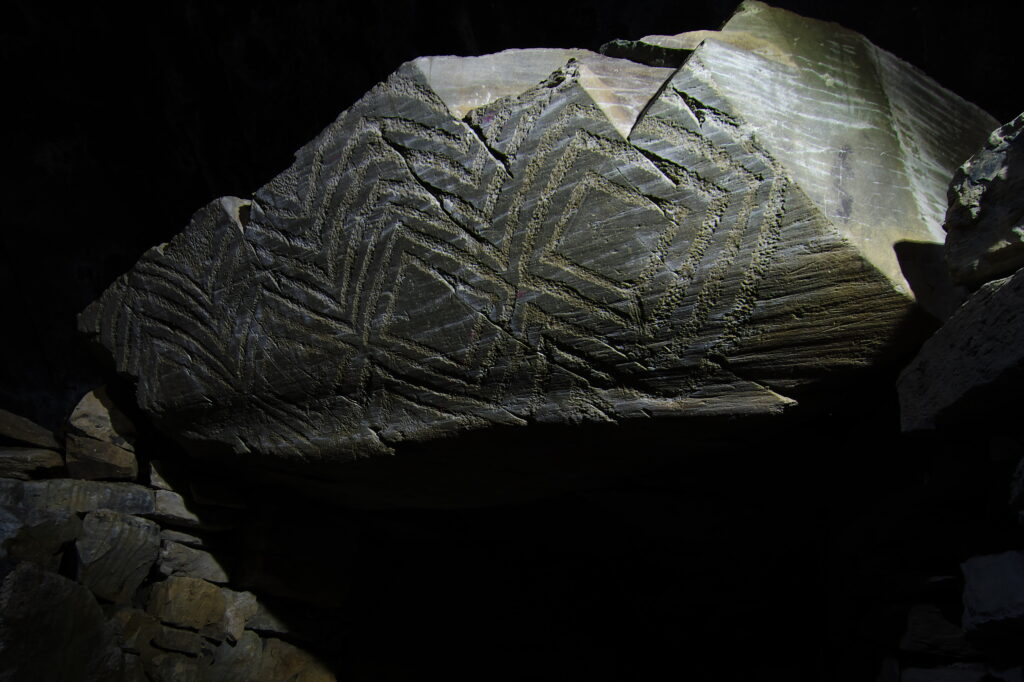
Ancient engravings on a lintel within Fourknocks Tomb. Credit: Rob Hurson via Wikimedia Commons
Step inside this Neolithic passage tomb and you’ll immediately notice that its distinctive interior is decorated with abstract megalithic motifs, and what is possibly the earliest known depiction of a human face in Ireland. The tomb is 5,000-4,500 years old and was intact when discovered in 1949, making its contents invaluable to our understanding of Prehistoric Ireland. Excavations revealed partial remains of at least 60 individuals of all ages and sexes who had once been laid to rest here, along with artefacts such as stone beads, bowls, cremation urns, miniature hammer pendants, and bone pins – all of which are now at the National Museum in Dublin.
Many visitors are also struck by its acoustics and unlike Newgrange, you’ll often have this atmospheric chamber all to yourself.
Can you visit? Yes, but you need to obtain a key from the landowner first.
Loughcrew Megalithic Cemetery: the one where sunlight illuminates the Equinox Stone
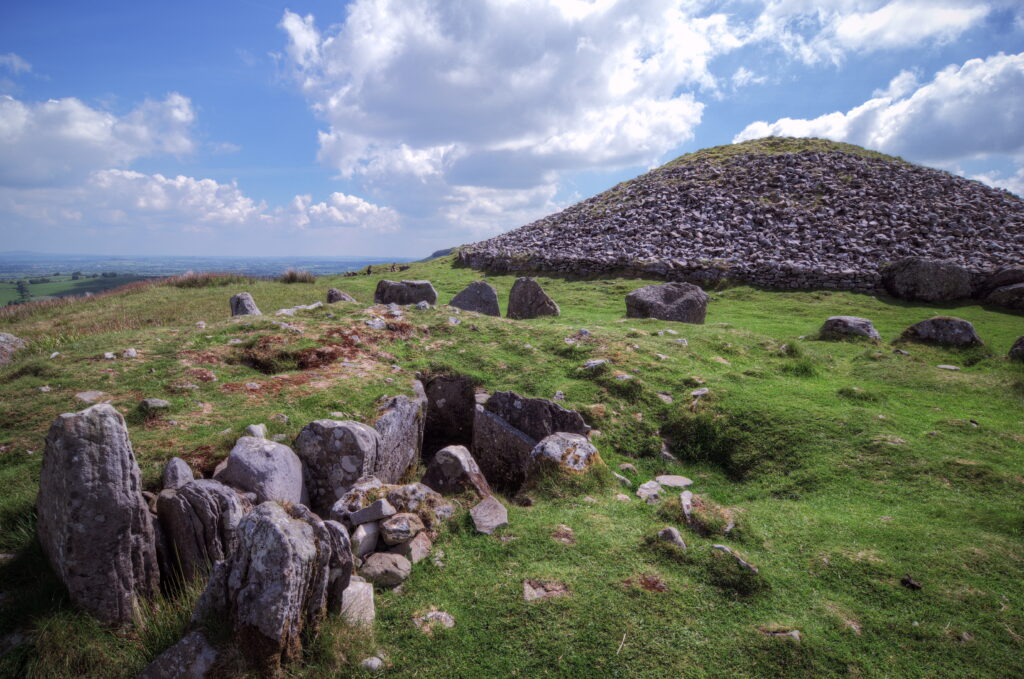
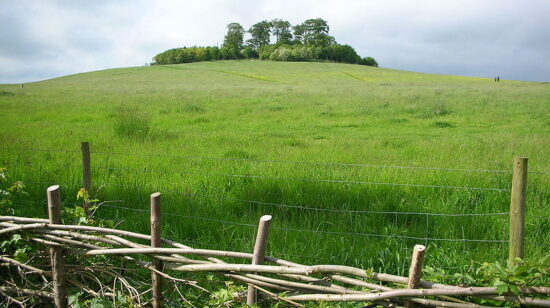
Cairns S and T at Loughcrew, Oldcastle. Credit: Rob Hurson via Wikimedia Commons
About an hour’s drive from Brú na Bóinne Visitor Centre you’ll find Loughcrew; home to at least 20 passage tombs dating back more than 6,000 years, making it one of Ireland’s four great megalithic cemeteries. Some of these tombs predate Newgrange and house some of Ireland’s oldest solar alignments. Among the most stunning is Cairn T, where you’ll find remarkable Neolithic art that demonstrates ancient astronomical an engineering knowledge.
At sunrise on both the spring and autumn equinox, a sunbeam enters the chamber and lights up the Equinox Stone illuminating an intricate set of solar symbols as it moves slowly from left to right, producing an astonishing 50 minute display.
Perched atop ‘the hillls of the witch’, the site’s remote location and challenging ascent keep crowds at bay, rewarding determined visitors with solitude among the ancient stones and spectacular views.
Can you visit? Yes, during seasonal opening times
Monknewtown Ritual Pond: the one where people once gathered for watery ceremonies
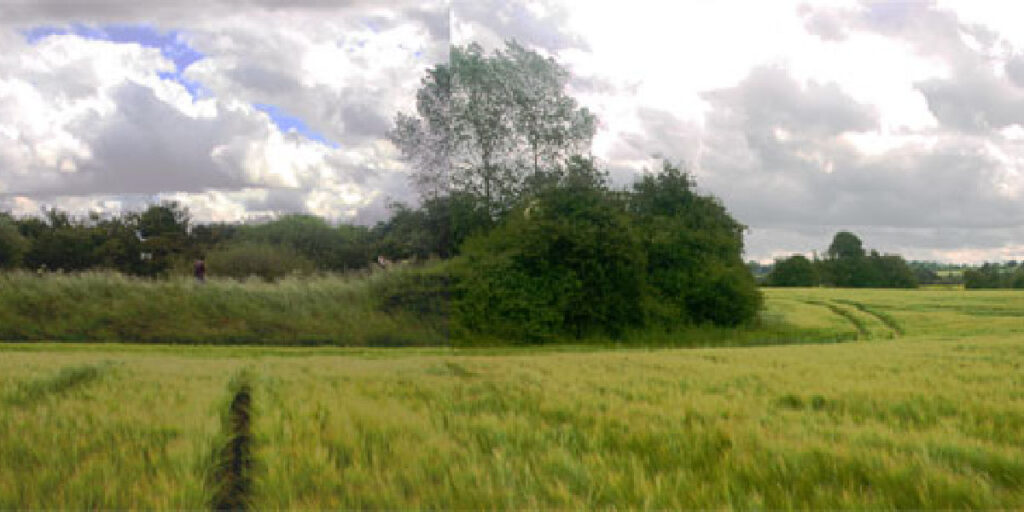
Monknewton Ritual Pond. Credit: Rosnaree Archaeology Project
This isn’t just any pond; this is what archaeologists describe as a raised ‘ritual pond’ that was built over 5,000 years ago. Consisting of a 3m high, circular earth bank, it forms a 30m wide raised pool that someone clearly went to a lot of effort to build and is one of only a handful of surviving ancient ‘ritual ponds’ in Ireland.
Whether it was a place for cleansing, some sort of Neolithic baptism, or something else entirely is currently unknown. But, standing on the northern buffer zone of the Brú na Bóinne World Heritage Site, and just a few hundred metres from Monknewtown Henge, it was clearly a meaningful place. For those of us trying to reimagine ancient beliefs, it offers a rare glimpse into some Neolithic ceremonies and celebrations where gathering around water may have been so important that they built ponds especially for it.
Can you visit? Not currently – it’s on private farmland and you would need landowners permission.
The Mound of Hostages: the one where burials reveal a changing society
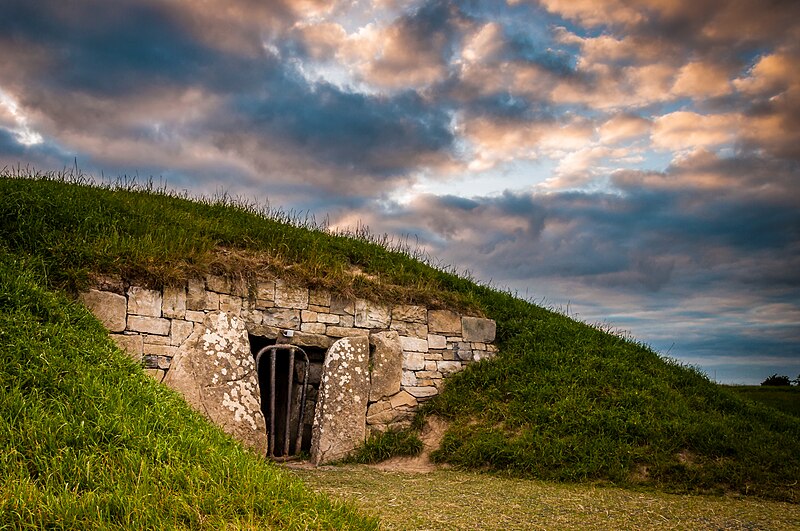
The passage tomb at the Hill of Tara. Credit: Poleary91 via Wikimedia Commons
The Hill of Tara is an ancient ceremonial and burial site which is best known as the inauguration place of the High Kings of Ireland. But while most tourists gather at the famous Royal Seat, there is an even older story still visible just behind it.
Tara is also home to multiple Neolithic and Iron Age monuments, including standing stones, enclosures, and the Mound of Hostages – a 5,200 year old passage tomb with a 250m “wood henge” that was later built to surround it.
Excavations revealed that this passage tomb served as the communal tomb for a single community, where 300 people were cremated and buried over the course of about 100 years. Almost 1,000 years later, during the Bronze Age, another 33 burials were added. During this time, only certain high-status individuals were buried there. At first, it was the tomb of one community, but later multiple communities came together to bury their elite there. The last burial was a full body burial of a young man of high status, with an ornate necklace and dagger. Many archaeologists consider the shift in how people were buried – from communal to elitist – to reflect significant changes in the beliefs and values that held these societies together.
Can you visit? Yes
Dowth: the one where surprises still abound
Dowth is one of the three main tombs of the Brú na Bóinne World Heritage Site, along with Newgrange and Knowth. It is also less than 1km from Dowth Henge, another staggeringly impressive Neolithic monument believed to be aligned to the summer and winter solstices. But just because these two sites are relatively well-known, it doesn’t mean there aren’t still surprises to be found nearby.
In 2018, renovation work revealed that Dowth Hall – a Georgian mansion halfway between the two – had been built directly on top of another 5,500 year old megalithic passage tomb. Inside, archaeologists found a stunning collection of megalithic art featuring intricate solar carvings comparable to those at Newgrange, but with distinct artistic styles. Who knows how many more secrets are waiting to be revealed?
Can you visit? Not currently, but the site has been bought by the government with plans to open to the public
And finally… the one where you can help archaeologists to investigate!
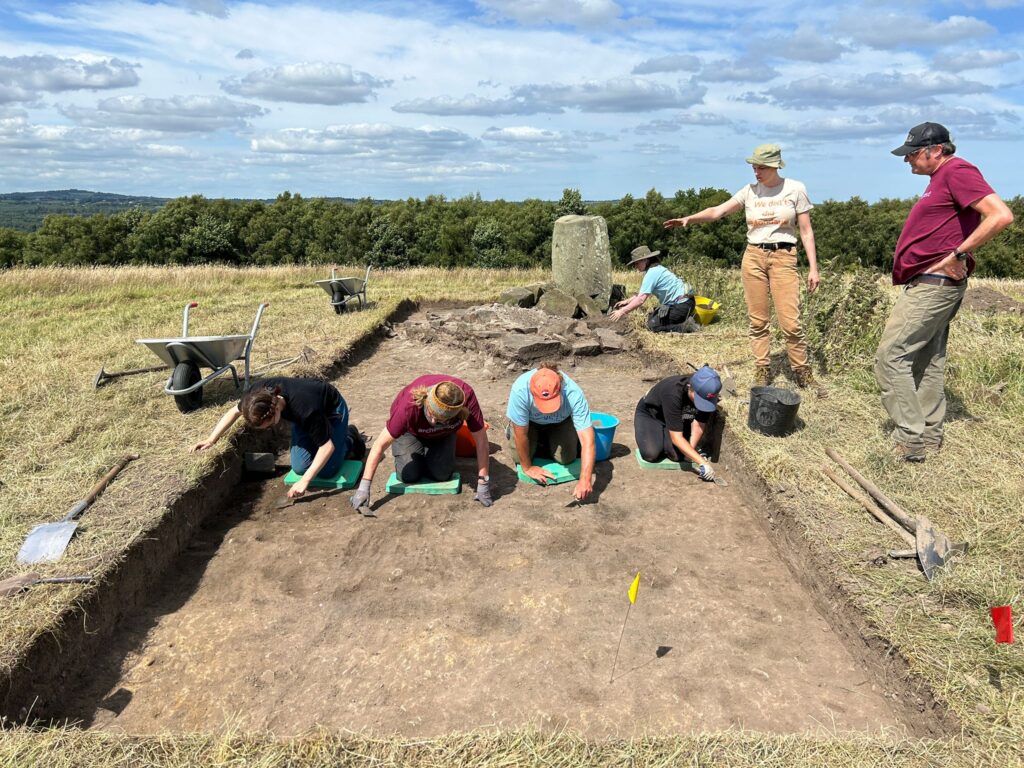
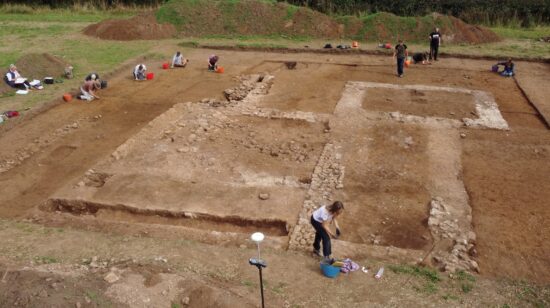
Digging with archaeologists. Credit: DigVentures
DigVentures is crowdfunding a dig to investigate a cluster of monuments that have been recently discovered in the southern buffer zone of the Brú na Bóinne World Heritage Site.
Among them there is a vast Neolithic causewayed enclosure, and a ceremonial avenue marked by a double row of tree-trunk sized posts on either side.
How old are they? Why were they built? Are they astronomically aligned or do they align with other monuments? And what evidence can they reveal about the beliefs and customs of the Neolithic communities who built them?
You can help us find the answers by crowdfunding the dig where you can choose to dig alongside archaeologists, sponsor a radiocarbon date, or watch the discoveries from home.
With your support, we can grow our understanding of Irish prehistory…
Can you visit? Only as part of the dig team



_and_T,_Loughcrew.jpg)
There are no comments on this post yet. Be the first!