
This flint tool was one of the only artefacts found inside the Morecambe burial urn. But was it from the same cremation as the body?
Careful examination of the stone tool found inside the Morecambe burial urn raises a surprising question about the body it was buried with.
We’ve heard a lot about the rare Bronze Age burial urn found by DigVentures’ crowdfunders on top of a hill overlooking Morecambe Bay, but I’m here to tell you about all the little pieces of stone that were found on the dig too. That’s right, not the beautiful ceramic vessel or the cremated human bones it contained, but the one single stone tool that was placed inside the urn with the body, and the many other stone artefacts from across the site. Individually, they may seem like little more than curious pebbles, but bring them all together and they start to provide some of the most interesting evidence we’ve got about this Bronze Age burial mound so far.
Bronze Age stone use in north west England
During the Early Bronze Age, people all over the British Isles were still using stone for making tools (and for other less tangible purposes as we shall see), but the stone working culture of the North West has only just started to receive the attention that other areas of Britain have had. What is quickly becoming evident from these studies is that even in prehistory the North West went its own way.
Northerners, for example, continued to use microliths (extremely tiny stone tools) for much longer than people further south. They also started using the larger, broader tools associated with the early Bronze Age quite a bit sooner, and they often used chert, which was more readily available to them than flint.
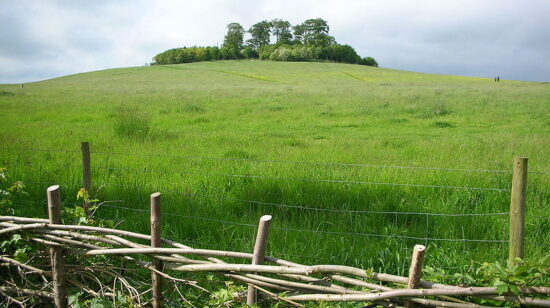
Our crowdfunded excavation on the hilltop overlooking Morecambe Bay largely conformed to these patterns, but there were a few things that made it a bit special too.
A single stone was placed with the body inside the urn
First of all, there was the beautiful burial urn. One of the wonders it contained, among nearly three kilos of burnt human bone, was a late Neolithic or early Bronze Age flint tool. Other than a few sherds of pottery, this was the only artefact placed inside the urn along with the cremated remains.
Although badly damaged, the flint tool was once roughly D-shaped, and is what archaeologists would usually call a scraper – a tool used to clean up the insides of animal hides, but which probably had many other uses too.
Flint tends to change colour and texture when heated to high temperatures, and this one had become white, grainy and glassy in parts, which suggests it had been subjected to some pretty considerable heat, probably in excess of about 1,000 °C.
This is where the plot begins to thicken, because when Sam the osteoarchaeologist examined the human remains inside the urn, the level of burning they’d been subjected to suggested that the body had been cremated at temperatures ranging from 300-600 °C.
While the temperature of cremations can vary greatly across the pyre, it does beg an interesting question: if the flint had been subjected to much higher temperature, was it necessarily during the same cremation as the body it shared the urn with? What if it came from an earlier cremation? It’s not that unusual to find bits and pieces from different cremations in the same burial urn, so perhaps it was included as a symbol of continuity with the occupant’s ancestral history and the people’s ties to the land. It’s an interesting idea.
Rock crystals, jet and quartz

This glittering piece of rock crystal was just one of many found scattered across the hilltop.
But the urn wasn’t the only place we found interesting bits of stone that add to the story. Scattered across the rest of the site, we also found a small but nonetheless significant number of stone artefacts, some of which seem to date back to the Mesolithic (10,000-5,500 years ago), and some of which were typical examples late Bronze Age and early Iron Age stone-working traditions, which together suggest that people were visiting this little hillock overlooking Morecambe Bay for something like 6,000 years.
Among the many practical artefacts, like flint tools and the chippings from their production, we also found pieces of jet (that gorgeous black stone derived from fossilised monkey puzzle trees), glass-like rock crystal, quartz and other bits of white stone whose purpose is a little more… intriguing.
Stones like these have a long history of being associated with funerary sites, so it’s perhaps not surprising to find them and they were probably associated with burials on the hill. Just like many modern cultures today, it may simply have been the ‘spirit’, or the ‘specialness’ of these items that made them important to deposit as part of a burial.
The difference between flint, and ‘poor man’s flint’

A piece of grey chert, most likely a core (a piece of stone you can chip sharp flakes off to use as blades)
In the North West a great deal of the stone artefacts are made of chert, rather than flint. Chert forms in limestone in much the same way that flint forms in chalk. There’s certainly plenty of limestone in the North West, but no chalk.
Chert seems to have been regarded as lower status – like every day stainless steel cutlery compared to the silver dinner set – a sort of poor man’s flint. Flint and chert can be hard to tell apart, but generally flint is more translucent and chert can look quite waxy. While the majority of what we found is knapping waste (the debris and leftovers from making stone tools, rather than the tools themselves), and most of it was dark grey or black chert, there is a very strange pattern among the tools that we did find.
Not the tools you’d expect

A piece of flint that has been chipped (or ‘knapped’) off a larger piece to create an incredibly sharp, multipurpose tool.
What’s missing from the stone finds so far are any really high status pieces and projectile points. This is where the plot thickens once again. While we found plenty of scrapers, like the one inside the urn, the hilltop doesn’t seem at all suitable for butchery or hide preparation, whereas as it does seem to be pretty ideal for hunting and observing the surrounding countryside – vegetation permitting.
Evidence of a cultural intersection
What’s even more interesting is that some of the stone could well come from as far afield as southern Scotland and the south of England. It includes stone only rarely found in a worked form in the area, like an attractive orange and silver chert like stone that may have travelled all the way down from Scotland.
All this suggests that the hilltop had a significance beyond being just a burial site. Its prominence may have made it a point of reference for those approaching from both sea and land, while the stone artefacts tell us that the site served as meeting point of different materials, which could very well be a reflection of a cultural and social intersection as well.
Whatever its uses, the site retained its significance for a considerable length of time. The collection of stone tools (or, in archaeology slang, the ‘lithic assemblage’) from this site shows that people kept coming back to it from the Late Mesolithic through the Bronze Age, and probably into the Early Iron Age.
There is so much more to learn from this isolated hill. While each individual artefact is interesting, it’s the bringing them all together that’s really starting to give us the clues to help us read this story written so many thousands of years ago.
Archaeology in your inbox?!
Want to join a dig? Learn more about archaeology? Join our email list for a monthly digest of our most popular stories, plus alerts for any digs, events, or courses you can join.
Join the list
Written by Alex Whitlock
Alex is an archaeological finds analyst specialising in worked stone. He's particularly fascinated by the Mesolithic, and thinks chert deserves as much academic love as flint. He's also pretty keen on motor bikes and music.



Comments (1)
Well, all hills and hillocks are nearer the sky..the probable destination [and maybe origin] of the released spirit, once it has been set free from its corporeal state by burning. There are sacred hills and mountains all over the world..some of them dedicated to a form of ultimate pilgrimage, and the destinations of ritual long range walks, ending in the death of the acolyte in a ceremony on the hill or mountain, sometimes with the aid of mood altering substances, as in South America.
I believe our ancestors viewed the landscape as INCLUDING the ground below AND the sky above..they did not separate these things, as we do now. These realms are connnected, and are kept spinning around the great World Axis [ie the celestial pole] hence “Seahenge” et al. as per some of the linguistic clues referring to “turning”, and associated sites [“Troytowns, Trendles”]
I also think it`s likely that the land and skyscape were used as backgrounds to a kind of “cosmic theatre”, telling the story of Creation and the endless cycle of birth and death. These landscapes were probably, in my view ENHANCED, which may explain some earthworks which seem to have no apparent day to day function.
The placing of certain stones and crystals would also fit in with the attribution of specific qualities or significance to different parts of the land and sky, as in both ancient and modern versions of “Astrology” and Augury. [A “temple” or “templum” was originally a division of the sky or land, used for divination]. A “shamanic ” aspect to some of these sites seems quite likely.
I personally don`t believe in these systems, but I think our ancestors almost certainly did. This may also explain some of the features and orientation of certain “henges” and other sites..I don`t think many of the highly accurate alignments noted are necessarily relevant. Stonehenge has a definite North alignment, as do other sites..North is the basic direction in our hemisphere, and is easy to find by observation..NO geometry or equations needed! Interestingly, or not, the modern Welsh for North is “Gog”..!! Which may sound familiar..