This August marks our tenth season of digging at East Yorkshire, and our discoveries from nine seasons of excavation tell a fascinating story of wealth and status. Evidence of international trade, high-end personal objects, a religious shrine, a villa and a sprawling settlement show this site wasn’t just another rural outpost, it was a place that mattered.
For nearly 300 years, the Romano-British lived, traded and worshipped here. While most rural settlements in the region faded over time, our site illustrates a community that thrived from the 2nd century through the late 4th century, making it one of the earliest and longest-occupied Roman settlements north of the Humber.
This year, we’re heading back to the trenches with our Venturers to dig deeper into this 4th-century settlement where everyday life and ritual activity existed side by side – and you can help make this happen.
But before we dig in, let’s revisit some of the most extraordinary discoveries from our past seasons. Join us as we stroll down memory lane (by way of a Roman road, perhaps?) in the lead-up to our tenth season…
From medieval to much, much older…
In 2017, we set out to uncover the remains of a deserted medieval village. Not only did we find it, but we also discovered tell-tale Roman pottery that hinted something even older lay beneath our feet. The next year, we were laser-focused on the Romans, and began excavating the remains of what we believed may be a mansio – a sort of Roman-era B&B where travellers could stop for a meal and some rest on their journeys to nearby settlements.
One particularly poignant find was made by Bill, one of our long-time Venturers, who carefully uncovered a tiny Roman brooch, just 2cm across, nestled alongside the burial of an infant.
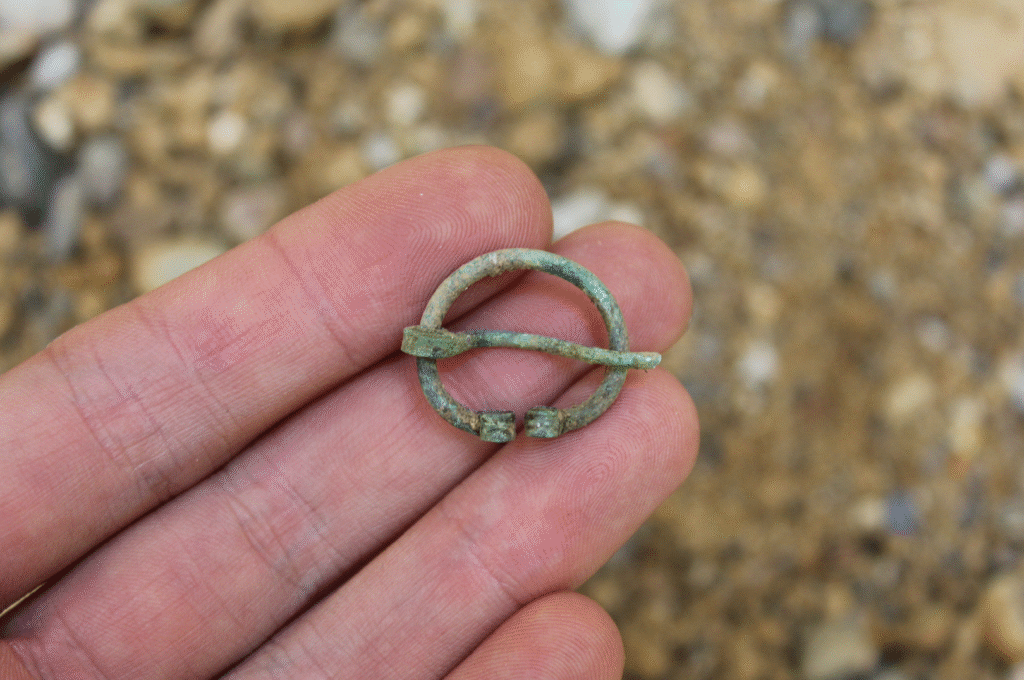
A very small penannular brooch. Credit: DigVentures
Home comforts
2019 saw us break ground in a new location, where we found evidence of a 3rd century villa, complete with roof tiles, evidence of a hypocaust (underfloor heating) and tesserae (ceramic cubes used to make mosaics). Junior archaeologist Jacob beautifully excavated and lifted this incredibly delicate Roman bone hairpin, expertly modelled here by Venturer Emily.

Credit: DigVentures
Brooches in a (very early) bin
From 2020 to 2022, we returned to the mansio to learn as much as we could. How big was it? When was it in use? And who lived here? Despite 2020 being our wettest season here on record, we managed to wade through and uncover some very important pottery, which pointed towards a 1st-2nd century settlement – one of the earliest sites north of the Humber.
Rubbish pits were also a key part of the mansio’s story. They may be full of actual rubbish like broken pottery, butchered animal bones, and ash from fires, but sometimes something beautiful emerges from the ashes (and discarded pottery). Like these two interlinked copper alloy brooches, dating to the late 1st century or early 2nd century AD. How did they end up in a rubbish pit? Was it a careless mistake or a deliberate deposit?

Credit: DigVentures
Layers of luxury
By 2022, we’d found the full extent of the building, discovered a possible courtyard and developed a better understanding of the people who lived here as residents of wealth with international connections.
Our discoveries included fragments of large amphorae, typically used to transport olive-based products such as oil from southern Spain, and high-end pottery known as Samian ware, usually imported from Gaul (modern-day France). One particularly intriguing bit of Samian pot was highly intricate, with the moulded impression of a hunting dog.

Credit: DigVentures
Patterns of the past
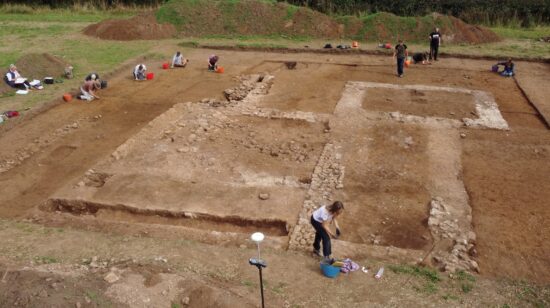
In 2023, cropmarks in a field near our mansio drew us in. Darker patches in the soil outlined a long central trackway, with square enclosures branching out from either side – the classic signs of a Roman ladder settlement. The cropmarks were true to their form, as we uncovered evidence of a large timber-framed building and two huge water storage pits. Smaller pits dotted around the trenches were crammed with rubbish, including nearly 2,000 sherds of pottery dating to the mid to late 2nd century.
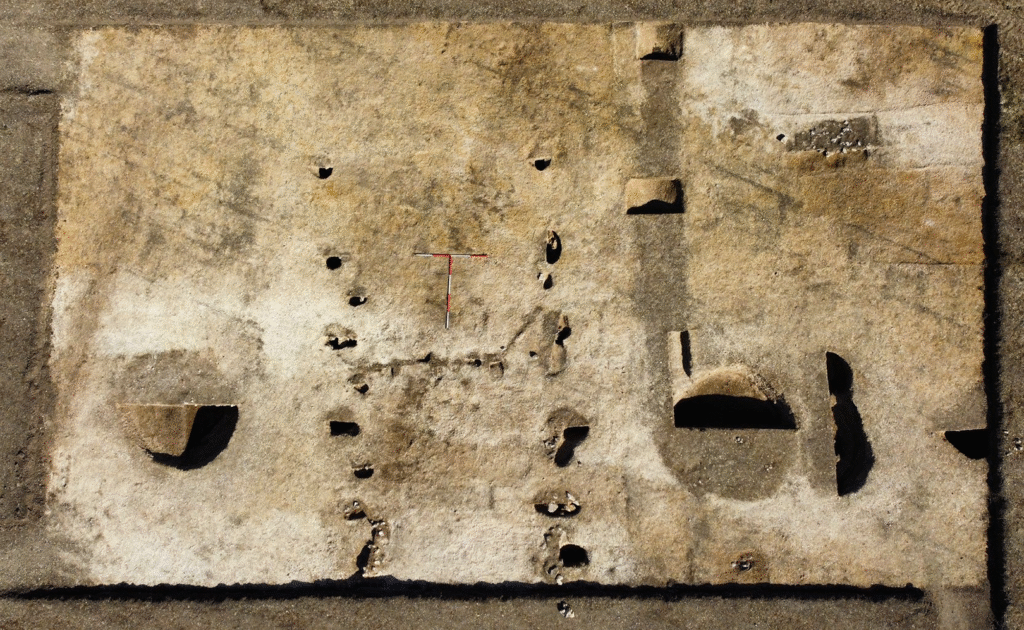
An aerial view of the trench containing the larger timber building and two huge pits. Credit: DigVentures
Hidden rituals
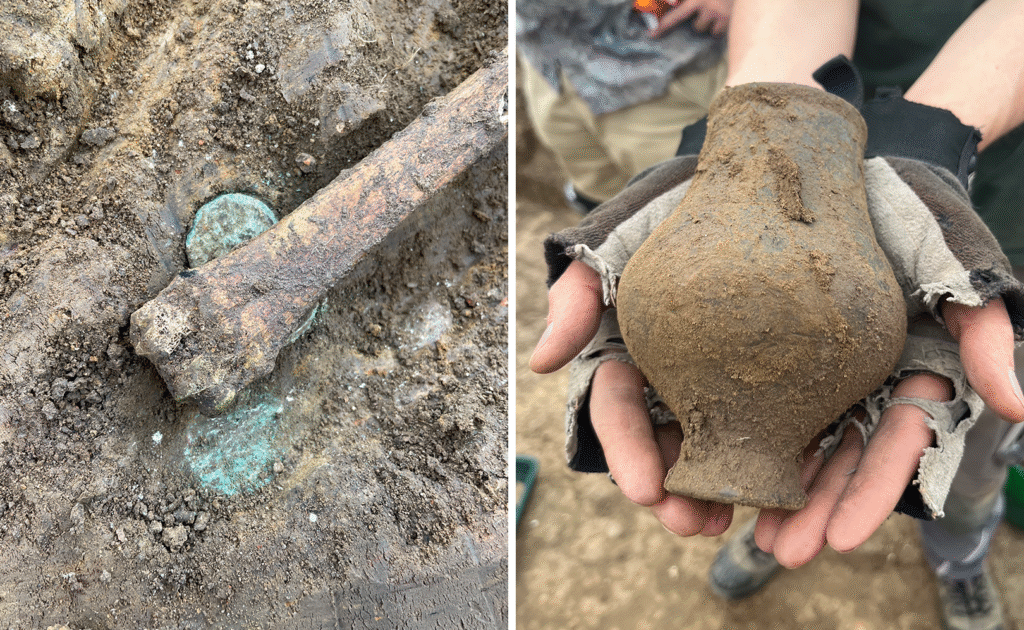
In 2024, an area near the ladder settlement caught the eye of Ben, Dig Ventures’ resident Roman expert, where previous archaeological work in the 1950s hinted at the possibility of a Roman shrine. Wanting to learn more about the religious aspect of the settlement, we laid out 3 trial trenches and a test pit. Our Venturers uncovered a fully intact beaker, buried upside down, and a ritual deposit of coins and animal bone placed deliberately in a pit.
Credit: DigVentures
A new hot spot
Returning to the ritual site in 2025, we uncovered a remarkable mix of features, including burnt pits filled with ash, a complete quern stone on its original floor, cheese presses and signs of intense burning that could mark the remains of an oven. The people living here were grinding grain, baking bread and making cheese – all just a short distance from where votive offerings and ritual deposits were placed.

Left: Ben with the quern stone. Center: Remains of a possible oven. Right: Cheese press. Credit: DigVentures
Join us in East Yorkshire this August
Over nine seasons, we’ve made some incredible discoveries that tell a story of an important, enduring, and complex site. From evidence of one of the earliest Roman settlements north of the Humber, to a 4th-century community at the waning end of the Empire, international trade and ornate brooches, to rubbish pits and grinding stones. Now we’re adding yet another layer – and exploring how people lived, worked and worshipped in this corner of East Yorkshire.
In our tenth season, we’re returning with bigger questions. Was this a settlement with a shrine at its centre? Did worship and daily activities happen side by side? How big was this settlement, and who lived here?
Crowdfund the dig to help make it happen, and help us find out!



There are no comments on this post yet. Be the first!