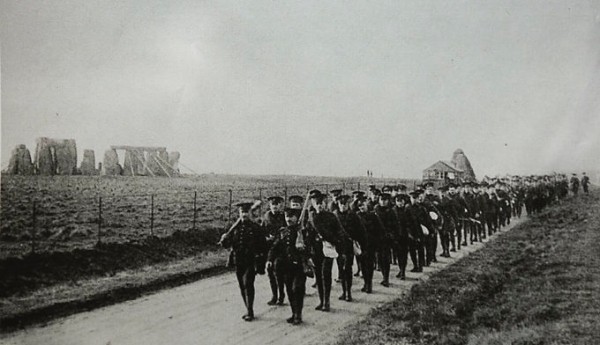
 What on earth does a prehistoric monument have to do with WW1? Well, after digging through some archives, it turns out… quite a lot. Here’s the story of how one of Britain’s most iconic landmarks became the centre of its largest military training ground.
The British Army first bought land in Salisbury Plain in 1897. Stretching over 94,000 acres, it would be perfect for training large numbers of soldiers, and its rolling hills would also provide plenty of space for building extra rail links for transporting soldiers to coastal ports, and away for battle. Right at the heart of this vast landscape stood the mysterious Stonehenge.
By then, the ancient stones were already a well known landmark, and their significance was clearly recognised. The stones were re-enforced and propped up with wooden struts to support them in case of enemy shell attack. But they gained a new significance as thousands of men flocked to the area after enlistment.
Before the war, Stonehenge was open to public visitors for a small fee, but the fee was reduced so that soldiers could visit whilst training in the area. During its course, over one million soldiers were trained on Salisbury plain, in the shadow of Stonehenge. Seeing Stonehenge became almost a rite of passage, but not just for the British.

Between October 1914 and February 1915, over 30,000 Canadians were trained in the area and Stonehenge features in many images of the Canadian forces at the time. Troops from Australia and New Zealand also received training at Salisbury plain.
King George V was known to visit Salisbury plain to review and inspect Commonwealth soldiers, visiting in 1915, 1916 and 1917. In April 1917, approximately 30,000 Australian troops were present at Salisbury and would have all witnessed the infamous Stonehenge and, during the 1917 review, the King decorated a number of men from the Australian Imperial Force for service at Gallipoli and France.

The sheer number of soldiers trained in the area is staggering. Especially considering how few would return home, but that’s not all. Salisbury plain suffered too. Turning the surrounding landscape into a military training ground also had a massive impact, which remain visible even today.
We can see still some of the best preserved practice trenches at Beacon Hill. In addition to trenches, barracks and firing ranges were built in order to train the men. Airfields were introduced alongside the ever expanding railway links. Field hospitals were built, not only for training, but to treat those injured before even leaving England. There were even provisions for War Horses (check out the Digging War Horse project run by the University of Bristol), with a veterinary hospital said to have cared for up to 500,000 animals during the war.
Though Stonehenge is now rarely associated with the armed forces, these images really show the emergence of Stonehenge as one of Britain’s most famous landmarks today.
Interested in the archaeology of WW1?
Subscribe to the DigVentures newsletter to find out about home front project opportunities.
Archaeology in your inbox?!
Want to join a dig? Learn more about archaeology? Join our email list for a monthly digest of our most popular stories, plus alerts for any digs, events, or courses you can join.
Join the list
Written by Sarah Ashbridge
Office monkey by day, forensic archaeologist by night, Sarah Ashbridge is a jack-of-all-trades and the master of one: the forensic identification the War Dead. She trained originally as an Egyptologist, but interests in the history of death and burial saw her make the step into archaeology, completing an MSc in Forensic Archaeology and Crime Scene Investigation at the University of Bradford. Armed with an ever-increasing library of books, a handful of illustration pens and a brand new trowel, Sarah writes our regular #WWWednesday column, working towards her PhD in Forensic Archaeology.


There are no comments on this post yet. Be the first!