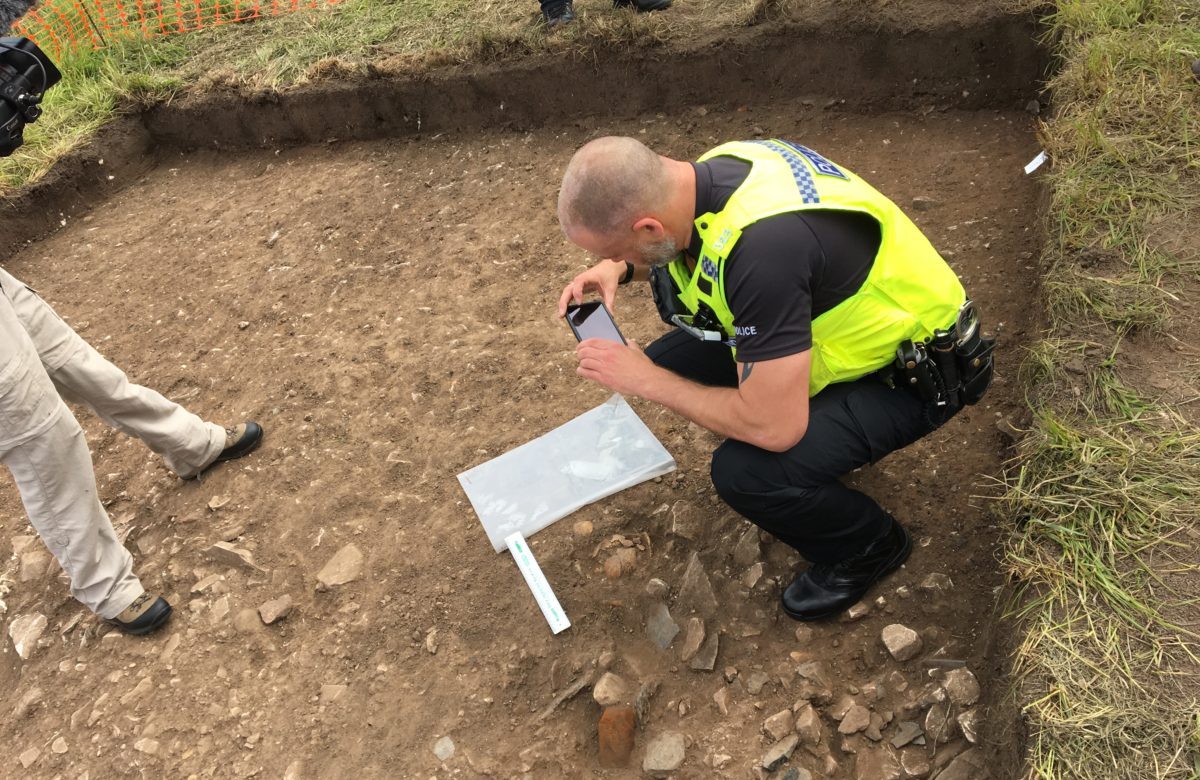
By now, you’ve probably heard about the Anglo-Saxon namestone that we found during our first season of excavation at Lindisfarne. What we haven’t mentioned yet are the scattered human bones we found nearby. Who do they belong to? And are they the first signs of a cemetery associated with the very monastery we’re looking for? Now that we’ve had a closer look, we have some clues…
Last summer, we began the first all-out archaeological search for the monastery founded by King Oswald in AD 635 on the island of Lindisfarne.
With help from hundreds of crowdfunders, we uncovered some really important evidence, including several early Medieval buildings, a silver coin, a bone comb, and a rare Anglo-Saxon namestone.
The namestone, inscribed with the name Ythfrith, is probably the most famous discovery. Featured on the BBC’s Digging For Britain, and in national newspapers, this gravemarker was incontrovertible proof that we were digging in the right place.
What we didn’t mention at the time were the scattered human bones that we found nearby. Starting with just a single human tooth, a few chunks of arm bone, and some fragments of cranium, by the end of the excavation, our crowdfunders had accumulated well over 500 pieces.
And in one corner of the trench, it looked like the outlines of two stone-lined (or ‘cist’) burials were starting to emerge. We’ve left those unexcavated (for now).
But of the bones we did excavate, none seemed to come from a complete skeleton, or from what we would call an ‘in situ’ burial. Instead, they were scattered, mixed up with bits of medieval rubble. They had clearly been disturbed, or redeposited, some time after they were buried.
Dr Sopie Newman took on the task of examining the bones. Their fragmentary nature made it difficult to identify age or sex, but what we do already know is that a fairly broad range of people were being buried here; the bones represent at least four people, including two adults, one child aged between 1 and 6, and a very young baby.
Analysing the adult bones has also given us some indication of their health. Several fragments of vertebra showed signs of degeneration, which may be a sign that they had been a particularly hard worker, or simply that they were getting on in years.
Two of the teeth analysed also had a very slight build up of dental calculus, suggesting that at least one of the adults hadpoor oral hygiene, and may also have had a fairly rich diet.
So, are these bones the first signs of a well-defined graveyard associated with the monastery, and when were they buried? So far, the artefacts found in association with the bone all point towards an early medieval date of around 600-900 AD.
Most obviously, there’s the namestone. We can pretty confidently date this to somewhere around 800-900 AD, and it is entirely possible that some of the bone we found belonged to Ythfrith, the person named on the stone.
Another stone, this time carved with three crosses, was also found nearby and may have been placed as another simple burial marker.
In addition, nine-year-old Sydney (our youngest Venturer) also found lots of rounded quartz pebbles from this area. Although she was attracted to them by their shape, they too are probably an indicator of an early medieval cemetery. Piles of quartz stones are known from many other early medieval cemeteries from Northern Britain, including Whithorn and Coldingham.
So far, everything we’ve found suggests that these bodies were buried before the Vikings attacked the island, and may even have been contemporaries of St Cuthbert – one of the monastery’s most famous figures.
For now, it really does seem that this is an early Christian graveyard, the first clues of a cemetery associated with the monastery.
Right now, we’re looking forward to our second crowdfunded excavation on the island this summer, and we’re hoping that lots of new people just like you will join in, and come to Lindisfarne this summer to help us investigate.
In the meantime, we’ve just sent off three bone samples for radiocarbon dating, which should confirm the precise date of the bones one way or the other… We can’t wait for the results!
Archaeology in your inbox?!
Want to join a dig? Learn more about archaeology? Join our email list for a monthly digest of our most popular stories, plus alerts for any digs, events, or courses you can join.
Join the list
Written by David Petts
David is a Senior Lecturer at Durham University, and an authority on early Medieval archaeology and the development of Christianity in the UK. That makes him the perfect collaborator in our search for Lindisfarne's Anglo-Saxon monastery. Oh, and he's a fine Morris Dancer too!



There are no comments on this post yet. Be the first!