This article is a companion piece to The New Cultural Entrepreneurs, which launched earlier this week and was co-produced with Simon Cronshaw and Ellen O’Hara. Fortress Leadership is an expansion of some of the key ideas fed into that process, and addresses how changing the leadership selection criteria will enable a surge in positivity for the culture sector. It follows on from last week’s provocation by Ellen O’Hara entitled ‘The Additive Trap‘, and our previous DV Trends ‘Imagining the Future of UK Archaeological Leadership‘ event.
For the past year, I’ve had the total joy of spending time with colleagues from different niches in the creative and cultural sector during the process of writing The New Cultural Entrepreneur. These conversations were fantastically motivating, yet it was as though we were all working in the shadow of an immense wall. Each time we revealed something positive, connected dots, or defined an achievable path forward, we would all inevitably remember The Wall and instantly deflate. What is this Wall? It is, of course, the sheer scale of the issues and the impenetrability of its component parts.
None of us has lost hope, however, and in fact finally found our way towards realising that a fundamental shift has already begun and it was actually just our mission to name it. My contribution to the collective draws on three overlapping practices: leadership, systems change, and deep-time study. As a Clore Leadership Programme Fellow and Ashoka Fellow, I am part of communities that understand leadership not as positional authority, but as a public responsibility requiring curiosity, courage, and service beyond the boundaries of any single organisation. As an archaeologist, my grounding brings a long view of how human societies create meaning, organise power, and respond to moments of stress and change.

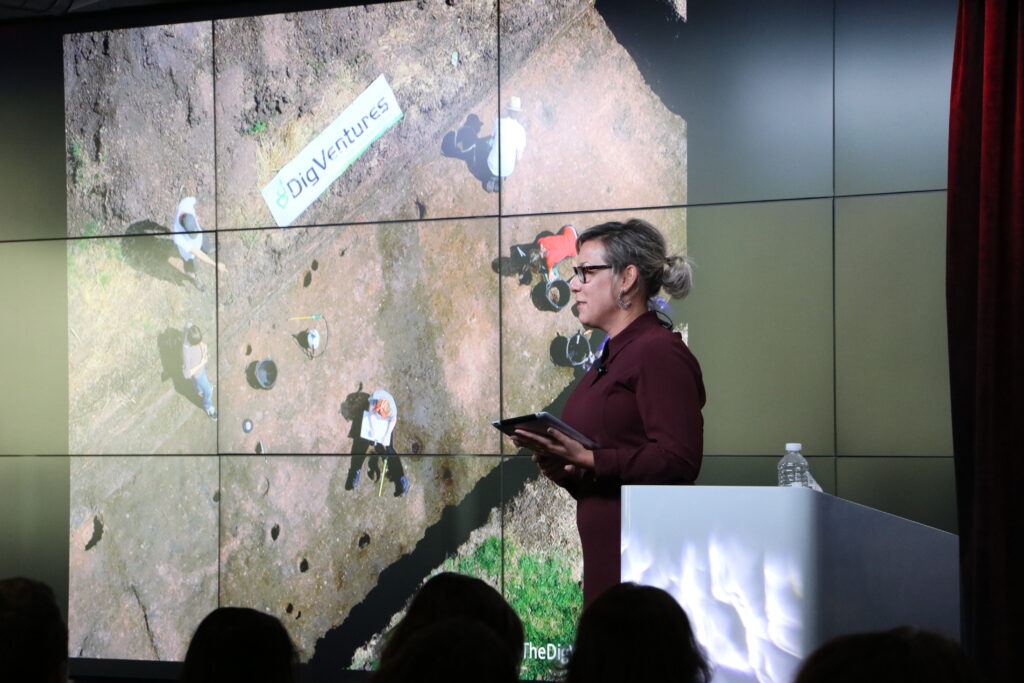
Lisa Westcott Wilkins on site with DigVentures team member, Ben.
Archaeology is generally positioned as a science outside the creative ecosystem, but I have always maintained that it is foundational beneath it: all creative expression draws from the same deep human well of identity, memory, and imagination. Tracking cultures across millennia shows that societies endure by adapting their systems, sharing knowledge, and regenerating meaning over time. I’m using this long view to make the case for a practical call to redesign leadership for this crucial moment in the future of the creative and cultural ecosystem, which (at least for me) also encompasses archaeology.
It is very clear that a pattern has developed around how cultural leadership is selected. The system elevates those who are safest to fund, easiest to govern, and least likely to disrupt existing power. Over time, this has shaped a leadership culture defined by caution, hierarchy, and institutional self-protection rather than the curiosity, flexibility and service so desperately needed for culture to thrive.
This culture can be defined as ‘Fortress Leadership’: a defensive posture in which institutions prioritise control, minimising risk, and organisational protection over the long-term health of the cultural ecosystem.
The Leadership Trap
Today’s cultural leaders are expected to be many things at once: visionary and compliant, entrepreneurial and risk-averse, collaborative yet competitive. Boards and funders often say they want ‘bold leadership’, but the structures surrounding leaders reward predictability and penalise uncertainty, without recognising that innovative practice by its nature is iterative.
This is a paralysing leadership trap that shows up in familiar ways:
- Leaders optimise for fundability rather than purpose
- Decision-making is pushed upwards “just in case”
- Innovation is confined to pilots that never threaten the core
- Partnerships become transactional rather than relational
- Boldness is viewed as a liability
- Institutions survive but lose relevance
Like Ellen’s ‘Additive Trap’ in organisational strategy, this leadership model makes sense when viewed one decision at a time. Each choice is defensible, each appointment reasonable, but eventually they produce a culture that has lost meaning.
Inflection Point
Culture, and cultural entrepreneurship, does not fail all at once. It erodes through missed connections, shrinking ambition, exhausted teams, and declining public trust/interest – with this final point being the death knell that justifies decreased funding. At a moment when intersecting polycrises, identity politics and democratic fragility challenge our understanding of the world, we need culture more than ever as societal connective tissue. ‘Fortress’ leadership squanders the unique potential that culture holds of offering common ground.
I see a critical, urgent, immediate need to reposition leadership as an act of service to the wider ecosystem rather than a defence of institutional territory.
A stewardship approach treats power, resources, and institutions as responsibilities held in trust, with decisions guided by their long-term impact on people, culture, and systems rather than short-term organisational advantage.
Governance must move beyond a singular focus on financial risk aversion toward fostering cultures of trust; boards that remove leaders simply for challenging convention, rather than walking alongside them through uncertainty, perpetuate the culture of fear that is holding the sector back.
This means valuing leaders who ask better, tougher questions rather than rush to easy answers, who share power, assets, and insight rather than hoarding them. It means recognising those who see collaboration as infrastructure rather than compromise or loss, who accept risk as a precondition of relevance, and are strong enough and well supported enough to see experimentation through to its conclusion.
Above all, it means elevating leaders who measure their success by the conditions they create for others to thrive, and reshaping governance and funding to require this as an essential measure of success.
From Fortress to Stewardship: A Decision Lens
Shifting away from Fortress leadership requires leaders to adopt a different decision lens that slows the moment of choice, and asks what is really being reinforced:
- The first test: where risk is being held? Decisions that appear to reduce institutional risk often displace it elsewhere: onto freelancers, partners, communities, or into the future. A productive change is to not default to avoiding risk, but asking whether it is being shared, learned from, and carried responsibly.
- The second test: distinguish between control and care. Fortress cultures default to control in moments of uncertainty, while stewardship approaches prioritise care, creating the conditions for others to act, contribute, and learn, even when outcomes are not fully known. Shift from “How do we retain control?” to “What conditions allow this work to thrive beyond us?”
- The third test: how does authority flow? When decisions consistently vest at the top, organisations teach people that judgement is risky and compliance is rewarded. Be on guard for where authority has become over-concentrated, and ask what would need to change for trust, challenge, and responsibility to be more widely distributed. The flat hierarchy/holocracy approach creates leadership at all levels.
Choosing the Future
The exhaustion that has settled over cultural life since the pandemic cannot become a permanent condition. Leadership pipelines are shaped by what we reward, what we tolerate, and what we discourage. If we continue to celebrate leaders because they are risk-averse, hierarchical, and institutionally protective, we should not be surprised with the result.
If our emerging leaders are learning from what we reward, what exactly are we teaching them? What are we really selecting for, and what are we losing as a result?
The future of culture and cultural entrepreneurship (and by default, archaeology) will not be secured by better rhetoric, advocacy, or by pouring more money into a system that rewards the wrong qualities. It will be secured by different leadership choices.
The archaeological record is full of societies that protected their institutions at the cost of their adaptability. It is also full of those that survived by doing the opposite. For archaeology itself, and for the wider cultural sector we are part of, the path forward is the same: identify the leaders already practising curiosity, courage, and service, often at the margins, and clear the way for them. Fund, appoint, and trust them, and redesign the systems that currently filter them out.






There are no comments on this post yet. Be the first!