From extinct animals to prayer beads made from fish bones, our crowdfunded dig on Lindisfarne has unearthed some very intriguing finds over the last nine years.
Lindisfarne is a small tidal island off the coast of Northumberland in northern England. Today, the island’s picturesque sand dunes and rich history attract visitors from across the globe.
Once the heart of Christianity in the Early Medieval kingdom of Northumbria, Lindisfarne is most famous for being the site of a devastating series of Viking raids starting in AD793, which have been the subject of popular TV shows such as Vikings and The Last Kingdom.
As far back as the 1950s, archaeologists have uncovered famed artefacts from the island, such as the Viking Domesday Stone, helping us to understand more about the island during the turbulent time of the Viking raids. But the precise target of the Viking raids – the early medieval monastery founded in AD 635 – had never been found.
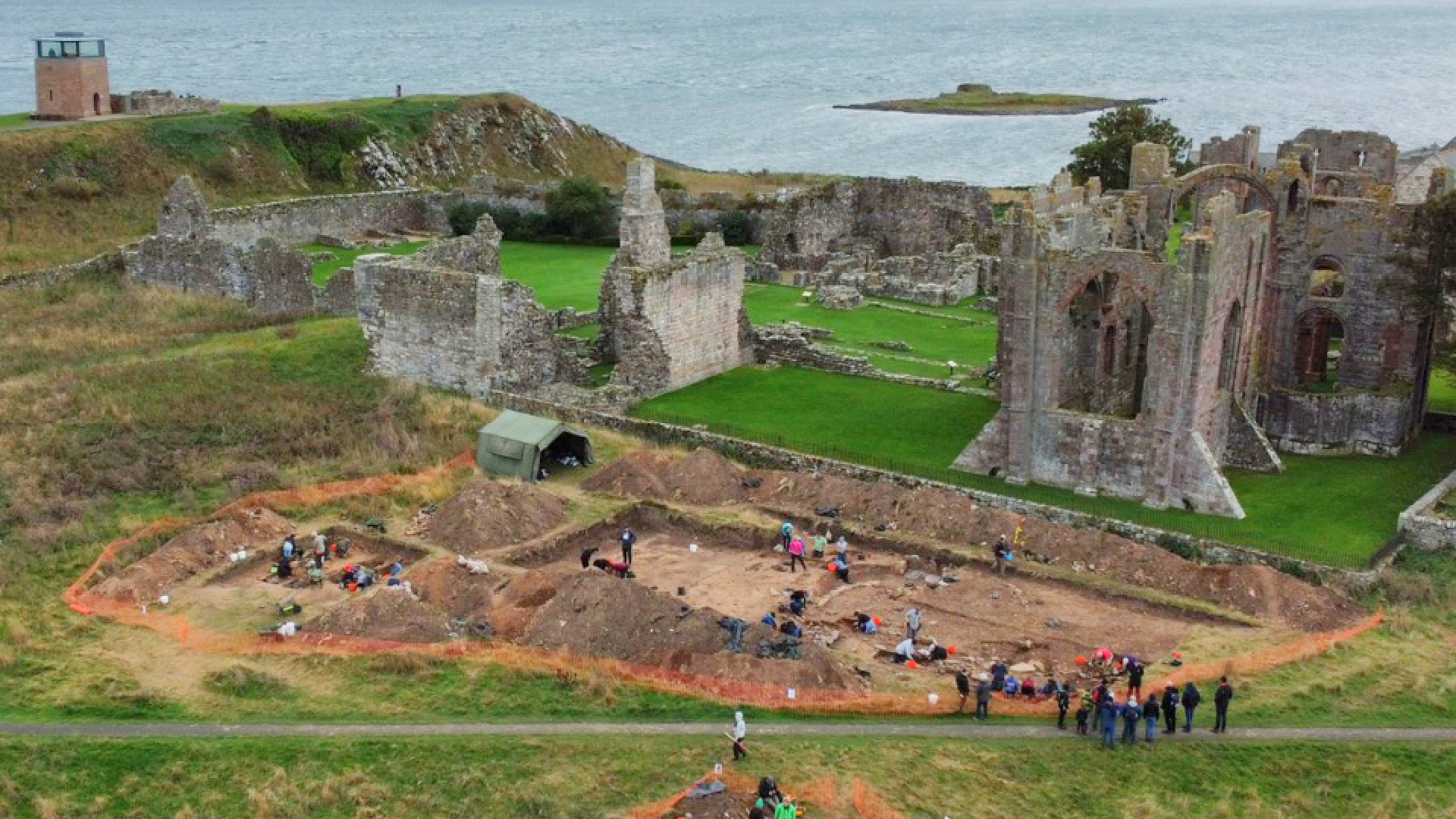
The ruins of Lindisfarne Priory, with the area of excavation where DigVentures and Durham University have been searching for traces of a much earlier early medieval monastery, with the support of crowdfunders. Credit: DigVentures
In search of this lost monastery, and to recover evidence that can help us understand what it was like to live on the island before, during, and after the Viking raids, DigVentures has crowdfunded a dig here every year since 2016.
Run in partnerhsip with Durham University, and with the help of all our crowdfunders, the discoveries we’ve made have revealed the remains of buildings, sculptures, workshops, and even part of a cemetery – all dating to this time.
Together, these discoveries are creating new knowledge, from who lived here (men, women, and children, not just monks) to what their lives were like.
Here are 15 intriguing discoveries, from the everyday to the somewhat surprising, that are changing what we know about this iconic site – all made thanks to our crowdfunders:
The claw of a medieval bear
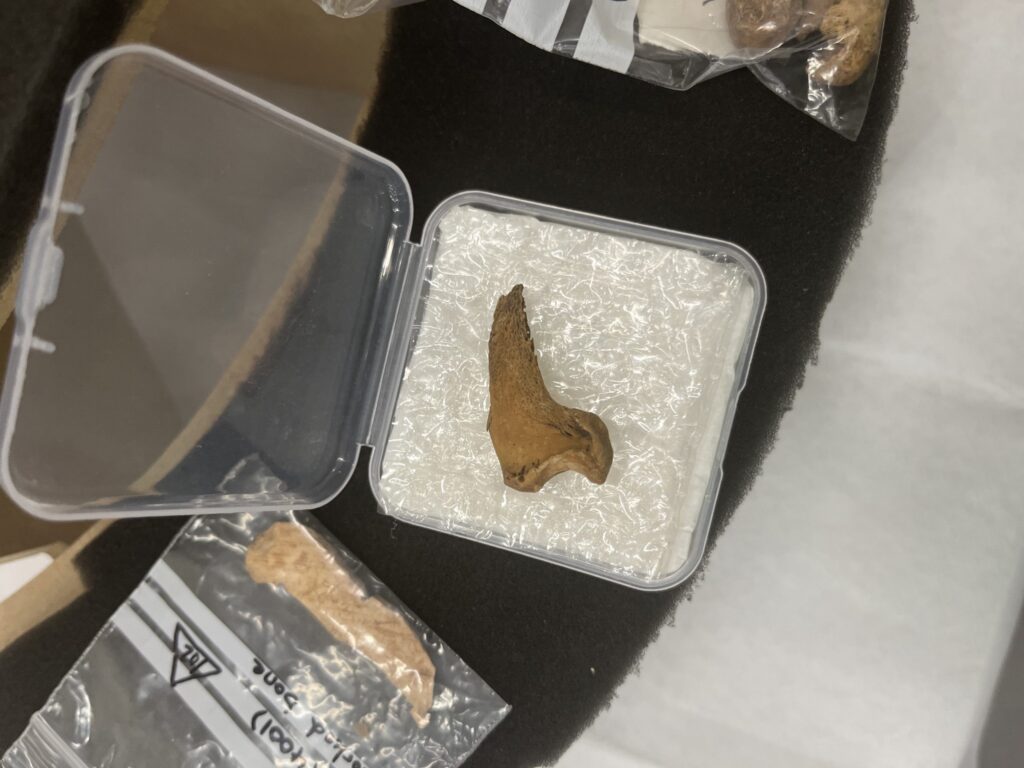
Medieval bear claw. Photo: DigVentures
Excavation has shown that the people of Lindisfarne consumed many different types of animal, including land animals such as cow, sheep and goat, as well as marine animals including seals, whale, porpoise, fish, and shellfish. But one of the most unexpected discoveries was the remains of a bear. Radiocarbon dating places the claw between 973 – 1234calAD, and may have arrived on the island as part of a pelt or fur after being hunted on the mainland.
Only 85 examples dating to the last 10,000 years have been found on archaeological sites in the UK, making this a nationally significant find.
Two early medieval rings – one made of copper, and one of animal bone
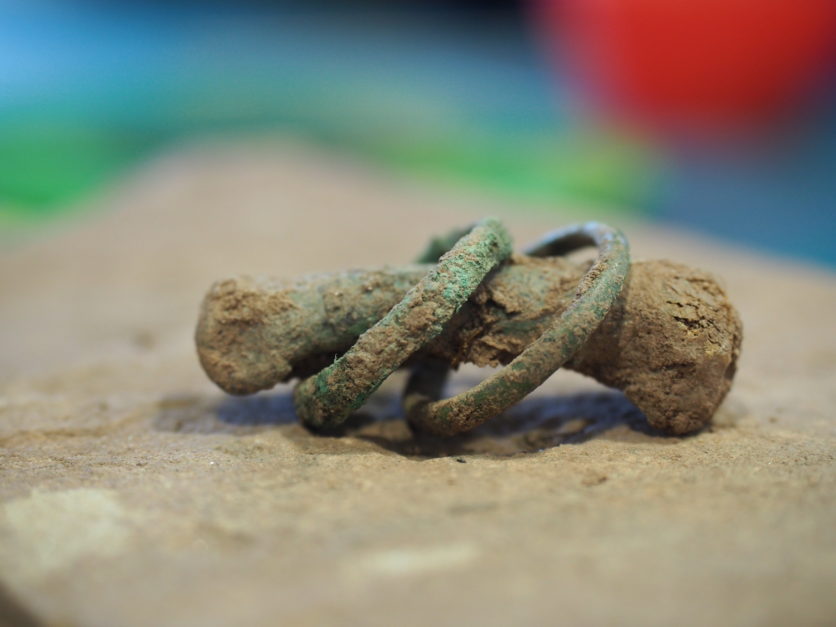
Two early medieval rings on a disarticulated finger bone. Photo: DigVentures
In 2019, we found two early medieval (c.8th-9th century AD) rings while excavating the large cemetery area. One ring was made from copper and the other from animal bone. Interestingly, these two rings were found on an isolated, disarticulated finger bone, rather than as part of a complete burial. This is probably because many of the burials on Lindisfarne were disturbed by centuries of use, and also by medieval and modern ploughing. As a result, some of the remains become separated from their original burial. It’s impressive that despite all this movement, the rings somehow stayed together on the finger.
A long-lost name
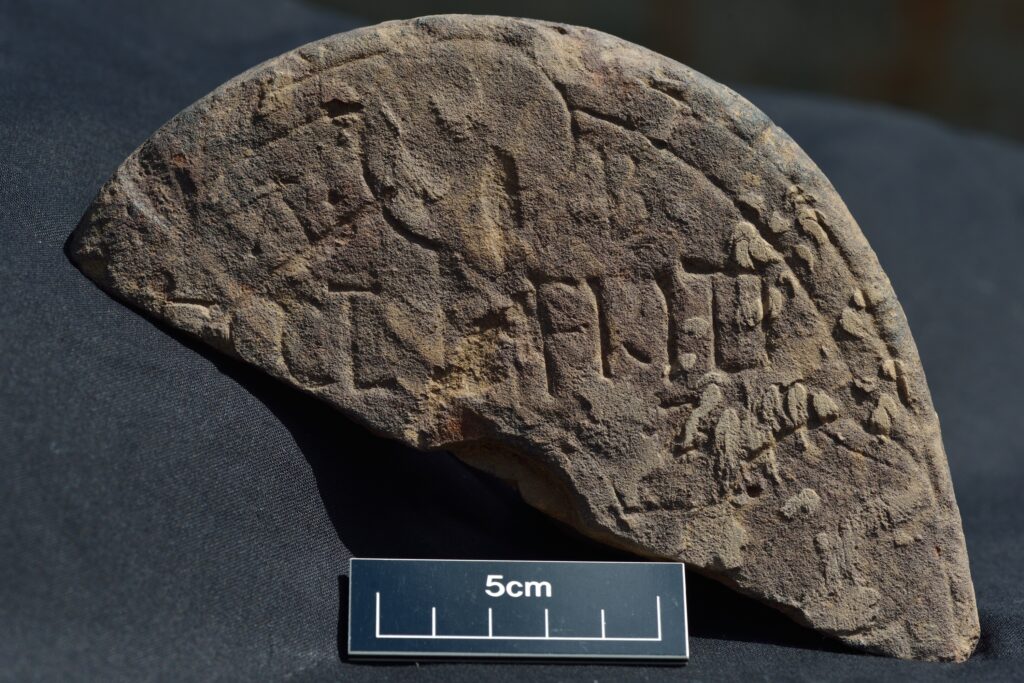
Ythfrith’s namestone. Photo: DigVentures
Namestones are a type of Early Medieval sculpture that is unique to north east England. Often featuring a central cross with a name inscribed either in Latin or runes. While many early medieval names are known from historical documents, there are many that have been lost to time. In 2016, one of the namestones revealed a very unusual name that historians had never come across before: Ythfrith’ (pronounced ‘uth-frith’). What makes this name so unusual is that it combines a typically masculine ending (-frith) with a typically feminine beginning (Yth-).
The lockplate from a ‘chest burial’
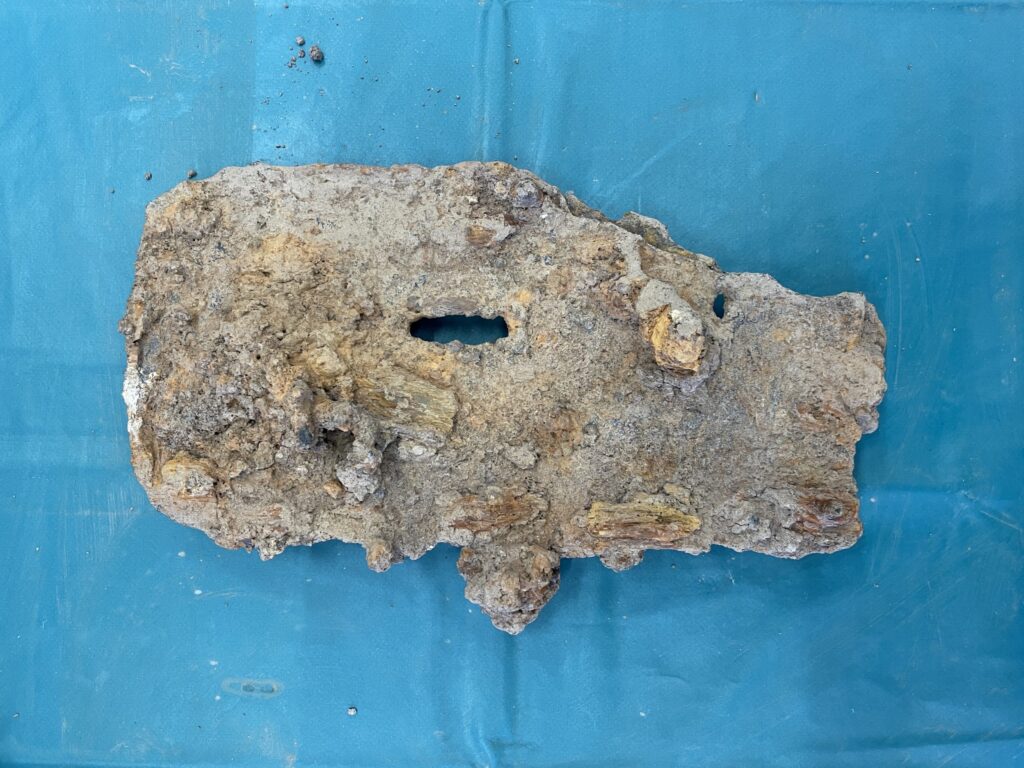
Burial practices in the Early Medieval period were much more varied than you might expect, and some were even interred in wooden chests – a type of burial unique to early medieval Northumbrian ecclesiastical sites.
The wooden chest was probably a valuable piece of domestic furniture, and although little of the wood survived, we did recover the lockplate for closing it. Osteoarchaeological analysis shows that the burial belonged to a teenager or young adult, who died between AD 800 – 1,000. We don’t know who they were, but based on other chest burials, they’re likely to have been important or high status, and may even have met a violent death.
A medieval bone comb with an important inscription
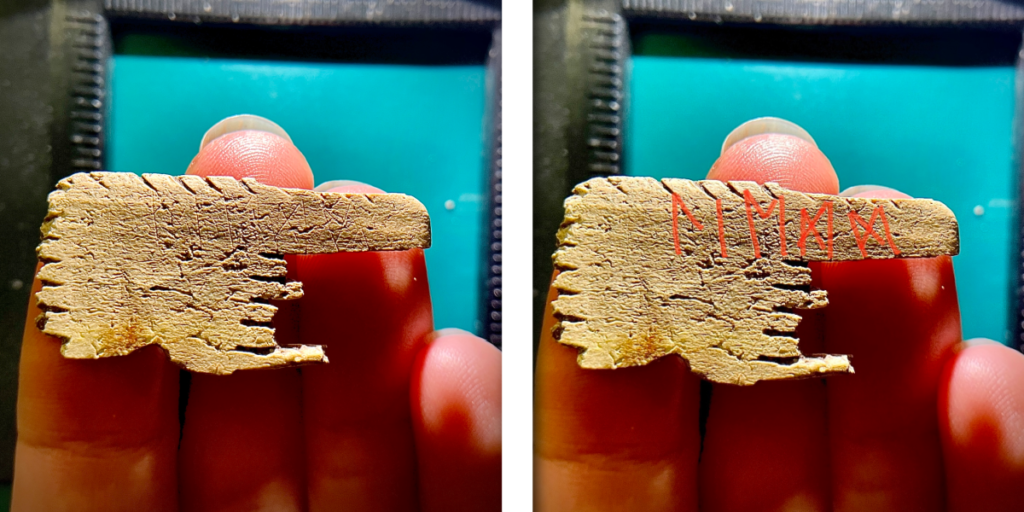
Fragment of bone comb, found by Venturer Cathy in 2021, with lettering highlighted on the right. Credit: DigVentures.
This bone comb, which likely dates to before the 8th century AD, features an inscription in Old English: “-EDE”, which could be the end of someone’s name or the ending of an Old English verb. In the medieval times, people used to write their names on bone combs, or sometimes even just the equivalent of ‘this is mine’. And it shows us something important – whoever owned it was literate.
A rare glass gaming piece
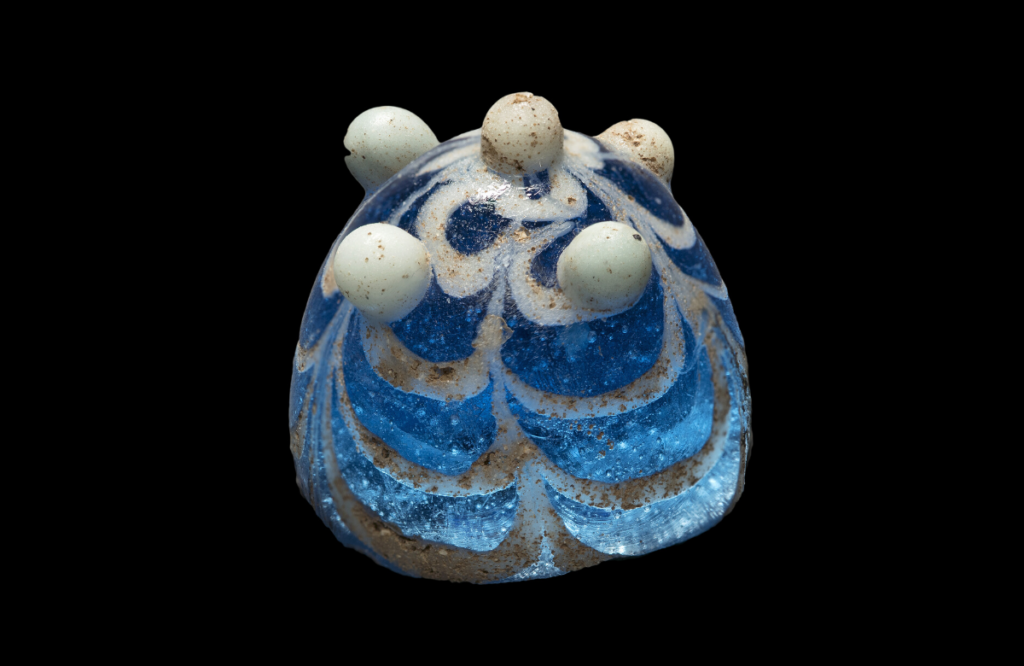
An early medieval glass ‘tafl’ king piece, found in 2019. Photo: DigVentures
This 1,200-year-old boardgame piece uncovered in 2019 is only the second to be found in the British Isles. Made of bright blue glass with an exuberant crown of five white bobbles, it’s probably the ‘king’ from a ‘tafl’ set – a strategy game that pre-dates chess. This incredible find not only shows us that the people visiting or living in the monastery in the early medieval enjoyed a good board game as much as we do today, as well as cultural connections Lindisfarne shared with other parts of Britain, mainland Europe, and beyond.
White quartz pebbles
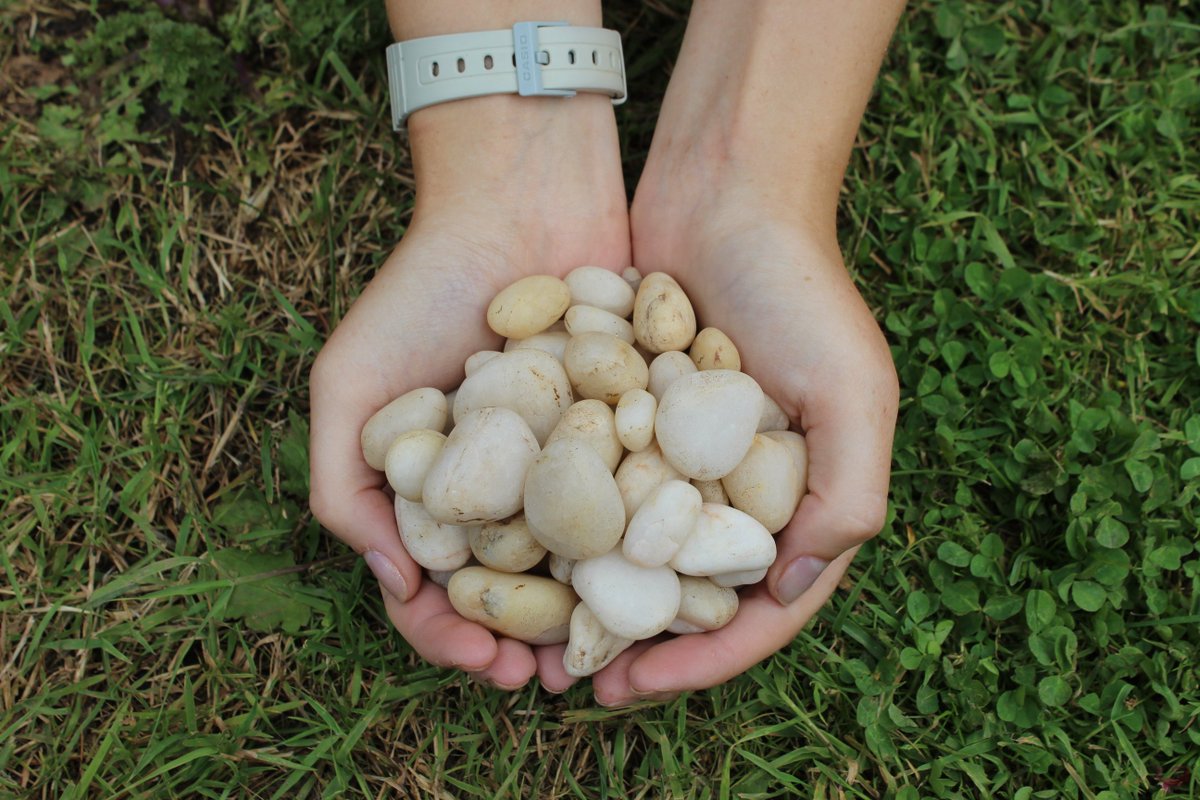
A collection of quartz pebbles excavated from Lindisfarne. Photo: DigVentures
Since our first season of excavations, we’ve found hundreds of quartz pebbles in the cemetery site. These white stones don’t occur naturally in the soil, so where did they come from? Thanks to some of our more determined Venturers, we’ve learned that these pebbles can be found around the island at the low tide mark, suggesting people were going down to the shore to collect these pebbles to bring to the cemetery and place on graves, much like we do with flowers today. Interestingly, they also found white quartz pebbles in the cemetery at Iona – the monastery where many of the monks who founded Lindisfarne originally came from.
The bones of a bird that’s been extinct since 1844
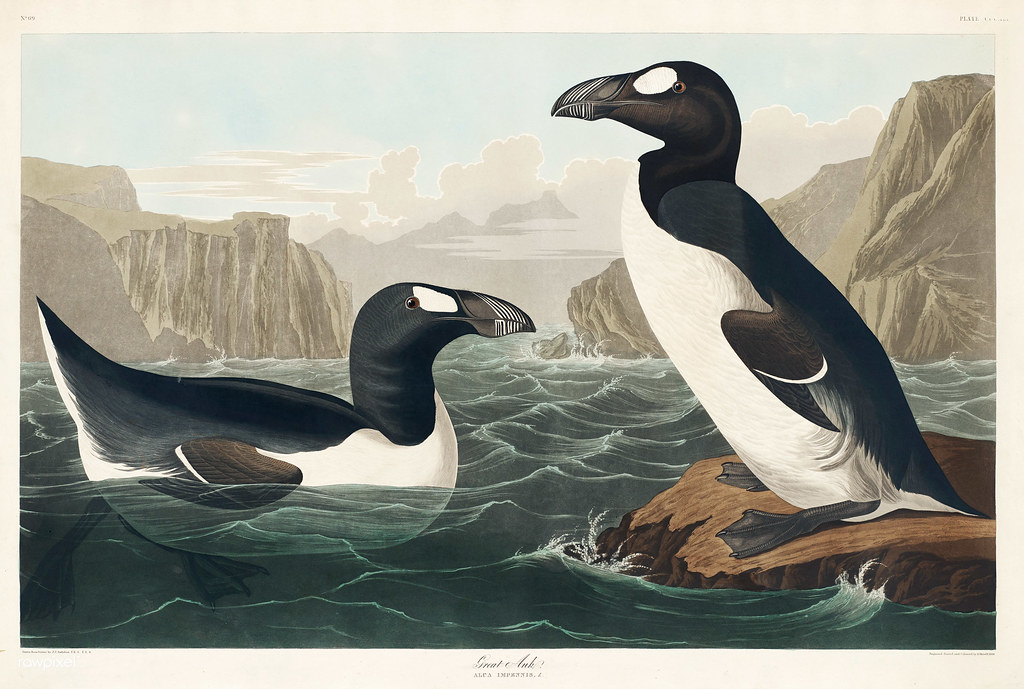
Great Auk // Source: Birds of America (1827) by John James Audubon (1785 – 1851), etched by Robert Havell (1793 – 1878). Via Flickr
Thousands of animal bones that have been recovered on the dig, and zooarchaeological analysis the remains of a giant auk – a large, flightless bird that sadly became extinct in 1844. Radiocarbon dating placed the auk bones between 718 – 1098 calAD, showing us that during the time of the Early Medieval monastery at least, they were thriving and may even have been hunted by island residents, along with seals, fish, whale, and other coastal creatures.
An unexpected fragment of Roman pottery
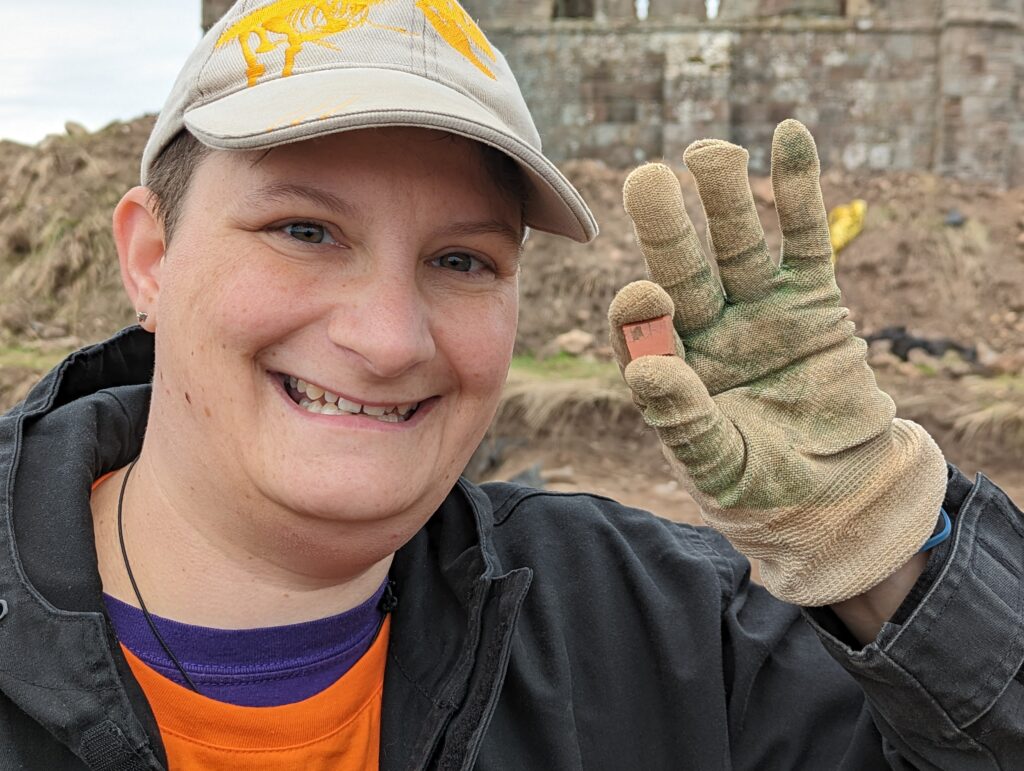
Alex with the Roman Samian Ware pottery immediately after discovery in 2022. Photo: DigVentures
This tiny piece of imported Roman Samian ware has challenged our understanding of Lindisfarne’s ancient history. It’s the first Roman artefact found during our investigations here, and while there’s no evidence that Romans settled on Lindisfarne, it shows that their influence did at least reach here and that the island may yet have been trading with mainland Roman settlers.
The earliest known example of fish-bone prayer beads in Britain
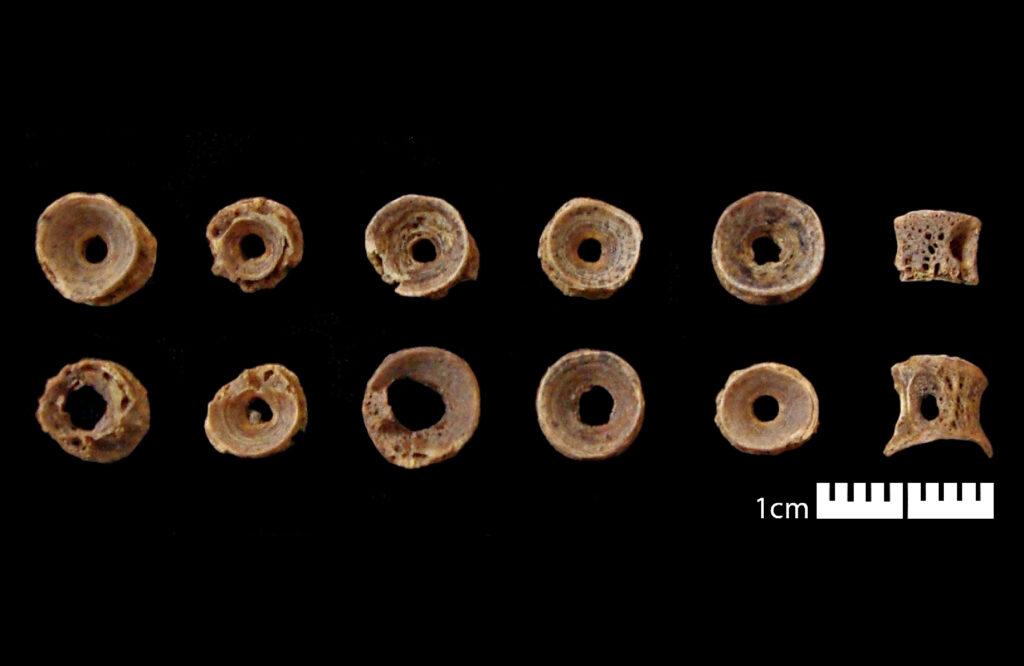
Modified fish vertebrae found clustered around the neck of a skeleton, found by Lesley Photo: DigVentures
Our Venturer Lesley noticed something fishy while working the finds room; a series of fish vertebrae clustered around the neck of a skeleton. Zooarchaeological analysis revealed that the naturally occurring holes in the centre of the bones had been deliberately widened to facilitate threading, or due to years of use, suggesting that they may have been used as prayer beads. Radiocarbon dating placed the skeleton between AD 1033 – 1164, confirming them as the earliest known example found in Britain to date.
A focal burial
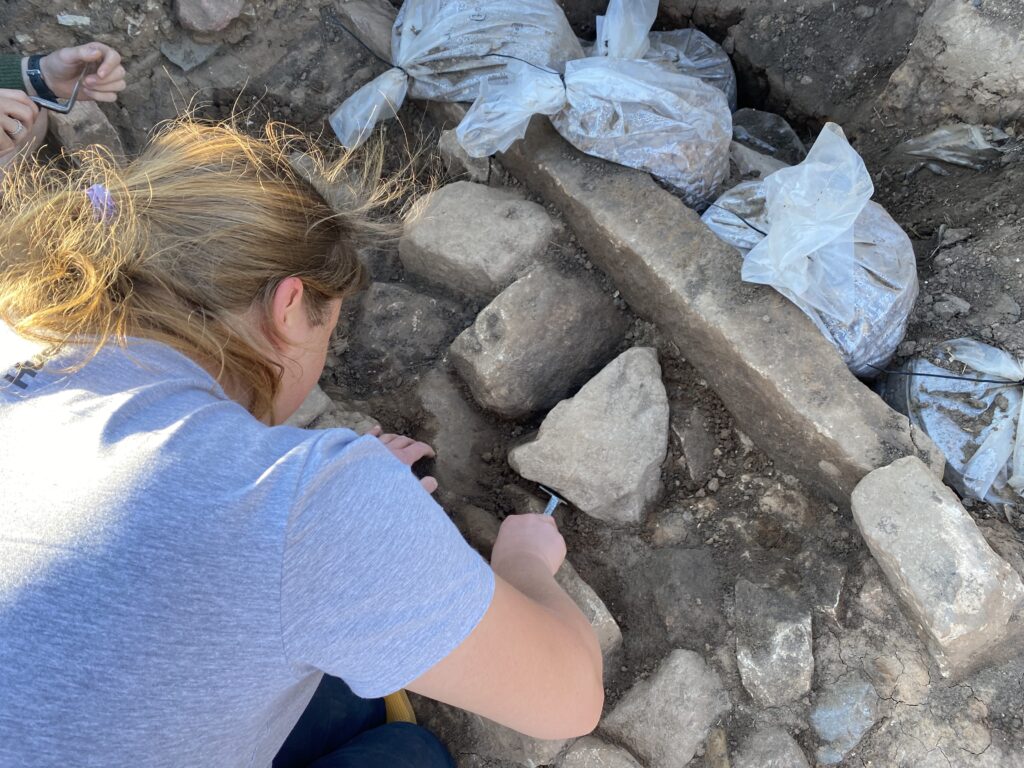
The focal burial mid-excavation in 2022. Photo: DigVentures
Most of the burials revealed on Lindisfarne are very similar; unmarked, no possessions, and facing east. That was until 2022, when our team unearthed the first signs of a focal burial – one that others buried their loved ones around.
Unlike the other burials, this one was clearly marked and lined with stone. Preliminary analysis suggests this could have been a woman, and many of the burials around them seem to be children. Radiocarbon dating indicates that the person within was buried between 771 – 978 calAD. Who were they? We hope that further scientific analysis may yet reveal who this person was, and why they were so highly regarded.
A delicate golden thread that may have decorated someone’s hair
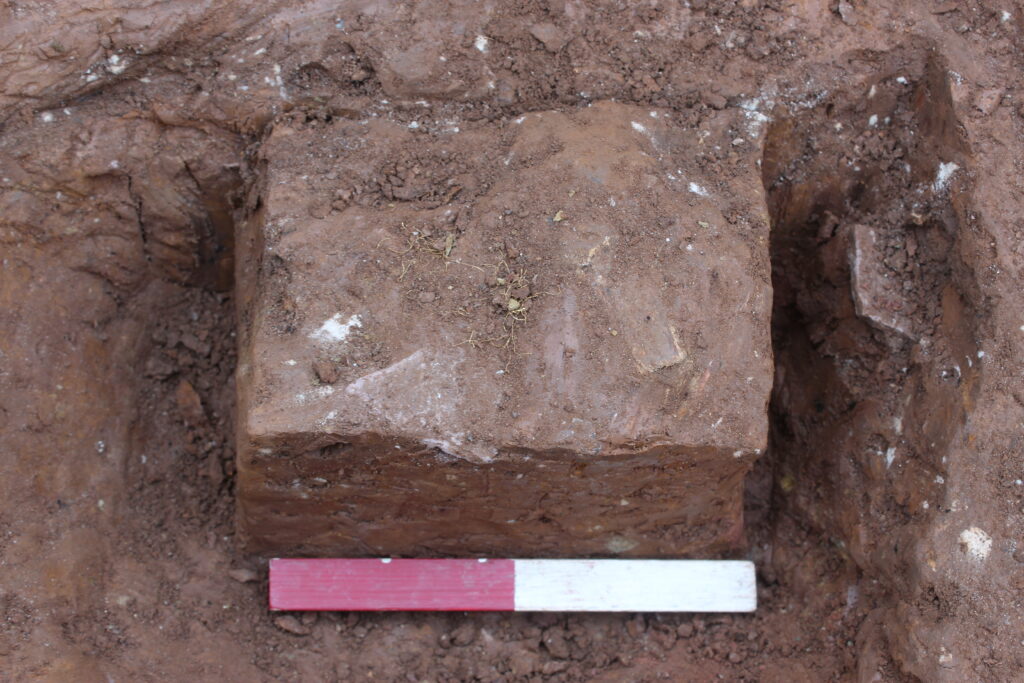
The gold thread ready to be block lifted from the trench in 2023. Photo: DigVentures
Students from Durham University made the defining discovery of their fieldschool when they spotted a hint of delicate golden thread, when excavation of the focal burial resumed in 2023. The thread was found at the head of the grave, suggesting it may have been used in a headdress. This helps to cement the theory that whoever was buried here was clearly someone important. Currently with the conservation team before it undergoes further analysis, we can’t wait to find out what else it could reveal.
A piece of portable altar
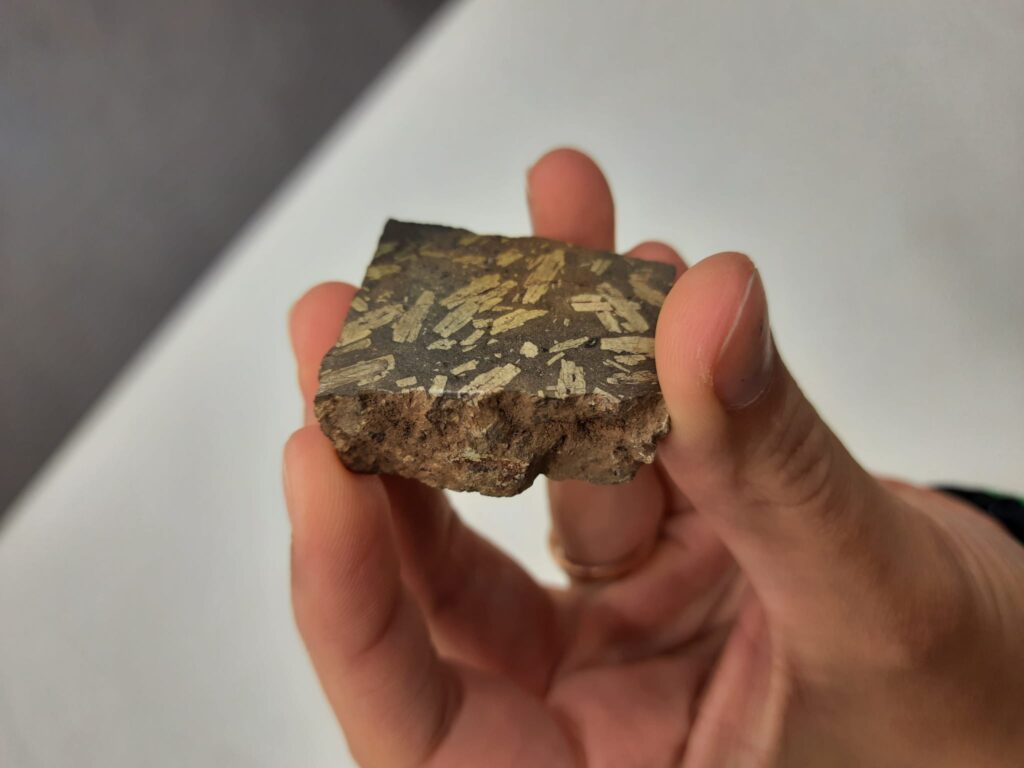
Fragment of Porphyry, found in 2021. Photo: DigVentures
In 2021, a fragment of green polished stone was recovered near to the focal burial. This stone appeared to be porphyritic lava stone, which isn’t native to the island. This could be a part of a portable altar (for conducting religious services while travelling) or reliquary (a container for holy relics), which would tie it directly to the working of the early medieval church on Lindisfarne. Currently, the stone is undergoing further study as part of our post-excavation analysis.
A coin that challenges the history books
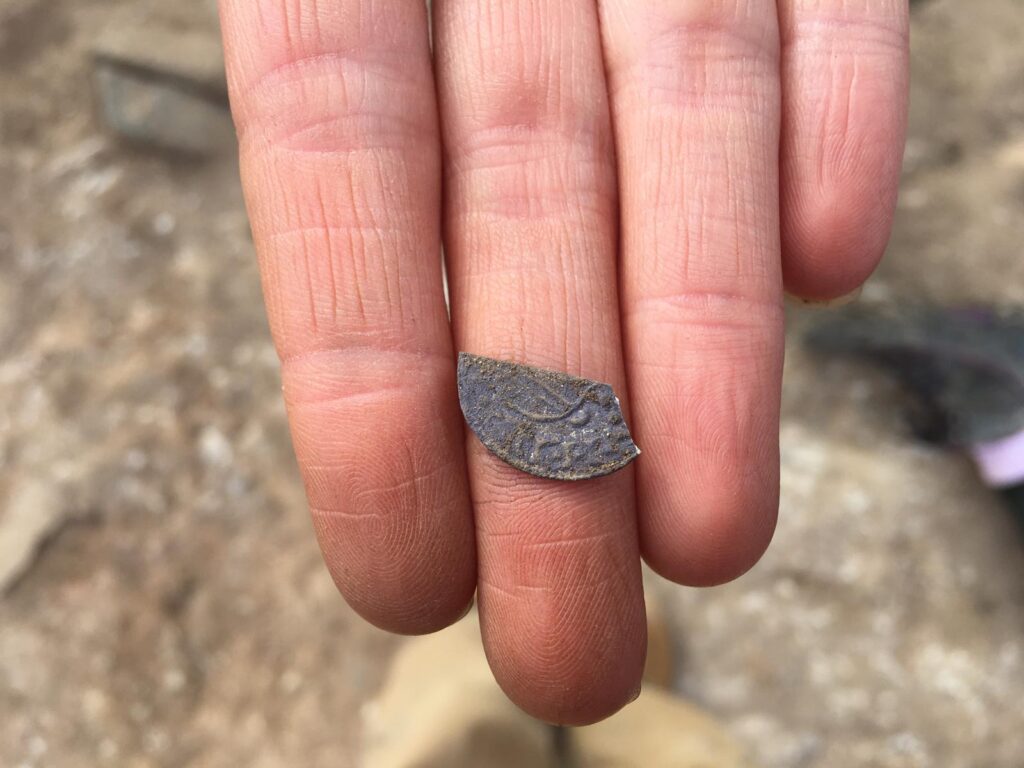
A coin of Edward the Confessor. Photo: DigVentures
Nearly 50 coins have been discovered on Lindisfarne, helping to date the site and reveal possible trade links. One of the most interesting was found right next to the focal burial: a coin of Edward the Confessor, dating from AD 1046 – 1048. What makes this coin particularly surprising is that it dates to the period between the 9th and 12th centuries AD when Lindsfarne’s monks are supposed to have abandoned the island. This coin suggests that the island might not have been as empty as some historical sources suggest, and that pilgrims may still have been visiting the island.
Another coin, of King Eadberht
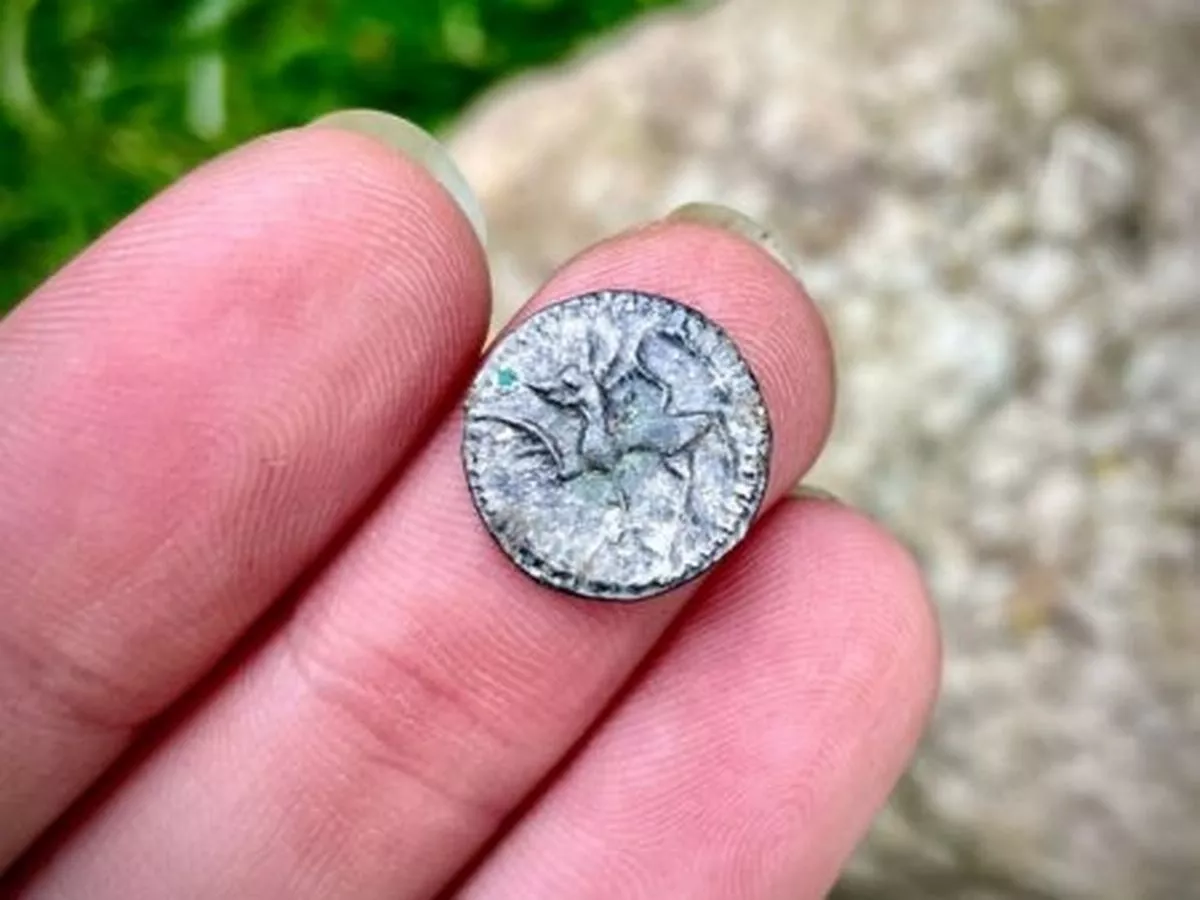
A sceat of King Eadberht, found in 2021. Photo: DigVentures
Another favourite coin of ours has to be the sceat we discovered in 2021. Dating to the reign of King Eadberht, the near-mint condition of this coin allowed us to admire the fantastical, four-legged beast decorating the reverse. King Eadberht became king of the early medieval kingdom of Northumbria in AD 737 after his cousin Ceolwulf abdicated. What makes this story extra poignant to us is that Ceolwulf took sanctuary at the monastery on Lindisfarne – the very site we’ve been looking for all these years.
With two more seasons of digging planned, we’re sure to uncover more unique and wonderful finds from Lindisfarne. Look out for future updates from our excavations on the island, set to take place in September 2024 and 2025. In the meantime, comment your favourite find below!



There are no comments on this post yet. Be the first!