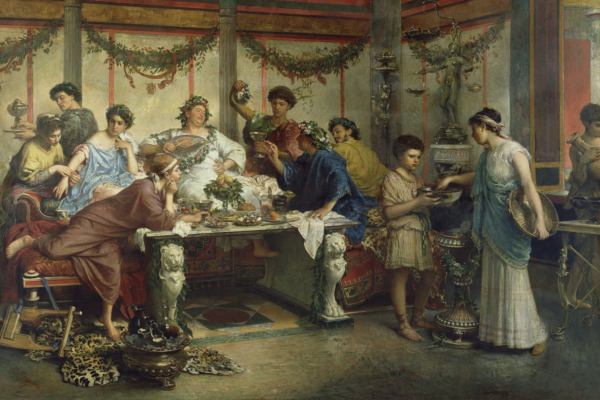
Digital image courtesy of the Getty’s Open Content Program
Gifts, feasts, candles and singing in the street. Sound familiar? The Romans may not have celebrated Christmas until much later, but that doesn’t mean they didn’t have their own holiday traditions in December – and they aren’t too different from our own today.
Fancy introducing some ancient flair to your festivities this holiday season? Here’s everything you need to know.
Did the Romans celebrate Christmas?
December was certainly party season for the Romans, as ancient Rome came alive for Saturnalia, a raucous mid-winter festival filled with food, drink, song, dancing, games. Starting on December 17th and lasting for up to seven days, this was followed by the celebration of the winter solstice and birth of the the sun god, Sol Invictus, on December 25th – an occasion marked by chariot races.
However, as the Roman Empire converted to Christianity, these festivities changed too: 25 December became a holy day, and from AD 336 Christ’s birthday was commemorated on 6 January. That was until AD 354–60, when the first reference is made to it being celebrated on 25 December. Parts of these different winter festivals were brought together, and eventually a new celebration emerged: Christmas Day. By the late 4th century, many Romans marked the occasion, and it spread outwards to other regions too.
But back to Saturnalia…
What is Saturnalia?
Saturnalia started out as a one-day farmers’ festival on 17th December each year. As you might have guessed by the name, the festival was to honour Saturn – the god of farming and the harvest. Over the centuries, the festival grew, eventually becoming a seven-day event culminating on December 23rd with Sigillaria – a day of gift-giving.
Like all public holidays, Saturnalia was a time to relax and have fun. People had time off from work, and even slaves were able to join in with the festivities. The streets would be flooded with merrymakers and filled with singing, dancing and games.
How did people celebrate?
Famously the most jovial Roman holiday, Saturnalia was filled with all sorts of fun. On top of the raucous partying, people also decorated their homes with greenery and candles, and wore colourful clothing. Slaves also wore special hats called pillei – pointy hats that were usually worn by freed slaves.
It had a carnival-like atmosphere, as roles were switched and the usual rules of society turned upside-down, with masters inviting their slaves to feast, and serving them food.
At the end of the festival – during Sigillaria – gifts were given to friends and loved ones. Traditional gifts included small figurines made from wax or terracotta (also called sigillaria), or candles (cerei).
What did they eat?
No holiday is complete without eating as much tasty food as possible, and Saturnalia was no different. While we don’t know any dishes specific to the holiday, we do know some other traditional Roman nibbles which might have made an appearance at the Saturnalia feast – from roasted meats, to delicious desserts, and plenty of wine.
Read more about what people might have eaten during Saturnalia.
Did everyone celebrate Saturnalia?
While it’s likely that people across the Roman empire would have honoured Saturnalia, there would have been all sorts of other holidays and traditions celebrated throughout the different countries occupied by Rome.
Christmas and Saturnalia?
While Christmas and Saturnalia aren’t the same – it’s not unlikely that some of our traditions were at one point inspired by those of the ancient Romans. During the later years of Saturnlia, it’s certain that Christians and Pagans would be co-existing. Eventually, as more people converted to Christianity, their traditions may have been absorbed into Christmas.
Without further ado, Happy Holidays (or Io Saturnalia if you’re in the ancient mood), hopefully your celebrations are as cheery as the Romans’!







There are no comments on this post yet. Be the first!