‘As a filmmaker for the BBC, you get this amazing privilege of being able to pick up the phone to pretty much any expert in the world and say, what can you tell me?’: Jamie Lochead, Creative Director at Windfall Films, spills the tea on filming archaeologists, and creating Attenborough and the Mammoth Graveyard.
We seem to be living through a new wave of archaeology on the telly. From films like The Dig, to emerging series such as Great British Dig and stand-alone documentaries like Attenborough and the Mammoth Graveyard, the best filmmakers are ditching the outdated egos and repetitive hyperbole that archaeology is often hung upon, in favour of a more gentle, informative storytelling that allows the passion, enthusiasm, and collaboration behind scientific discoveries to shine through. And we’re all for it. Nothing overstated, nothing underplayed, and yet as so many people have been saying, utterly riveting. More like that please.
Jamie Lochead is Creative Director at Windfall Films, and the producer who worked with us to film Attenborough and the Mammoth Graveyard. We sat down together to look back on how the film came together, and what a national treasure can teach archaeologists about storytelling.

Jamie on site with David Attenborough and co-presenter Ben Garrod
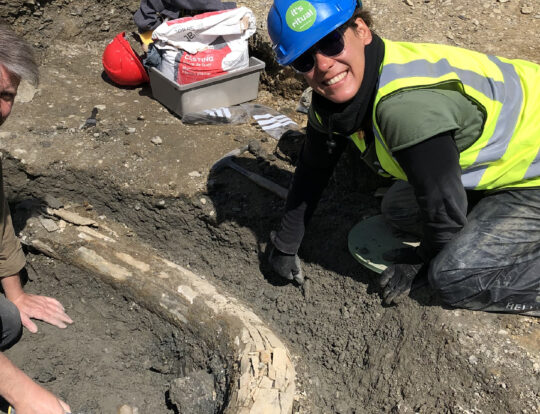
Lisa unearths a mammoth tusk
What is the process of making a documentary? And how did it happen with Mammoth Graveyard?
Unusually for me, I only came onto the project after it had already been commissioned and they needed somebody to make it. But these things usually start as a piece of paper, an idea, a proposal, a treatment. If the broadcasters are interested enough in the idea, they give you the commission. In this case, BBC One commissioned it with partner funders PBS in America. The next step is to extend the proposal into what we call a shooting script.
Where do you start?
The first few weeks are pure research, immersing yourself in books and articles and trying to get your head around it all and thinking about what the viewers might like. I love that process. It’s my favourite part of the job. When I started on this, I didn’t know anything about mammoths, or Neanderthals, or the human occupation of Britain, and had to get myself up to speed with what the latest research is as quickly as possible. As a documentary maker for the BBC, you get this wonderful privilege of being able to pick up the phone to pretty much any expert in the world and say, I’m starting this documentary, what can you tell me? And all the time you’re thinking, could this be a sequence? Could this be a segment in the documentary?
Did you already know about the Ice Age? How much did you have to learn?!
I had some pretty basic things to learn. I didn’t even know that the Ice Age wasn’t always icy. I got pretty far through the film, and I realised I didn’t have a line that said: “By the way, the Ice Age wasn’t always really icy”. So, I stopped everything and made a graphic that has ice sheets coming and going, just because I thought it was so relevant, especially to the human story.
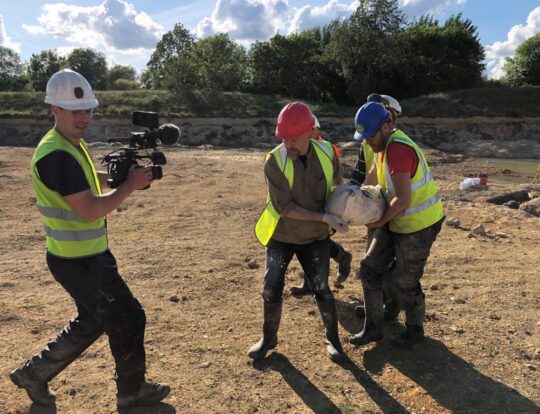
Jamie films the mammoth tusk being carried to safety

Archaeologists lifting the mammoth tusk
What was the most surprising thing you learned?
Did you know about those legends from Siberia? When they started finding mammoth bones, they thought they were underground burrowing creatures. How terrifying would it be to live your life thinking those remains were some gigantic horned terrifying underground horrible thing.
Ugh. Just imagine! And had you ever made an archaeology film before?
I’ve made plenty of factual and science documentaries, but never one about archaeology before. For me, the biggest unknown for me about this film was simply how much digging was going to be in it. I watched Attenborough and the Giant Dinosaur, and Attenborough and the Sea Dragon because they were very similar films to this one – and both surprised me because they had very, very few sequences from the dig sites in them.
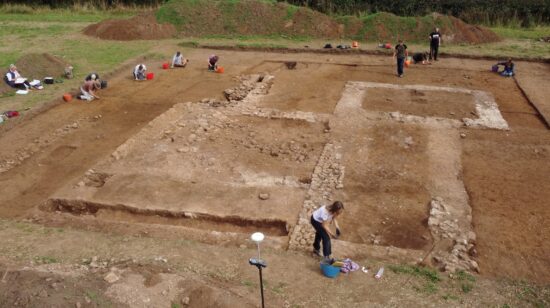
But while I was doing my research, I got really interested in the question of how you guys do it – the process of it all. Basically, I was fascinated by all the same questions you’re asking me now. Where do you start? How do you do it all? I remember on Day One of filming on site you said “We have to put up a drone and map the area”. It’s things like that – the fact that you need to record the site before you even start – that I think is really interesting for people to see.
How did you build the story?
I knew that I had three main areas that I could make sequences about. One was about mammoths, one was about humans, and one was about all the people who are so passionate about understanding them – Sally and Nev, you guys, all the scientists and specialists. We largely stuck to the chronology of how the site was uncovered. There is a natural progression, and a dramatic escalation that works from following the leads as they arise. We have this rhythm in the film of finding something at the dig site, going off to learn a bit more about it, coming back to see what else has been found at the dig site, and going off to learn a bit more about it again, until we build up the big picture.
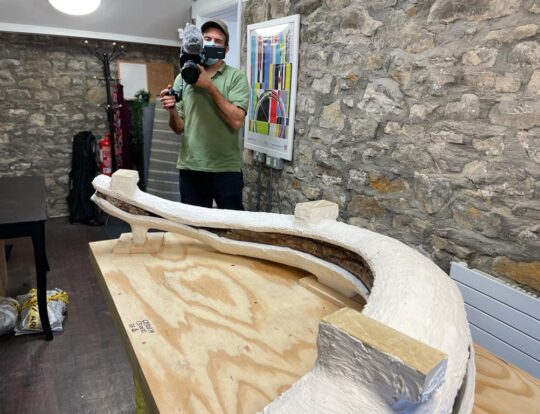
Filming the mammoth tusk in the conservation lab
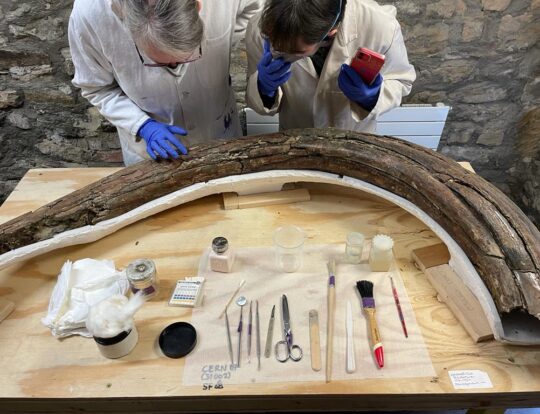
Conservators stabilise the mammoth tusk
What did you find most interesting about this story?
It had never occurred to me before that palaeontologists, the people who look at animals and hang out in the Natural History Museum, are a completely separate group of people from archaeologists, who just look for human stuff and hang out in the British Museum. As an outsider, it seems like at some point in history, somebody just decided to put a massive divide between those two disciplines. To me, the story of this project was all in the overlap; in the Ice Age this distinction becomes almost irrelevant, because the human species are just as much another animal species in the landscape, and you need both sets of expertise to understand them.
Often when you see archaeology on television, it’s sensationalised to try and pull in viewers. How did you manage to tell this story without sensationalising it?
We were so lucky in this one. We had mammoths, and everybody loves a mammoth, and we had Neanderthals. My kids watch movies about cavemen and mammoths! It’s already compelling. Ontop of that you’ve got Attenborough presenting, and he makes everything seem so inherently interesting and captivating. Plus Sally and Nev are so relatable. Who doesn’t love a good story about people who follow their obsession to the bitter end? And it’s not like archaeologists and scientists aren’t obsessed. There’s no substitute for that passion. It makes really great telly!
What is the magic that Attenborough brings to his documentaries?
I always enjoy filming David Attenborough talking to an expert, someone like Nick Ashton at the British Museum. You can see he almost forgot we were filming him, he was just so engaged in what he was being shown. As a filmmaker, you try and create those moments where people forget about the cameras, and it doesn’t happen often. I was over the moon that there’s at least three or four moments in the film where that happens with the whole team. I found myself cheering when Josh told me that you were starting to find flints on the dig!
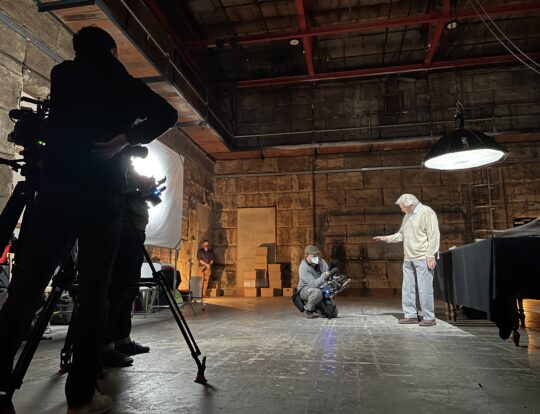
Attenborough estimates the height of a baby mammoth in the studio
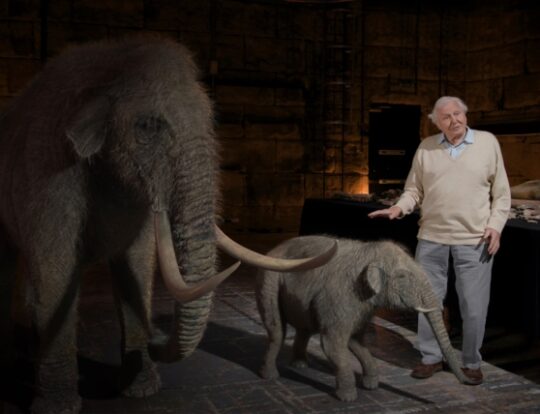
a 3D graphic of a baby mammoth is added in post-production
So part of the magic is being able to capture moments when that realness, the authenticity of it, comes out?
Exactly. That’s the word to use. Because it’s hard having a camera next to you. And it takes time, and not everybody gets used to it. I was kind of hoping for that, and it was a nice surprise when it happened.
Why do so many filmmakers struggle to film archaeology in action?
I think what’s different about archaeology is that it’s not a ‘normal’ science, and that you can’t really control any of it. I had no control over how much you would dig, what you would find, what the weather would be like, what you would or wouldn’t be able to do. I’ve never been in that situation before, of not knowing whether the film was ultimately going to be about mammoths, or humans, or whether we were going to film over one season or two.
I was lucky that whatever happened on the dig, we already had the I knew that I would have at least one hand axe to bring into the studio to tell human story, and that we had several mammoth bones and likely a couple of other species, to tell the animal one.
The real wildcard was how much of the dig process I’d actually be able to include, and it really comes down to a question of budget. How much money was I going to I throw at putting cameras around the dig? Looking at other films, for the hours you spend on site, you don’t really get that many minutes of television. You have to be really committed.
How did you overcome that?
It’s a huge trade off. I knew that if I went in light, I would miss stuff and get weaker sequences that probably wouldn’t make the final cut. But if I went too heavy the other way, I might get loads of good pictures, but if nothing really happens, then they’re not going to make the cut either.
In the end I plumped for a middle route and picked up a camera myself, which I haven’t done for a while. And then I just hung out with you guys!
I wanted to try and capture little stories, little insights, about the process, which would be interesting for the viewers, like the fact that you have to map and record the whole area before you even start. Or the boreholes, which gave a very real insight into the fact that there was a river, probably the River Thames.
So I just kind of sat there with a camera and filmed what I could, and brought in a proper camera operator for a few specific events.
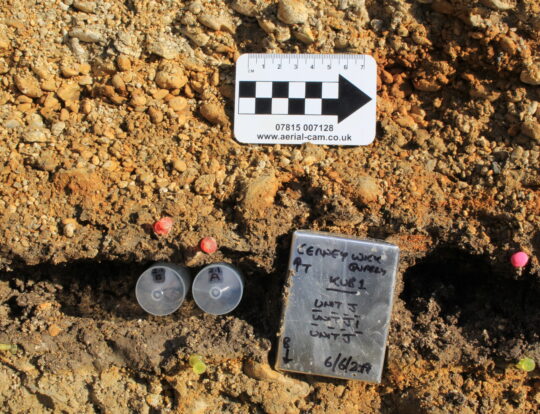
The scientific process becomes a key part of the story
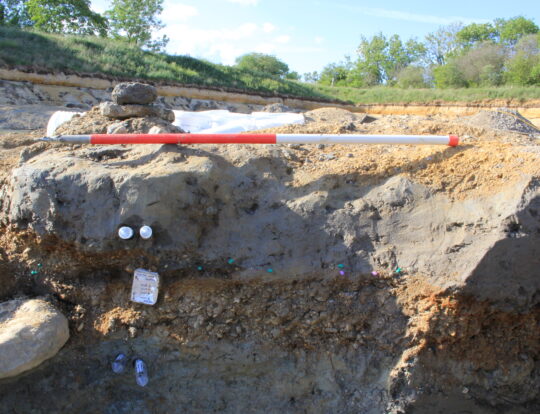
Stratigraphy reveals an ancient riverbed from the River Thames
What do you hope this film does for archaeology?
I hope that people will come away with more of an understanding of the process of archaeology than they do from other films. We largely stuck to the chronology, and there is a natural progression, and a dramatic escalation that works, partly because you find the flint quite late on in the process. We have this rhythm in the film of finding something at the dig site, going off to learn a bit more about it, coming back to see what else has been found at the dig site like, go off and learn a bit more about it, until we build up the big picture.
What’s the one thing you want to tell other archaeologists about what it’s like to make programmes like this?
Like many scientists, archaeologists have trust issues with misrepresentation in the media, if it’s a company with a track record like Windfall, where you can see the films that they made in the past, I’d say trust us. We’re fortunate enough to work in factual filmmaking, so we aren’t trying to expose anyone.
Yes, we do sometimes want to film things going sideways but only in the sense that it allows us to show the intelligence, the creative thinking that people have to deploy, whether it’s engineers, or scientists or archaeologists, to solve those problems. But we’re on your side. The sooner in the production process that collaborative trust emerges, the better, especially on a film like this.
And are we going to see you out digging with us anytime soon?
I’d love to join a dig! I find it very frustrating just sitting watching. I think on the first dig we filmed, I definitely put the camera down and helped with the wheelbarrows for a little while. As a filmmaker, you do sometimes feel that everybody else is doing the real work and you’re just there taking pictures.
Attenborough and the Mammoth Graveyard is available on BBC iPlayer. DigVentures would like to thank Windfall Films for sticking with the project and being so careful about the science and the quality of the story. We think they deserve a huge round of applause! It was one of the best experiences we’ve ever had with a production company.



There are no comments on this post yet. Be the first!