Wherever you go, you can be sure that someone else was there hundreds or even thousands of years before you. There are incredible ancient places hiding all around us. Let’s go find them!
Ringheiligtum Pömmelte (Ring Sanctuary of Pömmelte) is a 115 metre diameter timber circle or woodhenge in Saxony-Anhalt, first discovered in 1991 when it was spotted from a plane with aerial photography. The henge in Central Germany is located near the village of Pömmelte, about 85 miles (136 kilometers) southwest of Berlin.
Excavated by a team from Martin-Luther University in Halle-Wittenberg, the site dates to 2250 BC and was in use for about 250 years. Evidence from recent excavations at the Pömmelte enclosure suggests that, like other circular or henge-like enclosures, it may have been a place for communal gatherings, ritual activities and performance, with significant solar alignments.

Archaeologists believe that sunrises and sunsets played a central role in the rituals in Pömmelte and Stonehenge

The full extent of Pömmelte can be seen from the air

It may have been used communal gatherings, ritual activities, and performance, with a recently discovered residential area

Numerous finds prove that the site near Pömmelte was used for 250-300 years

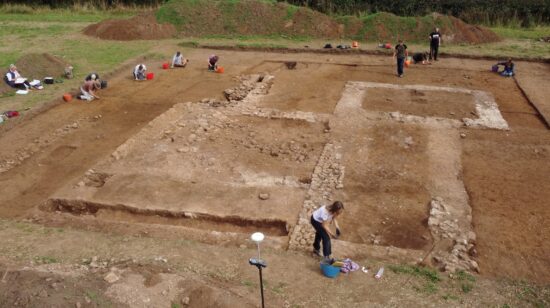
The site continues to be investigated by archaeologists at the Martin-Luther University in Halle-Wittenberg
Comparisons to Stonehenge
Whereas researchers have known about Stonehenge for centuries, archaeologists only became aware of Germany’s henge in 1991, when people flying on a plane over the site noticed it.
Now widely dubbed ‘Germany’s Stonehenge’, the sanctuary’s wooden posts were once arranged in several concentric circles, the largest measuring about 380 feet (115 meters) across, meaning that Ringheiligtum Pömmelte was slightly larger than Stonehenge, which extends just over 330 feet (100 m) in diameter.
While Stonehenge holds ancient cremated burials, archaeologists have found more macabre burials at the German site, including burials holding the broken bones of children, teenagers and women, who may have been brutally killed as part of human sacrifice rituals, according to a 2018 study published in the journal Antiquity.
17 circular sacrificial holes/graves were found, one of which contained various offerings and remains of bodies. Just outside of this, the grave of a chieftain was found.
More recently, archaeologists have also also found evidence of residential dwellings, which means that the site might not be as gruesome as some news articles make out: people also called this site home.
Living at the Ring Sanctuary of Pömmelte, or Pömmelte Henge
The archaeologists unearthed the remains of two houses, as well as 20 ditches and two human burials during excavations that began in May. Encouraged, they continued to dig and found more houses, bringing the total to 130 dwellings discovered at the site.
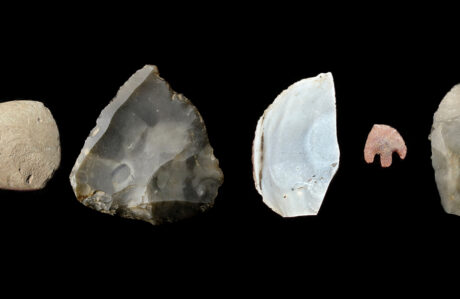
Excavators also previously found axes, drinking vessels, butchered animal bones and stone mills known as querns buried at the German site, according to the Antiquity study.
However, the new find is the first instance of a residential zone at the site, which dates from the late Neolithic period (late Stone Age) to the early Bronze Age, or from about 2300 B.C. until 2050 B.C., when it was destroyed.
The site opened to the public in 2016, and is one of several stops along a history trail in Saxony-Anhalt, including one at the Arch of Nebra, which are said to show areas where people stopped to observe the heavens thousands of years ago.





There are no comments on this post yet. Be the first!