
Aerial view of Sigiriya Rock, Central Province, Sri Lanka. Credit: Binuka Poojan, used under a Creative Commons License.
Wherever you go, you can be sure that someone else was there hundreds or thousands of years before you. There are incredible ancient places hiding all around us. Let’s go find them!
In the heart of Sri Lanka’s beautiful natural landscape lies a hidden wonder. The ancient rock fortress of Sigiriya stands proud, 200 metres above the surrounding jungle, and is considered a wonder by both locals and visitors alike: and it’s not hard to see why!
Nestled in a region that has been home to Buddhist monks as far back as the 3rd century BC, Sigiriya boasts exciting engineering, art and fortifications that have made it one of the most important urban prehistoric sites in the world.
The clifftop citadel was both a palace and a fortress. Built in the first millenium, during the reign of King Kashyapa (AD 477 – 495), it is home to a mighty palace, grand gardens and impressive defensive structures.
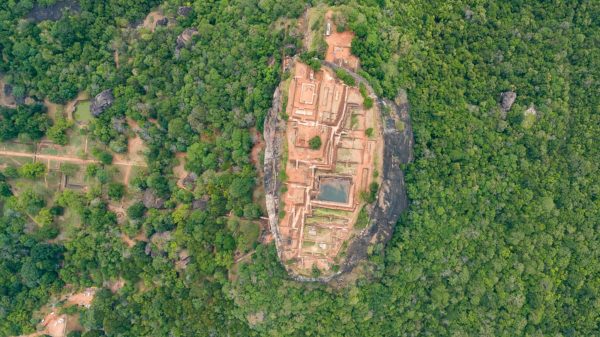
Sigiraya rock from above. Credit: Dronepicr. Image used under a creative commons license.
One of the most remarkable structures has to be the gatehouse: carved into the rock and shaped like a massive lion, this was the main feature of Sigiriya in its time and even inspired the name of the site – ‘Lion Rock’. Sadly, the head of this grand guardian collapsed many years ago.
The site was first investigated by archaeologists in the late 19th century after it was stumbled upon by soldiers of the British army. Even then, archaeologists were wowed by Sigiriya’s complex urban planning.
Designed to incorporate the natural form of the rock, its builders blended symmetry and asymmetry to create a site so beautiful and advanced, that thousands still flock to it today.

Frescoes at Sigiraya photographed in 1970. Credit: Schnobby. Image used under a creative commons license.
But that’s not all that this unique site has to offer. The western face of the rock – which measures a whopping 140m across and 40m high – is entirely covered in frescoes.
This historic art gallery depicts hundreds of women, whose identities we can only guess at, celebrating female beauty. These frescos don’t mark the end of Sigiriya’s graffiti, however, as a feature known as the ‘Mirror wall’ (due to how highly polished it was at the site’s prime) is filled with verses written by the visitors who sought out this site, dating back to the 8th century AD.
The blend of nature and human innovation really make this site special. Who could say no to joining all those who have explored this site over the ages? A place like this really connects us to our human past and is the perfect addition to any history lovers’ bucket list.
Archaeology in your inbox?!
Want to join a dig? Learn more about archaeology? Join our email list for a monthly digest of our most popular stories, plus alerts for any digs, events, or courses you can join.
Join the list
Written by Georgina Cole
Ginny is a Community Archaeologist with DigVentures and Durham University graduate. She has a passion for speaking to the public and she especially loves gender archaeology and forensics. In keeping with archaeological tradition, when she isn’t in the trenches you can often find her grabbing a pint at the local pub!


.jpg)

Comments (4)
A good article.Everyone who would like to explore ancient technology should go to Sigiriya Lion Rock.It is a good symbol of Sri Lankan ancient technology.The water fountains are still working.I’m an eye witness of that. I went to Sigiriya last December and it was an amazing experience.
How does one access it?
I 💚 Sigiriya!! My mother is Sri Lankan and I’ve been lucky to have visited Sigiriya several times over the years. I’d love to go back to Sri Lanka sometime soon as I haven’t been since around 2009 I think 💚🇱🇰💚
Quality articles or reviews is the crucial to be a focus for the
visitors to pay a visit the site, that’s what this
web site is providing.