
Archaeologists have made some amazing discoveries at Bouldnor Cliff
Grab your snorkel, because we’re going down to take a look at the ancient remains lying on the seafloor.
From ancient hunter-gatherer villages to vast and wealthy cities, underwater archaeology is as expansive as the ocean itself. But if one thing’s for sure, it’s as exciting as it is hazardous, and can answer questions that simply can’t be found on dry land.
We’re going to be following Garry Momber on his journey to rescue what’s left of an 8,000 year old village. To tide you over while he and his team wash out their wetsuits, top up their tanks and polish their underwater trowels, let’s take a look at some of current favourite underwater sites, starting with Garry’s…
1. Bouldnor Cliff, Isle of Wight (8,000 years old)
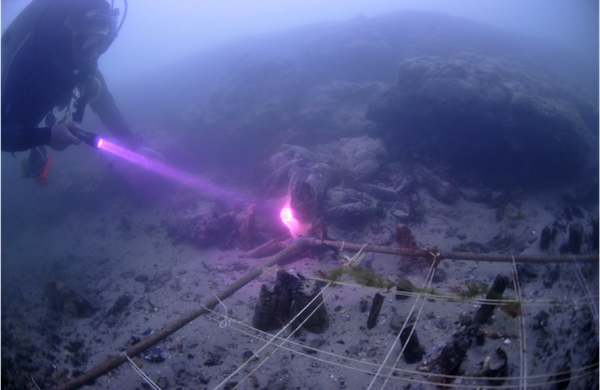
An archaeologist dives at Bouldnor Cliff. Image via Maritime Archaeology Trust
Submerged 11 meters below the Solent, just off the Isle of Wight, this site was only discovered when a lobster was spotted chucking stone worked flints from its burrow. Back when this site was inhabited, humans would have been able to walk from France to Britain, but flooded as sea levels rose. Archaeologists investigated, and have since found some amazing artefacts, like the oldest piece of string, and evidence of wheat previously not through to have arrived in Britain for another 2,000 years. At 8,000 years old, it’s the only Mesolithic village from this now-submerged area that we currently know of.
2. Area 240, Doggerland, North Sea (10,000 years old)
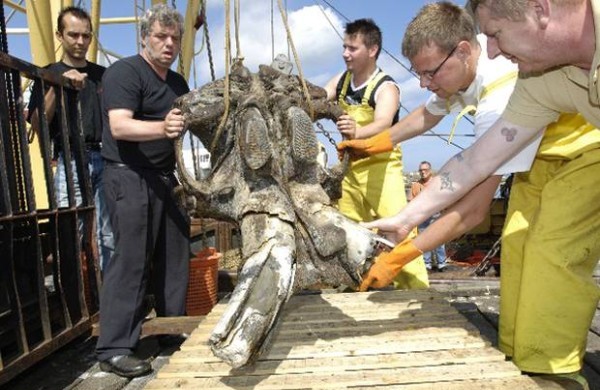
Archaeologists at Doggerland haul a might mammoth skull ashore. Image via BBC
Doggerland is the area that used to connect what we now know as Britain to the rest of the European continent. After the last glacial maximum, Doggerland slowly disappeared as sea levels rose, and now lies beneath the southern part of the North Sea. The area lost was actually bigger than the UK, so there’s a huge amount to explore and vast potential given that the totally water-logged environment makes for some pretty well preserved artefacts. Of particular intrigue, is a section of Doggerland known as Area 240, found off the coast of East Anglia. In 2008 nearly 90 palaeolithic artefacts, including hand axes and the bones of woolly mammoth were found in The Netherlands, having been dredged up from this site. A site level excavation was carried out and further samples were taken from the seabed. It had previously been thought that very little from this time period would have survived, but Area 240 completely blew that idea out of the water!
3. Langstone Harbour, Portsmouth (1,500 years old)
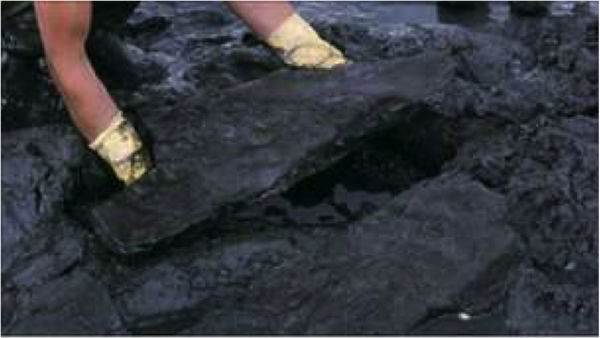
Recovering finds from the thick Langstone Harbour mud at low tide. Image via BBC
The great thing about Langstone Harbour, is that some areas are only tidally submerged, meaning that at certain times, they’re exposed, making it somewhat easier for archaeologists to access and excavate there. In 2003, two local enthusiasts looking for flint tools made an incredible discovery amongst the mudflats of the area; an early Saxon log boat was uncovered. It’s the oldest watercraft known to have been found in the area, and was remarkably well preserved, with the tool marks still visible where the tree has been hollowed out.
4. The Severn Estuary, West Country (12,000 years old)

Surveying in the Severn Estuary at low tide. Image via archaeoleg
The Severn Estuary spans a huge area, and archaeological projects in the area involve archaeologists from multiple counties across the West Country and Wales. The area is known to have been in use by humans for at least 12,000 years, but there is archaeological interest spanning right the way through until the 20th century due to its strategic positioning during war time. There are ancient forests submerged under the intertidal muds, which have produced some incredible Mesolithic findings, such as wooden tools, flints and even evidence that Mesolithic people were deliberately burning woodland to create new spaces for cattle to graze. At other sites in the estuary, Neolithic human footprints have been found preserved in silts, like those pictured above.
5. Oakbank Crannog, Loch Tay, Scotland (2,500 years old)

Oakbank is amazing above water as it is underwater! Image via crannog.co.uk
Crannogs are Iron Age dwellings found in Scotland and Ireland. They are built on loch sides (or lake sides), and sometimes even on estuaries. The Crannog at Oakbank has been excavated over the course of many sessions between 1979 and 2005, and radiocarbon dating from the timbers found give the site an approximate age of 2,500 years. The structure of the crannog was incredibly well preserved, and gave enough evidence to create a reconstruction on the south bank of the loch. This reconstruction (pictured above) is now part of an educational centre run by the Scottish Crannog Centre, and is well worth a visit.
6. Thonis-Heracleion, Egypt (1,200 years old)

Archaeologists deep under the sea at Thronis. Image via ScubaNews
Some of the most fascinating underwater archaeology is found in the Mediterranean and Thronis-Heracleion is no exception. Referred to in a handful ancient texts and inscriptions, it was though that the city had been lost, or even had never really existed at all, but that was all changed when the ancient city was rediscovered by Frank Goddio in 2000. Since then, huge efforts have been put into retrieving important artefacts that can tell us enormous amounts about trade between Egypt and the rest of the Mediterranean. A number of artefacts are at the British Museum for a temporary exhibition of underwater archaeology of Egypt this summer.
7. Arles, France (2,000 years old)

Roman boat. Image via National Geographic
In 2011, an almost completely in tact 102 foot-long Roman barge was found at the bottom of the Rhône river of Arles. Thought to have been a trading vessel, this boat would have been used by Romans to carry merchandise for commerce. Nearby, archaeologists found a marble statue of the god Neptune; fitting for an underwater archaeological site!
Archaeology in your inbox?!
Want to join a dig? Learn more about archaeology? Join our email list for a monthly digest of our most popular stories, plus alerts for any digs, events, or courses you can join.
Join the list
Written by Harriet Tatton
Harriet is one of DigVentures' community archaeologists. She loves museums, skeletons, and a good cup of Early Grey. Her first dig was at Bennachie, in Aberdeenshire, and since then she's never gone digging without her signature flowery wellies.




Comments (4)
uhm , Thonis Egypt is older than 1200 years old …
Hello.This post was extremely remarkable, especially since I was browsing for thoughts on this subject last couple of days.
Yay google іs my queen helped mе to find this outstanding
website!
An impressive share! I have just forwarded this onto a friend who has been
doing a little homework on this. And he actually ordered me dinner simply
because I stumbled upon it for him… lol. So allow me to reword this….
Thank YOU for the meal!! But yeah, thanks for spending time to
talk about this subject here on your website.