 With the wealth of war letters and literature now readily available online, it is easier than ever to reconstruct the detailed lives of our heroic ancestors.
But with an estimated 100,000 soldiers still unidentified or lying in unmarked graves (of the eye-watering 8.5-10 million soldiers believed to have died) there are obvious limits to our traditional techniques. For today’s #WWWednesday post, Sarah Ashbridge, Forensic Archaeologist, describes some recent studies using DNA evidence to help us find out more about this army of unknown warriors.
Even though 2014 marks the centenary of ‘the world to end all wars’, the remains of soldiers are still being recovered from the former WW1 battlefields of northern Europe. To help increase our chances of confirming their identity, archaeologists have been drawing on the latest advances in forensic sciences and DNA analysis, with the ultimate hope that these long forgotten heroes will one day be laid to rest in named graves.
The Fromalles Project, a collaboration between the Joint Australian Army and United Kingdom Ministry of Defence, is one such endeavour. The project began in 2006, when a study of aerial images confirmed the presence of a mass grave at the edge of Pheasant Woods, Fromelles, France. Excavations began shortly after, resulting in the discovery of a total of eight pits, leading to the excavation of the bodies by Oxford Archaeology in 2009. The remains of 250 Australian and British soldiers were successfully exhumed during fieldwork. As of 2010, 75 bodies have been positively identified, with an active programme to identify further soldiers’ until the end of 2014. But how exactly do they do it?
Crime Scene Investigation

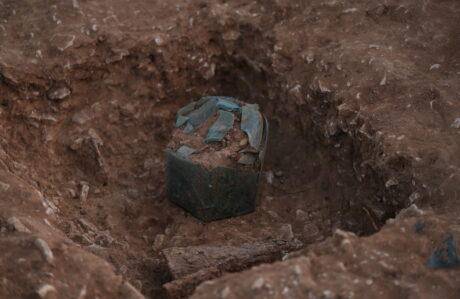
Talismans dug from the mass burial site at Fromelles, France. The one on the left was identified as belonging to Tim Whitford.
To decipher the identity of unknown soldiers, it’s necessary to combine a range of techniques . After the initial excavation, the remains were carefully removed from the scene to allow forensic examination including x-ray, photographs and meticulous documentation. Personal belongings are always a useful starting point for identifying human remains, and in World War One, soldiers were required to wear an identity disc (also known as a dog tag). By 1918, this had evolved into two tags, one red tag to be returned to headquarters, and one green tag to be left upon the body. These tags were created from fibreboard, and unfortunately were easily moved or destroyed in the heat of battle. Other items such as buttons or boots are also diagnostic, and can be compared with military records to discover which regiments were in the area at the time, and which soldiers were declared missing in action.
Forensic Science
This is all well and good, but to discover more than just the nationality of the solider, historical records must be used in combination with the finer grained techniques of biological anthropology, isotope geochemistry, DNA analysis, and conservation science. Examination of the skeleton by a trained anthropologist can help us to determine factors such as height, gender or age of an individual, and if at all possible, DNA can also be obtained from small samples of bone. Once processed, these strains of DNA can be examined to trace maternal or paternal bloodline, resulting in positive identification of those fallen in the Great War.
As with the DNA analysis proving the identity of Richard III, the results of this process are dependent on the provision of DNA samples from living family members to allow for comparison. Genetic samples have been taken from all 250 men buried at Pheasant Wood, however not all can be successfully identified as families of the deceased also have to provide a DNA sample for comparison.
It’s a sobering thought, but if you are inspired to research your World War One family history, you may find that you yourself are the final piece of missing evidence that can finally lay these unknown soldiers to rest.
Archaeology in your inbox?!
Want to join a dig? Learn more about archaeology? Join our email list for a monthly digest of our most popular stories, plus alerts for any digs, events, or courses you can join.
Join the list
Written by Sarah Ashbridge
Office monkey by day, forensic archaeologist by night, Sarah Ashbridge is a jack-of-all-trades and the master of one: the forensic identification the War Dead. She trained originally as an Egyptologist, but interests in the history of death and burial saw her make the step into archaeology, completing an MSc in Forensic Archaeology and Crime Scene Investigation at the University of Bradford. Armed with an ever-increasing library of books, a handful of illustration pens and a brand new trowel, Sarah writes our regular #WWWednesday column, working towards her PhD in Forensic Archaeology.


There are no comments on this post yet. Be the first!