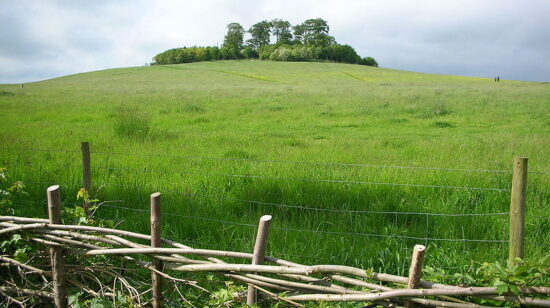
St David’s was clearly the focus of substantial ecclesiastical activity in the 1st millennium AD. The presence of a substantial assemblage of early medieval carved stone are testament to the importance this site held from the 7th century onwards. In the 10th and 11th centuries AD it suffered a series of Viking attacks. Although the current site is primarily of Norman and later planning, the possibility of the survival of earlier medieval features had been raised and geophysics has been completed on Chanters Orchard to the south-west of the cathedral.
The results reveal a lot of activity with intriguing features potentially relating to earlier enclosures, a potential boundary wall and features associated with the nawdd (zone of sanctuary).
This large early medieval circular enclosure around possibly a 5th or 6th century precursor to the ecclesiastical site at St David’s.
This site is potentially an early medieval church enclosure.
The names suggest an early medieval burial ground which has already produced graves of early medieval date.
The name means ‘the chapel of the old cemetery’ which implies an earlier medieval or early medieval phase of activity at the site.
This site is a possible predecessor of the later ecclesiastical site at St David’s defined by an enclosure with fragments of medieval floor tile.
Founded at the turn of the 7th century by St Aidan, also known as St Máedhóg (who died in 624), he was reputed to have been a pupil of St David of Wales. There are three plain granite crosses and a cross slab that testify to the earlier origins of Ferns. Diarmait MacMurrough King of Leinster reputedly died at Ferns in 1171 and the broken fragment of a decorated high cross in the graveyard is said to mark his grave. Ferns was later known as St Mary’s Abbey and that field contains the probable early monastery and monastic enclosure that have been already been targeted for excavation by the Irish Archaeological Field School and geophysics will help with the excavation targeting.
This site is probably an early monastery with an oval ecclesiastical enclosure consisting of an inner and an outer enclosure.
This site appears to be an early ecclesiastical enclosure with a tradition of being an early church site.
Kilmyshall is the site of an early church, graveyard and holy well in an oval enclosure.
Follow the latest archaeology action from our Ancient Connections sites as it happens.
Sign up to discover opportunities to get involved in archaeology - in your area, and beyond!
Easy opt-out at any time - Privacy Policy
See all the archaeology digs, talks, festivals and other events coming up at DigVentures
Learn more about digging up the past and have fun while you're doing it!
We're connecting people who love archaeology, with opportunities to do archaeology.
Find projects you can be part of or follow all the archaeological action with our Live Updates ›
Archaeology experiences and other perfect presents for people who love the past.