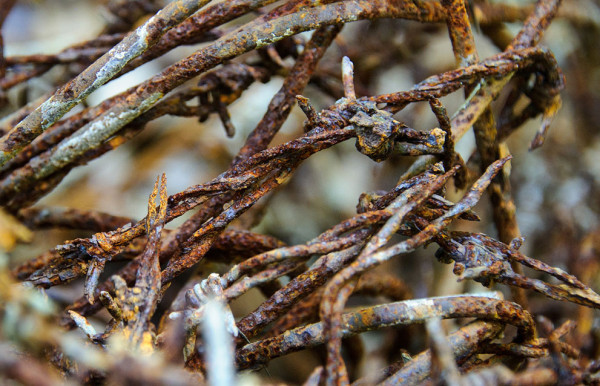
100 years on, rusting barbed wire sits near the kilometer zero (zero mile marker) of the WWI front line on the Swiss-French border (via theatlantic.com)
Enough’s enough. Here’s what we really need to be thinking about 100 years after the start of World War One.
Am I the only person who has had heard and seen more than enough about the start of the First World War? My problem has been with the nature of the coverage, which I have found insubstantial, ephemeral and uncritical of the systemic roots of the war itself.
There has been a certain amount about the horror of the trenches and the extent of what was the first major exercise in industrial-scale slaughter (the earlier, smaller-scale example was the American Civil War, especially in its later stages, where the death-toll was obscene).
There has been quite a lot, too, about the political machinations leading up to the Declaration of War. But there has been very, very little about the underlying social tensions and pressures which were starting to unsettle most European nations, but in diverse ways.
Yes, I can understand why we should be interested in how celebrities’ ancestors coped with the Great War, and I think it’s interesting to see how towns, villages and defined communities coped with the terrible casualties that were inflicted, often within a few days or even hours – if, for example, a local ‘Pals’ unit went over the top together. BUT, but, but…
My problem is that I don’t think we’re treating the Great War with sufficient intellectual rigour. Yes, there’s lots and lots of tearful, slightly sentimental, poppy-laden emotional ‘respect’. And I can understand that – even if I find some of it a bit staged and insincere. A hundred years is, when all is said and done, a very long time ago.
As an archaeologist I’m interested in processes of change. I’m less concerned with one-off events. I’m also fascinated by what one might call the ‘bottom-up’ approach to the past, rather than the ‘top-down’, event-led political version of British history, that is still taught at so many British schools.
It’s not the individual events themselves that matter: it’s the way they evolve and give rise to other, connected events, as part of a longer, larger process that interests me. And it strikes me that the current approach to the Great War is heavily biased in favour of an event-led and very short-term approach.
The trouble is, that this way of telling history is also short-sighted. It skates over the surface and doesn’t seek the real lessons: the bigger picture. It seems to me inconceivable that we should be discussing the origins of the First War, without also considering the Second. The two conflicts are intimately linked.
Indeed, one could say that WW2 continued much of the unfinished business started in 1914-18. And if we are to take such a long-term view of the 20th century, mightn’t it also be a good idea to draw a few lessons and think about our own time?
Yes, social relations changed in response to the First World War, a great deal of respect was lost for class structures. Of course, snobbery wasn’t abolished over-night, but there was a huge contrast in the way British society was organised in Edwardian times, when compared with the Jazz Age of the 1920s.
But isn’t the ever-widening gap between the top and bottom of society, which is such a feature of the Western World in the early 21st century, a major cause for concern? Wasn’t growing social disparity one of the factors that led to both World Wars?
Archaeology in your inbox?!
Want to join a dig? Learn more about archaeology? Join our email list for a monthly digest of our most popular stories, plus alerts for any digs, events, or courses you can join.
Join the list
Written by Alan Cadbury
Commercial archaeologist with a flair for forensics, Alan Cadburry's currently working on a book on Bronze Age settlement and land-use. Oppinion's are his own - but you can have 'em!


Comments (2)
A well-known argument as well is attributed to a crumbling Prussian/German empire which because they were late and not prominent in the Colonial world,and so, they invade Europe? I agree with you, not many of the stuff I’ve read (which I admit is not immense) have had a satisfactory analysis of the long-term processes that generated the circumstances for a global conflict like WW1 (and WW2). There were previous conflicts between colonial powers. It is an emotive event and chapter of history, yes, but if we want to understand them (and stop them repeating themselves) then we ought to distance ourselves a little and be critical. Disappointing coverage indeed.
Two comments, as someone who engages in Great War conflict archaeology, I don’t have a problem with the personal strand of the coverage, which looks at individuals because my experience is that this is what we do very well in contemporary and conflict archaeology. Secondly, I don’t think 2014 is the time to be thinking about the origins of WW2, in 2018/19 (helpfully also the anniversaries of Munich and then the outbreak of WW2) there should be that debate but now, we should think about the way we can see immediate change, whether that’s in the Front Line in Belgium, or in training, both areas of research for me, or, for example, in the changes to factories to allow the mobilisation of female labour. I do note that Mr Farage has been commenting on the origins of 1939 already, claiming a view put forward by Pershing and Foch and claiming it as his own.