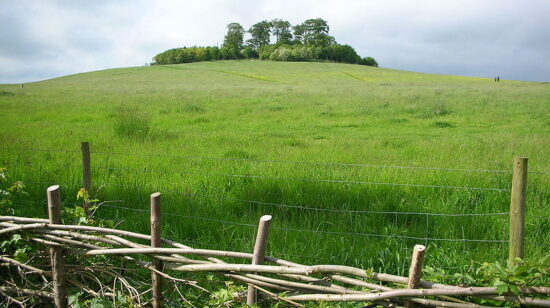
In June 2025, our Venturers returned to Wittenham Clumps to uncover more of the Iron Age and Roman settlement at the foot of this iconic landmark. What we found, from a surprisingly large, multi-storey Roman building to the carefully buried remains of a beloved Iron Age dog, exceeded all expectations.
Read on to discover what we learned about the families who called this place home, and how you can join the team in 2026.
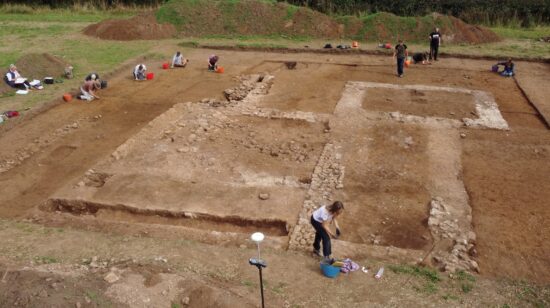
Our archaeological journey began here in 2018 ahead of planned improvements around the Earth Trust charity’s visitor centre. These early excavations revealed a previously unknown Iron Age and Roman settlement, including the remains of a large Roman building that we believe to be a farmhouse. This discovery, along with the artefacts uncovered, began to tell the long-hidden story of a Romano-British family, living and working here during the 3rd and 4th centuries AD.
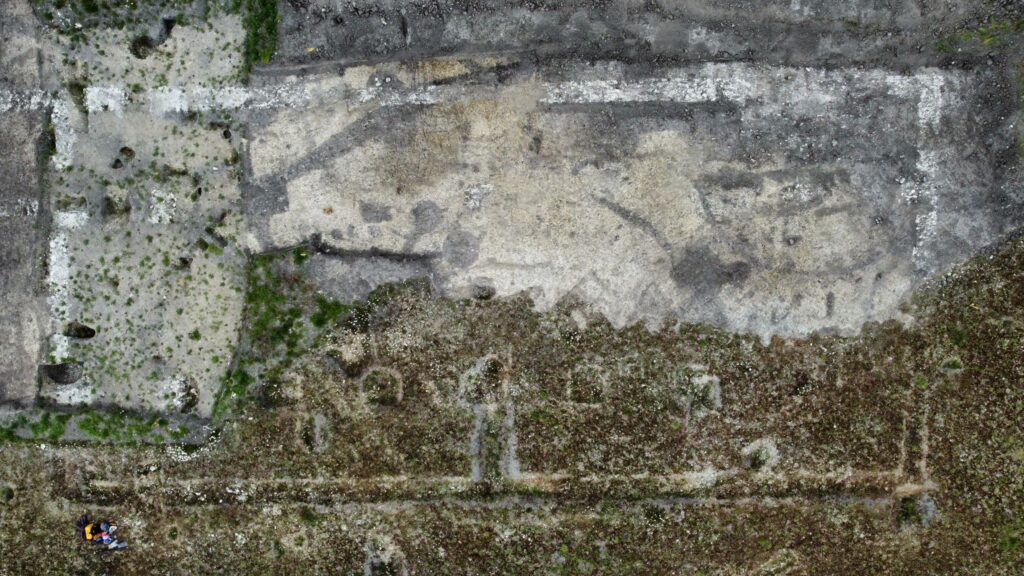
Aerial view of the Roman building. Credit: DigVentures
Among the finds were deeply personal objects, including a toilet spoon, a child’s bracelet, a complete Roman bowl and even the remains of a small pet dog. Together, these fragments offered an intimate glimpse of life here, and only begin to hint at the people behind the archaeology.
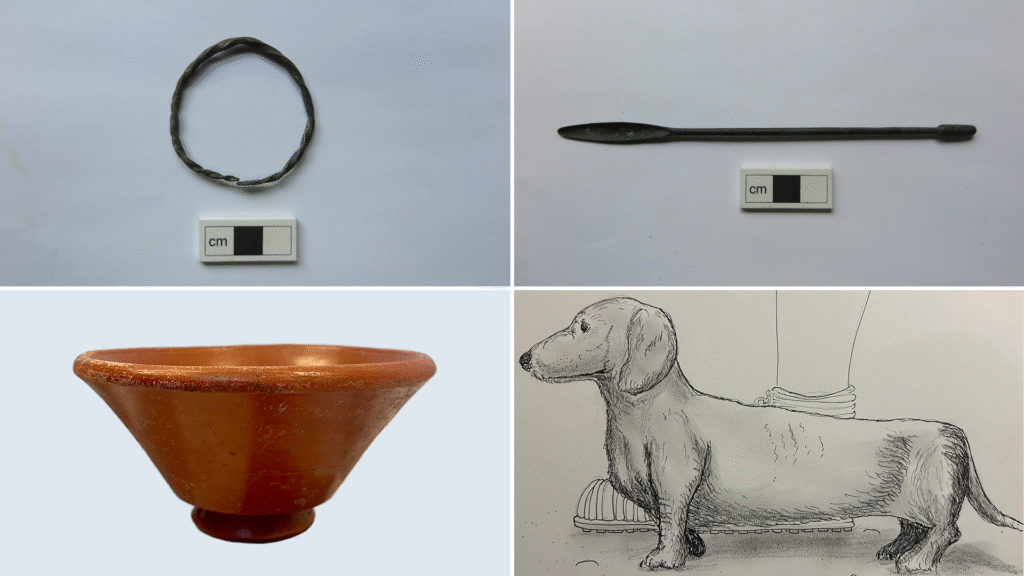
Finds from our previous excavations at Wittenham Clumps. Top left: Child’s bracelet. Top right: Toilet spoon. Bottom left: Roman bowl. Bottom right: Illustration of the pet dog based on the remains we uncovered. Credit: DigVentures
Beneath the Roman building lay an earlier Iron Age village, featuring storage pits, postholes and refuse deposits that reveal domestic and agricultural life during the transition to Roman occupation. Finds included a whorl, used as a weight on a spindle to turn fibres into thread or yarn, and butchered animal bones, which tell us more about what the community ate, and the animals they kept.
Roman discoveries from 2025
We returned in June year with a clear aim to learn more about the Roman building by mapping its footprint and getting a better understanding of its function, and to dig deeper into the Iron Age settlement beneath it.
This season brought some surprises, as the Roman building turned out to be significantly larger than we’d first thought. With additional rooms and a series of large post pads, uncovered by our Venturers, the structure may have once had more than one floor. Stacked tiles near one corner of the building also suggest a possible arched doorway.
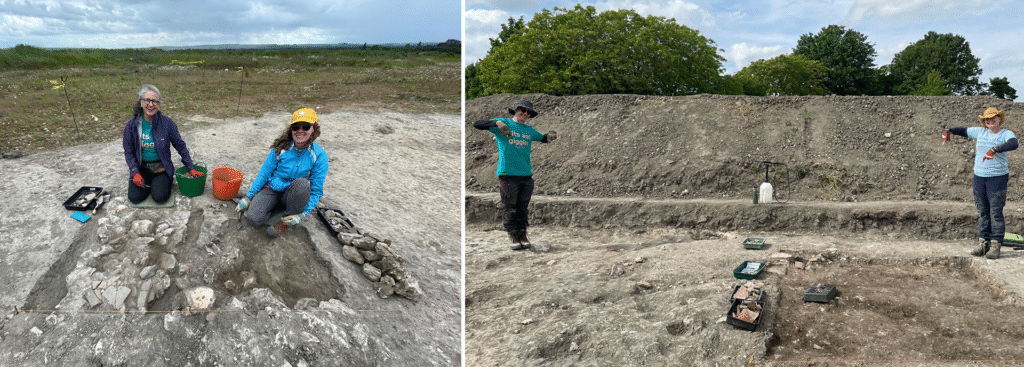
Left: Venturers Rebecca and Catherine excavate a column base. Right: Venturers Peter and Hannah demonstrate the possible arched entrance location. Credit: DigVentures
We can now see that the building had multiple eras of construction, suggesting a long period of use. Excitingly, we found evidence that an earlier phase might have included a hypocaust – a type of Roman underfloor heating system that would have kept the occupants toasty warm during the winter.

Left: Stacked tiles, a possible base for an arched entranceway. Right: A hypocaust tile. Credit: DigVentures
Life beneath the Roman settlement
Beneath the Roman settlement, we uncovered further traces of this Iron Age community, including clusters of storage pits filled with curious deposits – from a carefully placed dog burial, to the remains of two cows and a spindle whorl. Finds like these raise intriguing questions – were these practical deposits, ritual offerings, or something else entirely?
In their first life, these pits functioned like the Iron Age equivalent of a fridge or pantry, storing surplus food and household goods. Once they fell out of use, they were often repurposed, sometimes as rubbish pits or as places for deliberate ritual deposits.
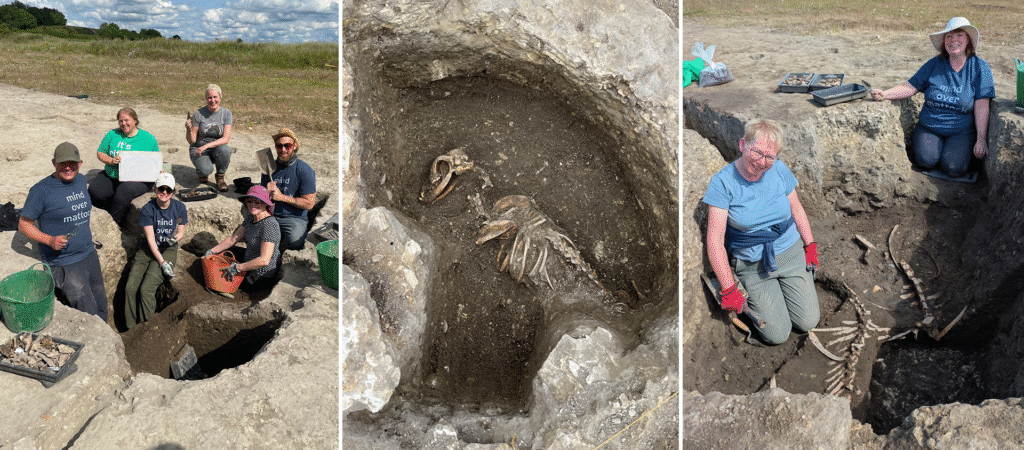
Left: A cluster of pits which yielded a cow skull, a broken quern stone and cooking stones. Centre: An Iron Age Pit with a dog burial. Right: Iron Age pits with cow remains. Credit: DigVentures
One group of closely clustered pits produced what looks like an ancient shopping list: a complete cow skull, a broken quern stone for grinding grain, cooking stones for heating water and a set of spine and tail vertebrae – everything you’d need to make an Iron Age meal.
Another pit revealed the remains of a dog, likely similar in size to a modern Labrador. Bone analysis shows he lived beyond the age of 10 despite breaks and badly healed injuries, abnormal bone growth, heavy tooth wear and a canine tooth worn smooth. Sheep, goat and young pig bones found near his ribcage show his final meals, probably scraps shared with a companion. The care taken in his burial, and the time he must have needed to recover from his injuries, strongly suggests he was cared for and loved.

The remains of the Iron Age dog. Credit: DigVentures
Dig deeper…
Want to explore these discoveries up close? We’ve created 3D models so you can step inside the evidence for yourself. Dive into the Iron Age pit cluster containing two cow torsos, two cow skulls, a spindle whorl, and the storage pit with the dog burial.
Looking ahead
Now, a team of specialists in artefacts and animal bones will examine each find, and we’ll share what they reveal as the story continues to unfold. We can’t wait to find out what else they uncover about the people who lived here, how they interacted with and shaped this land, and the remarkable history hidden beneath this picturesque corner of Oxfordshire.
If you’ve ever wanted to be part of a team making real, ground-breaking discoveries about the past, this is your chance. Support the dig online, or join us in person, and help make nationally important archaeology possible.
Find out more about our dig at Earth Trust later this year, and how you can get involved.



There are no comments on this post yet. Be the first!