Citizen Science, Artificial Intelligence and Earth Observation Data promises to transform nature recovery, but what should we do about the vast quantities of data that these tech-enabled methods produce?
The global challenges of the 21st century have highlighted data’s transformative potential for social good. From pandemic response to climate action, organisations worldwide seek to harness data-driven solutions. Yet the path to responsible data management remains complex, requiring careful consideration of individual and community interests.
Trust in data practices has eroded following high-profile breaches and sharing scandals. The dominance of tech giants using extractive data models has heightened public concerns and limited data accessibility for social benefit, necessitating a fresh approach to data governance.
Deep Time, a platform enabling citizens to map archaeological sites and ecological habitats using satellite imagery and LiDAR, epitomises this challenge. This innovation arrives at a critical moment – UK species have declined 19% since 1970, with one in six facing extinction. To reverse this decline, we need targeted nature recovery investments. However, we lack landscape-level data to identify prime regeneration opportunities or monitor ongoing projects. Satellite imagery and AI could provide insights, but analysing this vast data exceeds technological capability and our professional workforce’s capacity.
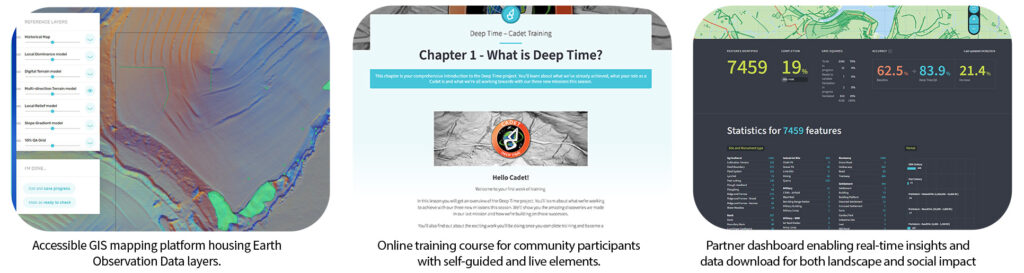
The Deep Time platform provides landowners with crucial landscape data for nature recovery while empowering communities to participate in environmental transformation. Citizens become either ‘Pastronauts’ mapping historic landscape features like shadow woods and ghost ponds that provide blueprints for restoration, or ‘Futurenauts’ identifying prime regeneration spots and tracking recovery progress.
Our results demonstrate significant impact: 1,200 trained participants mapped 4,500 square kilometres of North East England in five months – six times Greater Manchester’s area. Nearly half were newcomers, spanning diverse demographics and often exceeding initial time commitments. The scope of landscape data is comprehensive: from the North Pennines’ 7,430 water bodies across 2,369 km² to Hadrian’s Wall corridor’s 20,826 habitat types across 1,120 km². The Wallington estate contributed 6,456 habitat types across 315 km², while Brightwater Landscape documented 11,646 habitat types across 483 km², and 500 km² on the Northumberland Coast, with all data undergoing rigorous quality assessment.
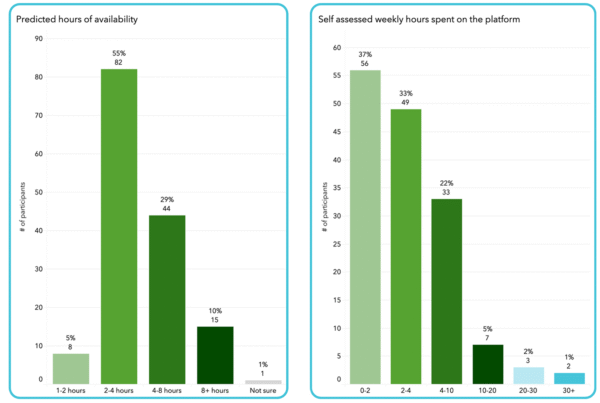
Participant post-mission survey results: self-assessment of contributed hours
Deep Time’s potential to transform nature recovery demands new approaches to data governance that balance public benefit with privacy protection, ensuring responsible data sharing between citizens, governments, and organisations.
Working with Impetus, an EU innovation program, Deep Time has developed citizen-centric governance models for responsible data sharing. Built on data platform cooperative principles, this approach addresses key challenges: validating non-professional data contributions, ensuring diverse participation, democratizing decision-making, and equitably distributing created value. Deep Time offers a pathway toward a citizen-driven digital ecosystem that serves the greater good while protecting individual rights.
As we navigate this technological revolution, institutional innovation must keep pace. The Deep Time model shows it is possible to manage data as a modern commons, balancing the transformative potential of Artificial Intelligence and Earth Observation Data for nature recovery with responsible governance for citizen participation.




There are no comments on this post yet. Be the first!