From Roman pets to children’s items, Roman artefacts uncovered from our crowdfunded dig at Earth Trust in Oxfordshire reveal the details of everyday family life in ancient Britain.
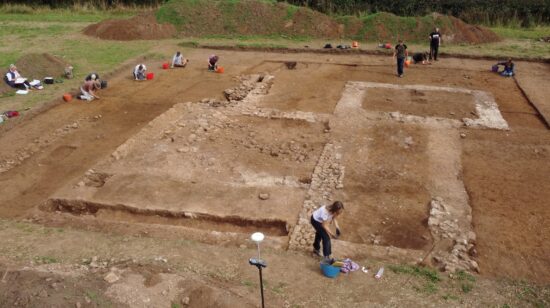
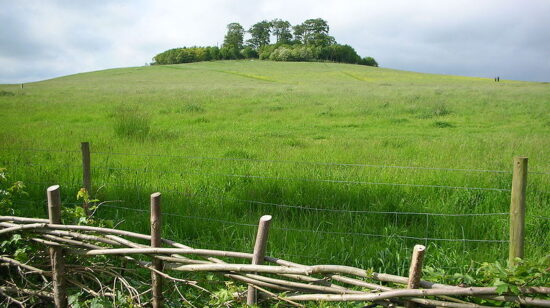
When DigVentures discovered the remains of a Roman villa during excavations next to the Earth Trust visitor centre, at the foot of Wittenham Clumps in Oxfordshire, it began to reveal the story of a Romano-British family who lived and worked the land in the 3rd-4th centuries AD.
Although it’s usually the grand, shiny artefacts that capture media attention, it’s actually everyday items like tools, personal items, and even pets that can really help us to unlock the mysteries of daily life from thousands of years ago.
And these excavations have revealed hundreds of everyday artefacts, as well as a large villa building contructed in a ‘uniquely Romano-British’ style.
From the arrival of the first pet dogs in Britain to whether anyone in the family was literate, and from the gifts they gave their children to how they interacted with the world around them, each artefact we uncover is a clue in an unfolding story.
This isn’t just archaeology – it’s a living story unfolding beneath our feet. And if you crowdfund this year’s dig, you can help us continue to grow the story, explore new areas of the site, and bring ancient history to life.
Here’s what we’ve learned about everyday life from some of the artefacts we’ve discovered so far:
1. A stylus that tells us about literacy
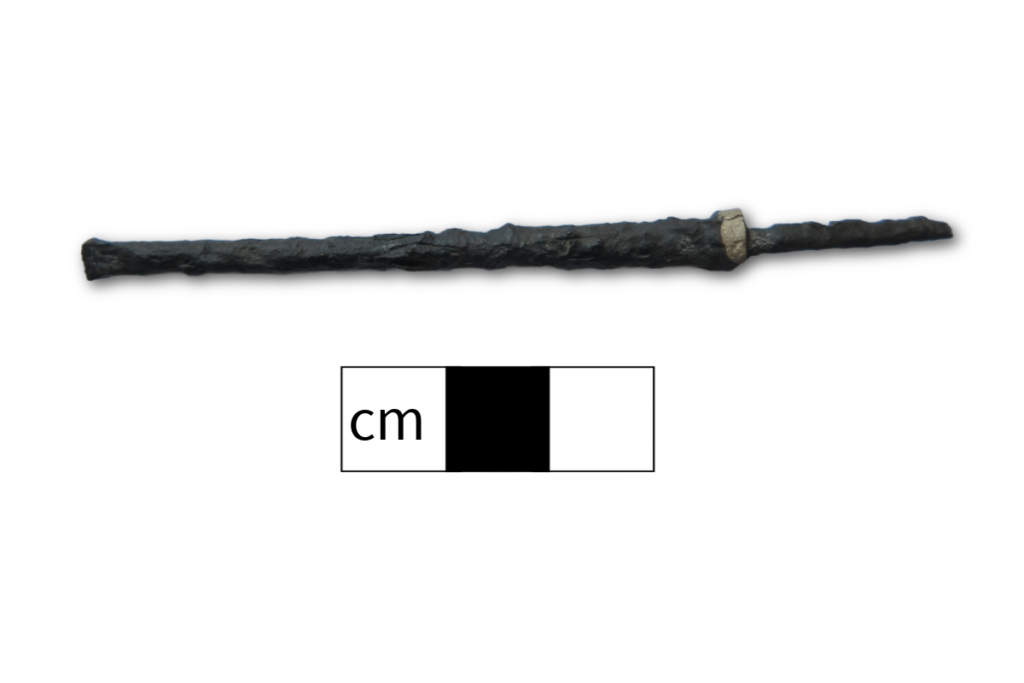
Ancient Roman stylus after conservation (DigVentures)
This ancient stylus was used for writing on a wax tablet – the ancient equivalent of a notebook. A practical object with a bit of flair – featuring a decorative coppery alloy ring around one end that may have been used as a finger rest or to aid with grip. Vitally, this find suggests that someone in the Roman family living here could read and write. What history did this stylus capture in its day?
2. A child’s bracelet

Child’s bracelet, immediately after discovery on site (DigVentures)
This delicate copper bracelet tells a touching story. Originally made for an adult before being cut down in size to fit a child’s wrist – could this be a family heirloom, passed down from parent to child? It’s these small stories found through archaeology that bring the past to life.
3. A toilet spoon or spatula
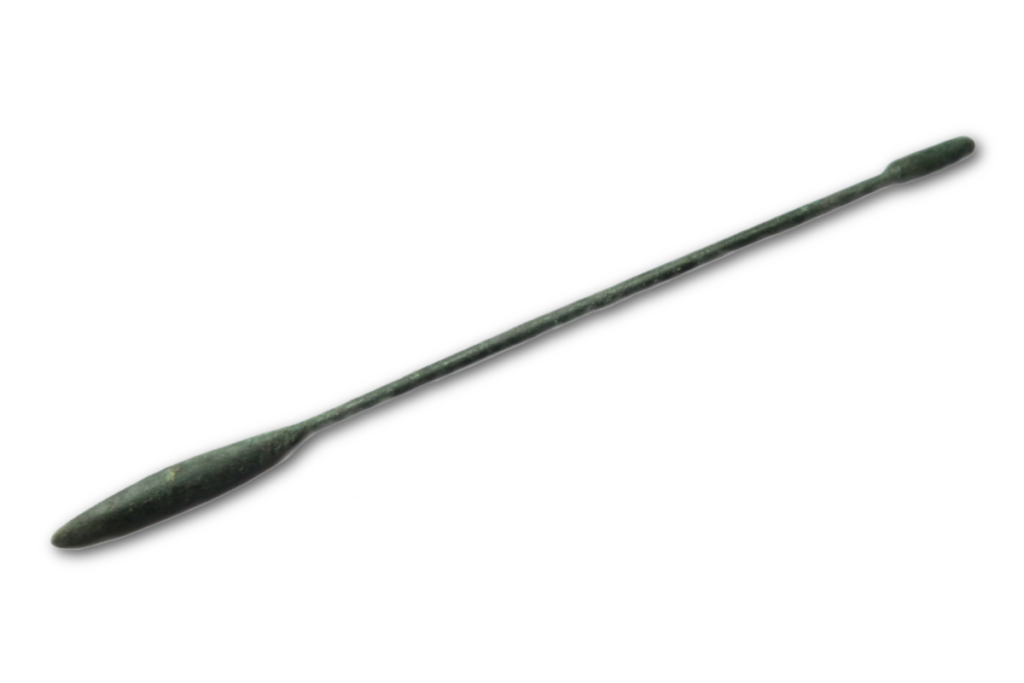
Roman toilet spoon (spatula probe) after conservation (DigVentures)
Ever wondered how people cleaned their ears, put on make up, or applied ointments before cotton buds? Well, wonder no more! Introducing, the Roman toilet spoon. The Romans had a pretty extensive toolkit for medical or cosmetic purposes, including this copper alloy toilet spoon (sometimes known as a spatula probe). As well as hygiene, this tool could also have been used for extracting the contents of a cosmetic container, or even for surgical procedures. This remarkably well-preserved find gives us insight into everyday Roman life – and shows how they had developed specialized tools for hygiene and medical care nearly 2,000 years ago.
4. A complete Samian ware cup
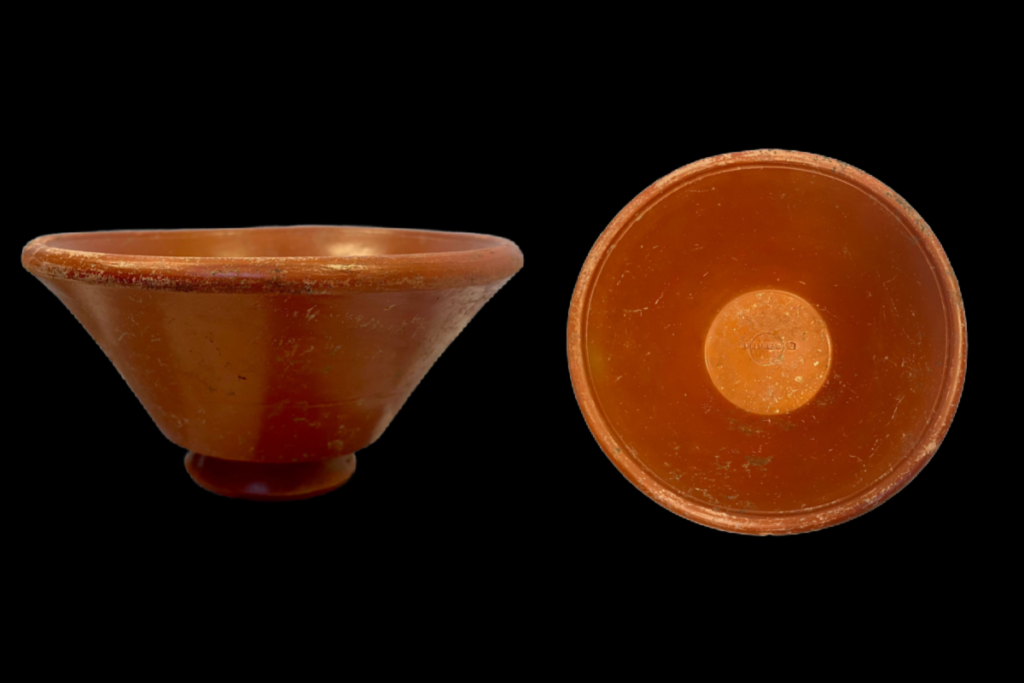
The complete Samian Ware cup, featuring a potter’s stamp on the inner base (DigVentures)
This complete Samian ware cup was the Roman equivalent of your fine China ware. This pottery wasn’t for casual use in the kitchen and was reserved for fine dining. Most Samian ware was made in Gaul (France) and imported into Britain. Interestingly, this cup also features a potter’s stamp, meaning we can trace its maker. From research, we can say this cup was produced at Lezoux between AD145 and 175 and stamped by the potter Divixtus – a clear indication that the family could afford some imported luxuries.
5. A Tiny Roman pet dog

‘Clumpy’ the Roman lapdog (AI Generated, DigVentures)
Among our most captivating discoveries was the remains of a remarkably small Roman dog, which attracted national media attention as the fifth smallest Roman dog ever discovered in Britain. Small dogs first appeared in Britain with the Roman arrival, marking a cultural shift from the Iron Age when only larger dogs were present. Due to her small size and bowed legs, it’s unlikely that ‘Clumpy’ was a working dog. Instead, she was probably the family’s pet – a heartwarming insight into Roman domestic life and the changing relationship between humans and dogs during this period of British history, and showing that people have loved tiny dogs for thousands of years!
6. Three bone combs

One of the three Roman combs found at Earth Trust (DigVentures)
These delicate bone (or possibly antler) combs were uncovered from a cemetery that was close to the villa. They all feature eye-like ring-and-dot motifs or holes on the terminals which, when coupled with the feather-like design of the teeth, create an owl-like design. In fact, this owl design is quite common in combs from this period. All three were associated with Roman burials found near the villa – having been placed there by people laying their loved one to rest.
7. A brooch
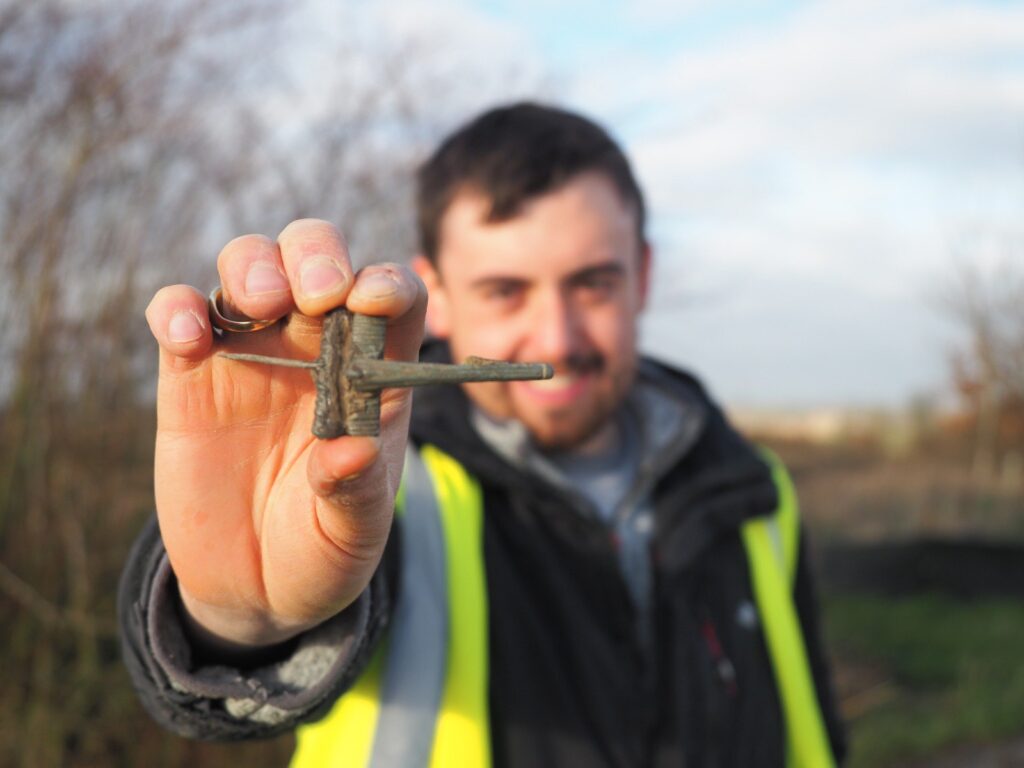
Colchester Roman brooch immediately after discovery on site (DigVentures)
This stunning brooch is a Colchester two-piece brooch, dating to AD 43-100. Serving as both a stylish embellishment to your everyday look and as a status indicator, brooches in the Roman period could also be used to highlight your rank in society or the military. The Colchester brooch in particular is a type of jewellery with strong Romano-British influences, showing us how Roman fashions were blending with the local influences.
8. A Roman purse dropped in a ditch
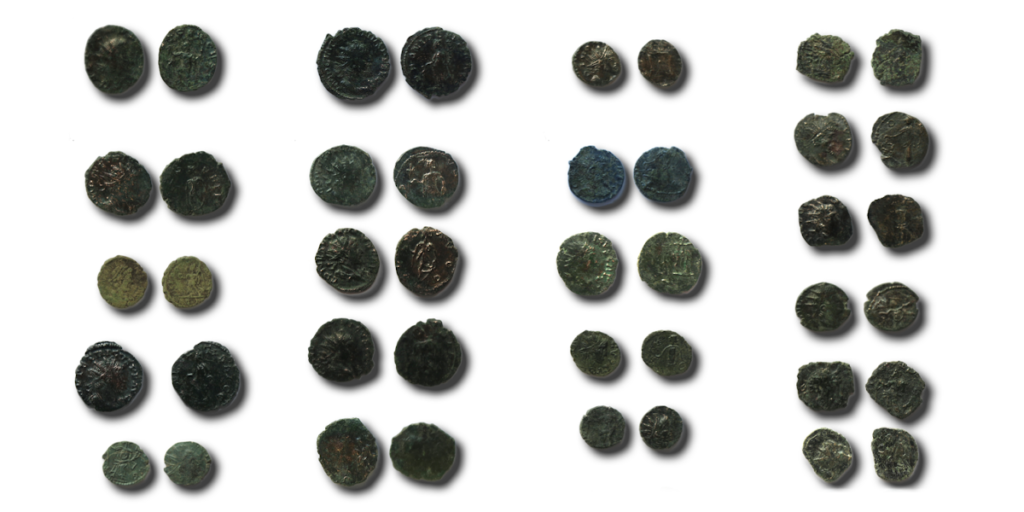
Twenty-two of the Roman coins uncovered from a ditch on site, post-excavation (DigVentures)
Twenty-six Roman coins were uncovered from a ditch dating to the 3rd century AD. From the way they were clustered, we can tell they had likely fallen while still in some kind of purse, which has long since rotted away. Perhaps a Roman traveler or a one of the villa owners on their way back from the nearby town of Dorchester, their purse heavy with coins after a day at the market – until an unfortunate fumble sent the purse tumbling into the ditch, where they remained ever since.
9. A pestle
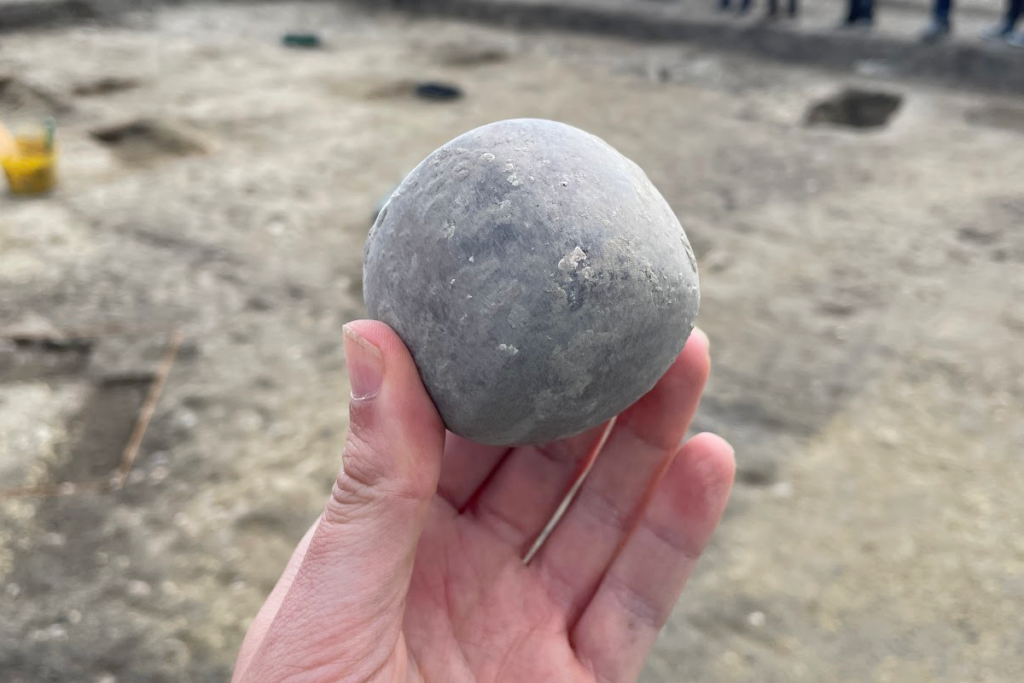
Roman pestle immediately after discovery on site (DigVentures)
This mysterious ‘square ball’ was discovered by our Venturer Erin at the bottom of a Roman column base on our first crowdfunded excavation. After a little research, we managed to identify it as a Roman pestle for crushing and grinding substances into powders or pastes. This find suggests that the Romans may have been using herbs and spices in their cooking to enhance the flavours of their meals – we can only wonder what sort of delicious recipes might this pestle have helped to create over the years!
10. A double pointed bone needle
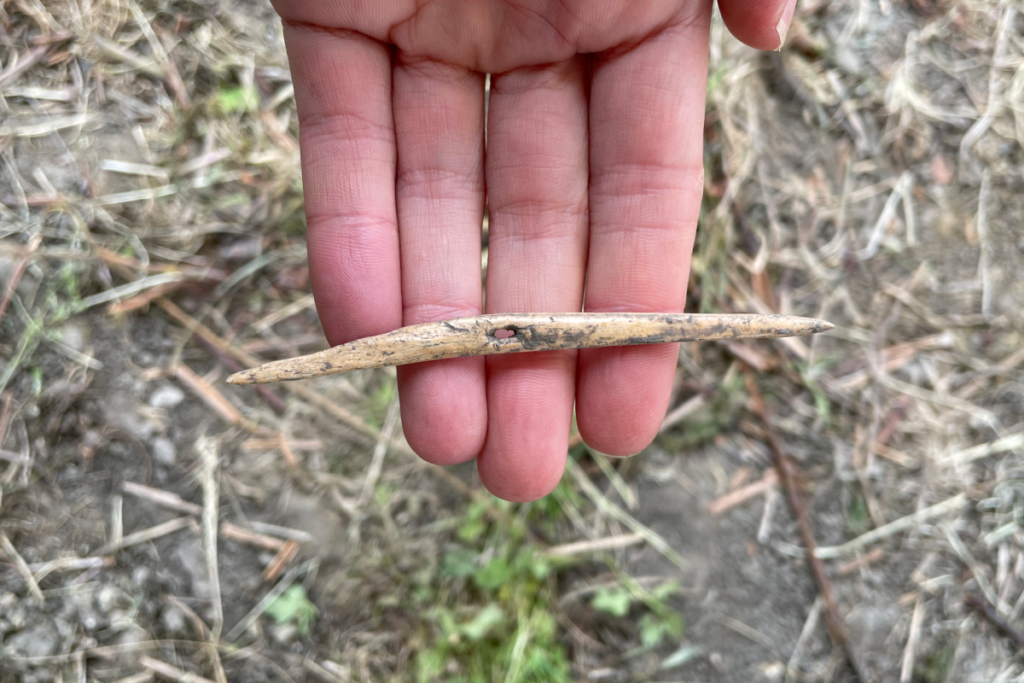
Bone needle immediately after discovery on site (DigVentures)
This is one of three bone needles or pins that have been found on site. It was found by Lara in 2024. Analysis of the finds uncovered in our first community dig is still underway, and our specialists will help us to date this find and identify what it might have been used for. Suggestions so far range from weaving, to fishing gores – showing how these ancient communities relied on their self-sufficiency, utilising skills and craft techniques that may be lost to most of us today.
These finds are just the beginning of the story. Each discovery helps us to understand more about the ancient community that called this place home.
Fancy adding to the story? Our mission to find out more about this Roman villa continues. Crowdfund our next dig to be part of it – online or in the field.




Comments (1)
It’s so interesting to see some of the exciting items that volunteers at the Digs actually found. How excited they must have been, how fun to see them actually holding their finds.
Two years ago many DigVentures volunteers from around the world participated in an archaeological Dig that used their home computers and LiDAR photography instead of trowels to identify possible ancient items lurking under the surface in National Trust properties in the UK.
I would love to see in the Newsletter some of the exciting finds we made. Many of us still talk among ourselves about items we thought looked exciting, but so far not much feedback.
What about showing us what we uncovered? Those of us who ‘dug’ from home would love to see what we found too.
Fran in Canada