Archaeologists have unearthed a rare example of a blacksmith’s workshop dating to 771-515 BC, when ironworking had only just arrived in Britain.
A rare example of a blacksmith’s workshop dating back nearly 2,700 years to the earliest days of ironworking in Britain has been unearthed in Oxfordshire.
Archaeologists believe that the workshop, which has been radiocarbon dated to 771-515 BC, was unlikely to have been used by an ordinary village blacksmith.
Instead, researchers say the workshop probably belonged to an ‘elite’ or ‘master blacksmith’ with a specialised hearth for producing large or high-end iron artefacts, such as trade bars, swords, and cart or chariot wheels.

Interior: Artist’s impression of the blacksmith at work. An assistant uses bellows to propel air through a tuyere (bellows protector) into the hearth. Image made using Adobe Firefly.
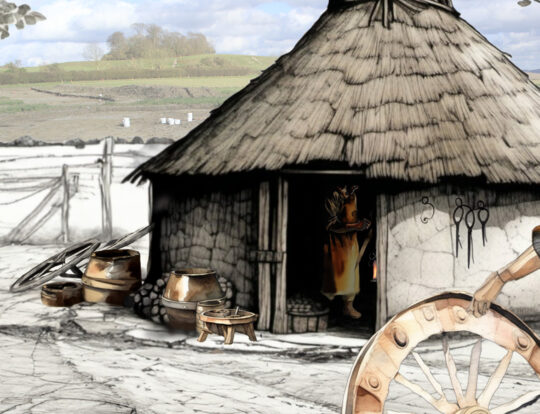
Exterior: Artist's impression of the blacksmith's workshop, with Wittenham Clumps visible in the background. Image made using Adobe Firefly.
The discoveries were unearthed by archaeologists from DigVentures during excavations at the headquarters of environmental charity Earth Trust near Abingdon, approximately 15 miles from Oxford and 50 miles from London.
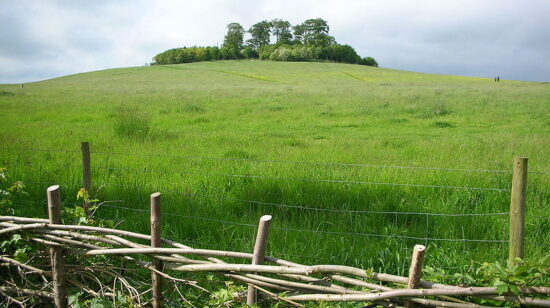
Excavations took place just downslope from Wittenham Clumps, one of South Oxfordshire’s most iconic landmarks, which is also owned and managed by Earth Trust. Known locally as ‘The Clumps’, it includes Castle Hill, an ancient hillfort and scheduled ancient monument.
Evidence from the dig also included an Iron Age village contemporary with the hillfort, and a later Roman villa where the remains of a tiny Roman pet dog were also discovered.
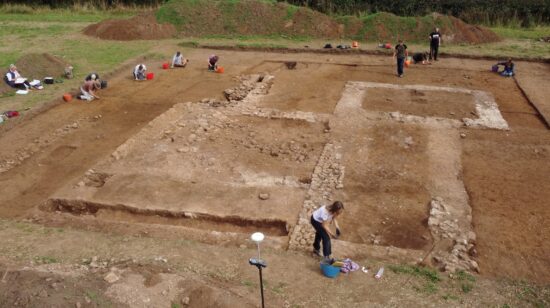
New results and ongoing analysis by specialists have now identified the blacksmith’s workshop, including the footprint of the smithy building and internal structures, pieces of hearth lining, waste metal or ‘slag’, hammerscale, and pieces of iron bar.
Archaeologists have also hailed the exceptionally rare discovery of an intact tuyere – a crucial component that channelled air into the blacksmith’s hearth, while also acting as a buffer to protect the bellows from the extreme heat of the flames.
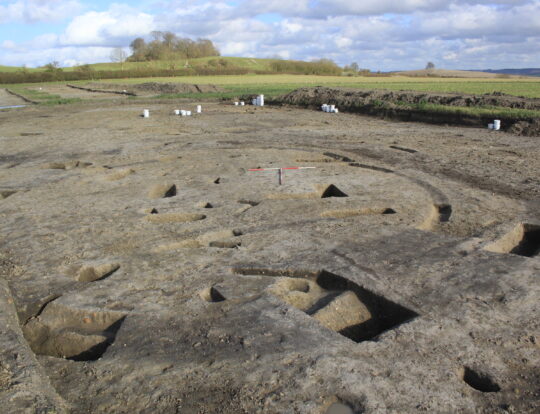
A series of circular and semi-circular gullies form the footprint the blacksmith’s workshop with an entrance on the southeast side, additional structures to limit the light, and a smaller ring of postholes marking out an internal feature. Credit: DigVentures
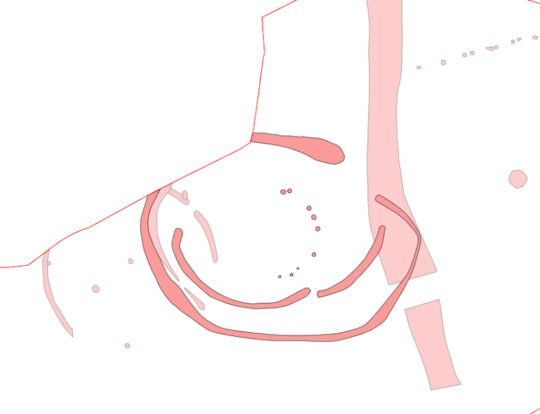
The footprint of the blacksmith's workshop shown in dark pink, with other Iron Age features shown in light pink. Credit: DigVentures.
“It’s exceptionally rare to find a complete tuyere, especially one that’s as old as this. Although there are examples from later periods, including Saxon, Viking-age, and medieval pieces, this is one of the only known Iron Age ones in the country, if not Europe. The fact that it dates not just to the Iron Age, but to the first few centuries of ironworking in Britain, is remarkable” said Gerry McDonnell, the archaeometallurgical specialist who examined the finds.
“What’s more, the size of it suggests we’re looking at a hearth that was much larger and more specialised than that of your average village smithy” he continued.
The vast majority of artefacts produced in the Iron Age weren’t very big and could be produced with quite a small hearth, while larger hearths would have taken much more skill and resources to control, said the researchers.
“The only reason a blacksmith would need a bigger hearth would be if they were forging something long like swords or trade bars, or big like cart wheels. And these wouldn’t be done by your average village smithy who would normally take care of everyday objects and repairs” explains McDonnell.
“The fact that this early Iron Age smithy had a specialist tuyere shows us this was much more likely to have been a serious operation by a highly skilled, elite, or master blacksmith” he concluded.
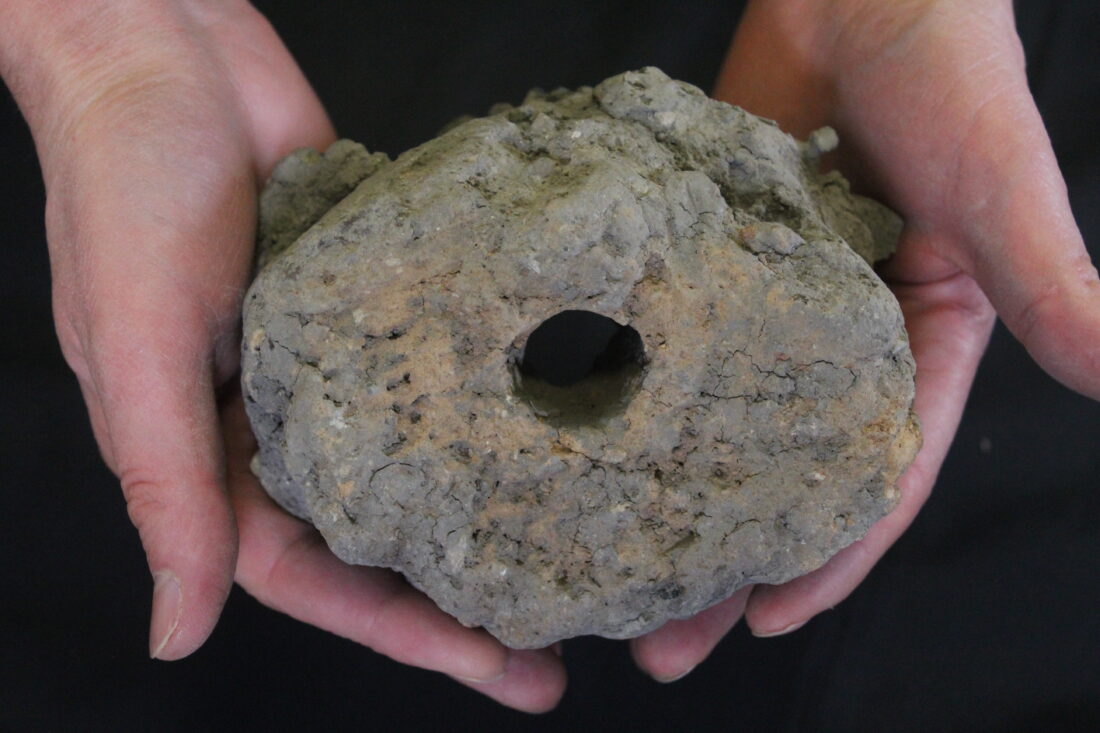
A tuyere is a crucial component of a blacksmith’s hearth, protecting the bellows while allowing air to enter. This one, measuring 120mm across with a 25mm air hole, is a rare discovery and one of the only intact examples from Iron Age Britain. A diameter of 15mm is more typical. Credit: DigVentures
Even though the Iron Age takes its name from the mastery of this metal, sites that provide direct evidence of how they did this – especially ones from such an early period – are extremely scarce.
“It’s always exciting to uncover the remains of ancient buildings that were occupied thousands of years ago, but it’s even more special when we find such direct evidence of who lived there and what they were doing inside” said Nat Jackson, DigVentures Site Director, who led the excavation.
“In this case, the range of evidence is remarkable. We’ve got almost every component of the blacksmith’s workshop; the building, internal structures, hearth lining, tuyere, even the tiny bits of metal that fly off when the blacksmith is hammering the metal. The only thing we haven’t found is the tools” he said.
“It’s an incredible thrill to uncover something like this. It basically allows us to peer back in time and see what could have been one of Britain’s earliest master blacksmiths at work” he concluded.
Excavations also revealed an Iron Age settlement including a cluster of roundhouses, an Iron Age pantry, and evidence of ceremonial or ritual activity including animal burials, as well as a later Roman villa where archaeologists found the remains of a tiny Roman pet dog.
“At Earth Trust, our vision is a world where people and nature thrive together. The more we learn about Wittenham Clumps’ historic people, the more we understand that balance” said Anna Wilson, Earth Trust’s Head of Experience and Engagement.
“Nearly 15,000 artefacts were recovered during the dig, and as we continue to analyse them the story gets more and more captivating. These new discoveries are literally forging new history before our very eyes and revealing more of the ancient mysteries behind this very special place” she said.
“We’re thrilled to announce that the key finds from the dig will be displayed in a free pop-up exhibition at our visitor centre, and that we’ll be bringing them to life with talks and hands-on activities during our upcoming Festival of Discovery in February” adds Wilson.
The Festival of Discovery 17-18 February 2024 will take place at the Earth Trust Centre in Abingdon, featuring a free pop-up exhibition, talks, and hands-on workshops with the archaeologists.
More information and tickets are available at digventures.com/calendar





There are no comments on this post yet. Be the first!