
Yes, we’re removing the turf on our trenches by hand. Yes, it’s usually done with a big yellow machine. Yes, we realise it’s going to take a fair amount of time… Or is it?
First things first, why are we doing it by hand when we could do it with a JCB? Well, we know the archaeology here is really close to the surface. And it’s really delicate. It’s been ploughed too. All good reasons for choosing to do it by hand.
But by hand doesn’t have to be laborious. Not if you get organised.
One of the Venturers took the task to hand, and it goes a little something like this:
https://youtu.be/HfwqScEqDIo
One person leads the way cutting lines along the X axis.
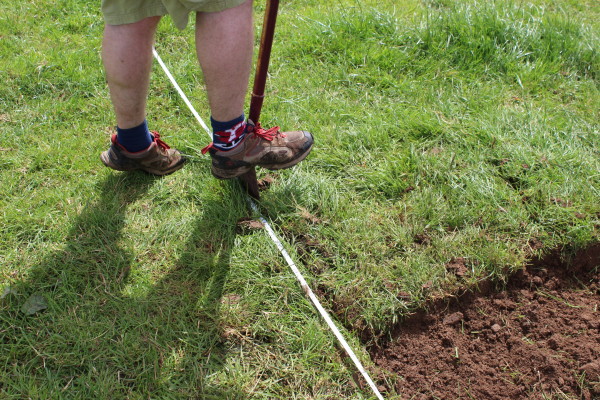
One person follows cutting lines along the Y axis.

And one person follows lifting up the little squares of turf, or scooping them up like a slice of cake and chucking it into the wheelbarrow.

Until finally, you have something that looks like this…
And that, archaeology friends, is how to deturf your trench by hand in the most efficient way possible.
Henry Ford, eat your heart out.
Archaeology in your inbox?!
Want to join a dig? Learn more about archaeology? Join our email list for a monthly digest of our most popular stories, plus alerts for any digs, events, or courses you can join.
Join the list
Written by Maiya Pina-Dacier
Director of Engagement at DigVentures, Maiya digs with a trowel in one hand, and a Twitter feed in the other. She loves finding new ways to get people involved in archaeology - online and in the field.




Comments (8)
It’s a LOT easier to cut the turf if you use a lawn edger!!!
What Richard said. The flat blade makes it easy to bring up the sod after you cut your squares as it slips easily between the sod and the soil. You’re left with sod in perfect shape to replace after back-filling. Far superior to any type of spade.
Turf wall – grass to grass, earth to earth. Or is it never put back these days 😊😊
We always make a turf wall – not a rough pile like in these photos. But we are just volunteers 🙂
sounds like we could do with you on our side!
Hard work
When I was helping on a Mesolithic site on Exmoor a lot of artefacts were very close to the surface and we needed to examine the underside of the turves.
That demo shows nice easy ground, what about deturfing hard sun baked ground. Its not that easy!