The Inspector of Ancient Monuments for London is a role that dates back to the 1800s, when Pitt-Rivers became the first of a long line of archaeologists to take on the responsibility of protecting London’s most iconic sites. Today, Jane Sidell is the archaeologist with that incredible responsibility.
In this DigVentures mash-up of Desert Island Discs and ‘A History of the World in 100 Objects’, we ask Jane to talk us through the objects and artefacts that sum up her life, and what they mean to her.
1. Brass Sieves
My first long-term job was as an environmental archaeologist with the Museum of London, where I handled all sorts of material from the Thames, from enormous whale bones to single celled algae. I spent hours using them to sort through soil samples. Without the use of such sieves archaeologists would miss so much evidence, and we simply wouldn’t be able to tell the stories that we do.
2. Vintage ‘British Rail Inspector’ Badge
I’m often out and about checking up on London’s monuments and talking to people about our heritage as Londoners. Day to day, I also advise the Department of Media, Culture and Sport on any building application that affects scheduled monuments in London. That includes everything from the Tower of London, right down to 18th century milestones. Negotiating schemes that allow us to build over monuments without affecting them can take years, but it also gives us a chance to investigate them properly, and improve their presentation for the public. Maybe it’s because I’m a Londoner, but I feel like I have the best job in archaeology and I love wearing the inspector badge!
3. Mineralised leaves from the sarcophagus of the ‘Spitalfields Princess’
The most evocative moment I’ve experienced in my life as an archaeologist so far was the evening we lifted the lid on the sarcophagus of what became known as the ‘Spitalfields Princess’. We ended up doing it at midnight, live on camera. There were spotlights beaming down on us and news crews from all over the country waiting to broadcast what was inside. The suspense was killing us, but despite the media circus, that moment when we saw her skeleton for the first time was really moving. When we opened it up, we found mineralized leaves all around her skull. That was the moment we knew we’d found something incredibly important.
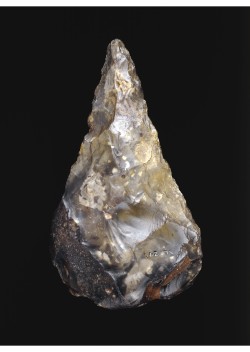
The Conyers Handaxe by kind permission of the Trustees of the British Museum
A small group of us later worked on the coffin and the finds, talking to members of the public as we worked. It was a wonderful example of the astonishing finds we can make, the fascination the public have for archaeology, and the good fortune a number of us have, not only to work in the area, but to be paid for it!
4. The Conyers handaxe
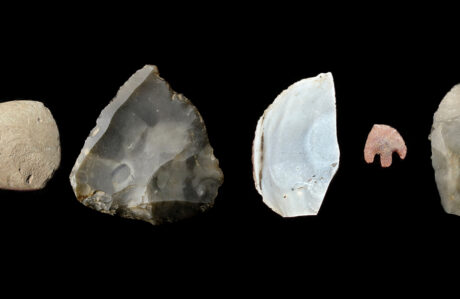
This handaxe, now held by the British Museum, represents one of the most significant breakthroughs in archaeology, and why archaeology is so important to understanding humanity. It was found by John Conyers in the 17th century, alongside the remains of a mammoth, close to what is now Kings Cross station in London.
Conyers could be considered London’s first archaeologist – he made records of all the Roman remains disturbed by Christopher Wren when St Paul’s cathedral was being rebuilt. He was also one of the first people to recognise handaxes as crafted by people, not geological items – an incredibly significant breakthrough!
For me, this object conveys the sheer depth of time that humans have occupied Britain, going back well over 800,000 years, and highlights the history of archaeological study. It’s only a little thing, but it’s such a potent symbol of the duration and durability of human endeavour.
5. The Queen Elizabeth Oak
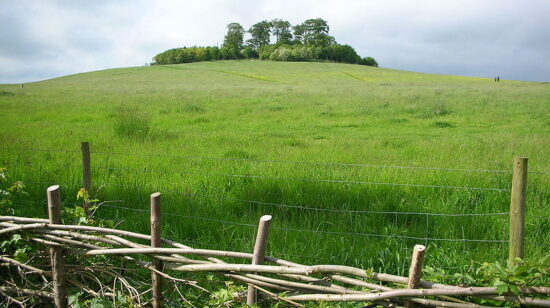
One of my favourite sites in London is Greenwich. It’s a World Heritage site and I take lots of friends there, walking them up the hill to the site of the Roman Temple, and then over to the Anglo-Saxon barrow cemetery, where 31 barrows still survive as earthworks.

Elizabeth Oak
You can still see ridge and furrow marks, the medieval park boundary earthwork, the magnificent Baroque buildings of the Old Royal Naval College and of course, the Queen Elizabeth Oak which according to local myth dates to the reign of Elizabeth I.
A dendro project was recently carried out to establish whether this was true. The results actually revealed that the tree probably pre-dates the creation of the hunting park, making it a rare and beautiful trace of the natural landscape of medieval Greenwich. Sadly the tree died some years ago, but is still decaying gracefully in situ.
6. The Dagenham Idol
I love any archaeology that is to do with the prehistoric environment, and particularly interaction between people and the Thames floodplain. If I could only place one object in the ‘Museum of Me’, that represents my life so far, it would have to be the Dagenham Idol from the Late Neolithic.
It was found in the peats of Dagenham in 1922, and is one of many from northern Europe, which are often ascribed a mythical slant. Was it a cult object which ended its life deposited as a votive offering? The non-scientific side of my brain is seduced by the possibilities of what this object means.
7. My desert island object would be…
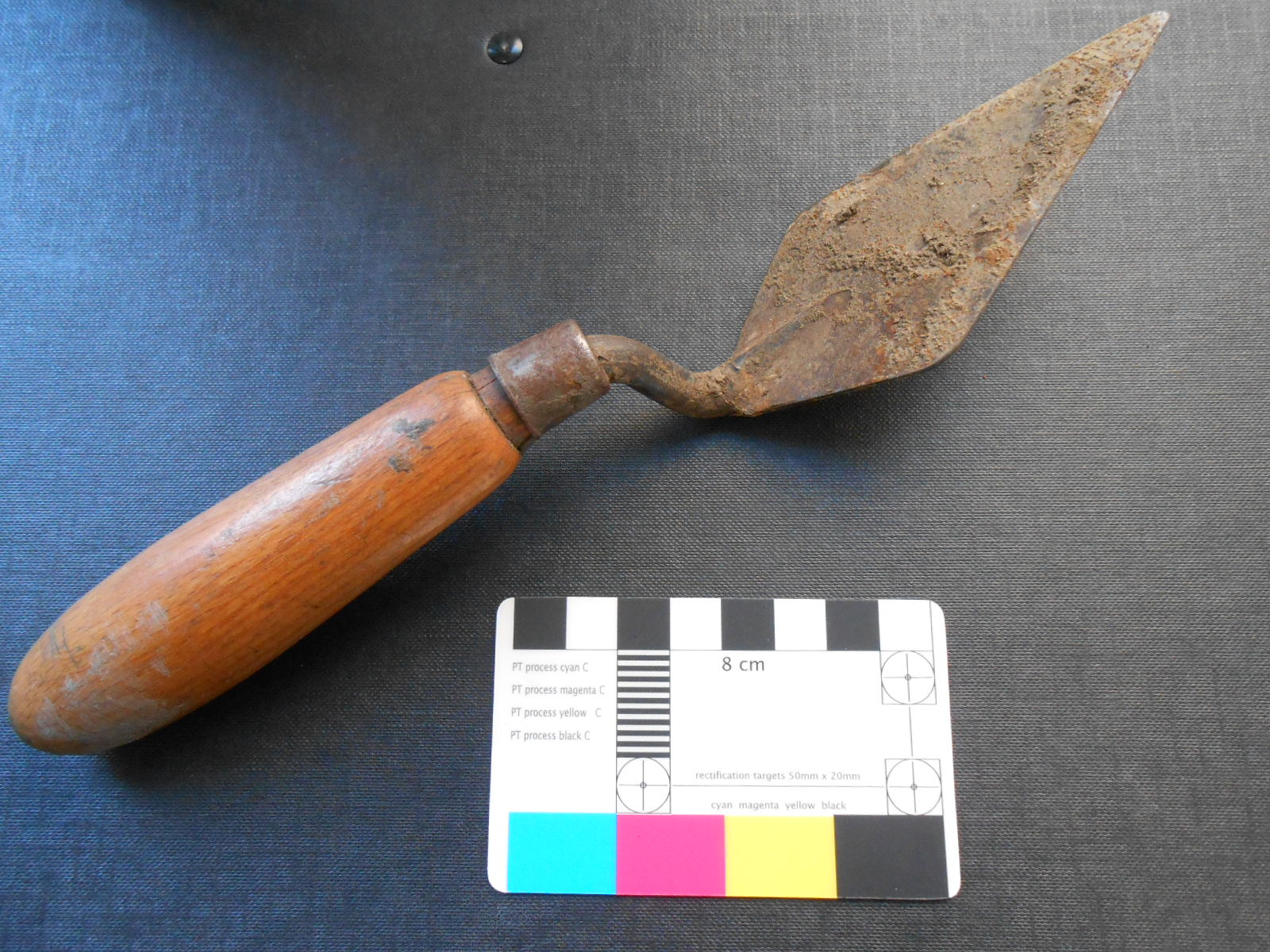
Is this Inspector Sidell’s ACTUAL trowel?
If I were to be stranded on a desert island… Well, the Hitchhiker’s Guide to the Galaxy has a great maxim – never be without a towel. Clearly this was a misprint. It should be… trowel.
They’re good for digging fire pits, gutting fish (I suspect I’d have to give up vegetarianism), and I could even sharpen it to cut wood and make a shelter, before using the blade to plaster my new home with daub. Finally, whenever I had a moment to take a break from raw survival, I could use it to dig into the sands and find out about my desert island predecessors.
Thanks Jane! If you want to hear more about Jane’s fascinating work, you can find her on twitter @Inspector Sidell
Archaeology in your inbox?!
Want to join a dig? Learn more about archaeology? Join our email list for a monthly digest of our most popular stories, plus alerts for any digs, events, or courses you can join.
Join the list
Written by Rosanna Ring
Rosanna is one of DigVentures' intrepid Community Archaeologists. She's busy turning Barrowed Time (our dig at Morecambe's Bronze Age burial mound) into a real seaside adventure, and getting the Pop-Up Museum on the Prom ready for you to visit!