
There’s a latent perception that archaeologists spend most of their time scratching about the earth with tweezers and paintbrushes, gently unravelling the past crumb-by-painstaking-crumb. The truth is, we save time by getting started with what’s fondly known as ‘the big yellow trowel’.
Yes, some of our work is extremely delicate. Human remains for instance, or complex features like hearths or kilns where each layer has to be carefully removed to reveal the strict order of events, require some pretty fancy footwork and attention to detail. But trade in that delicate child’s paintbrush for a JCB’s back hoe, or even better – a monster 25 tonne track machine – and you’re getting closer to many archaeologist’s preferred tool of choice.
On most community-based projects, the ‘monster truck’ stage of work is completed long before the site team arrives. despite appearance, it’s such a delicate skill that you’ll probably be some years into archaeology before you ever take responsibility for machine watching. But given that this is such a key part in the archaeological process, it’s essential that all diggers – new or old – understand the basic principles of How to Dig… with the big yellow trowel!
1. First things first:
Always remember that the machine driver wants to kill you. He or she probably looks and seems quite ‘normal’, but… for health and safety purposes… get used to imagining that under that jolly exterior lurks a bloodthirsty killer with psychopathic tendencies. The one and only thing that can possibly save you from this bona fide wrong ‘un is…
2. Gesticulations:
wild and ostentatious gesticulations – especially if you’re approaching or walking past the machine whilst it’s moving. Wait to catch the driver’s eye, and never ever approach the driver’s cab unless…
3. The bucket is grounded:
Be safe out there folks – it’s only archaeology! Got that? Good, lets start looking for…
4. Features!
Which means carefully peeling back the soil, layer-by-layer, slice-by-slice. The reason we use a machine is that on most archaeological sites, the top layer can be said to be ‘archaeologically meaningless’. There may well be finds in there somewhere, but the top layers of soil are constantly churned by earthworms and burrowing animals, mixing finds of all periods into the ‘background noise’ of antiquity. It’s not until we…
5. Remove the overburden:
revealing a clean surface of unmodified ‘natural’, that the postholes, wall footings and silted up ditches can be clearly seen. It’s at that point that archaeologists reach for their trowels, things start getting interesting, and we can…
6. Call in the dig team!
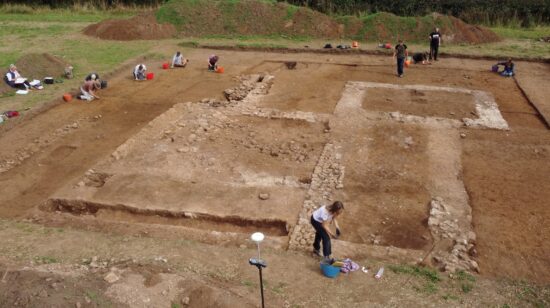
If you’ve worked on a community project before (or if you happen to be one of our lovely Venturers!) this is the point when you’ll first see the site – a clean, organised trench ready to begin troweling. Any trenches deeper than 1 metre should be stepped to guard against collapse, spoil heaps should be metal detected and barriers erected to stop the public falling into deep holes. Once that’s all done, take a good look round trench to get your bearings, dust off your trusty trowel and start digging!
Archaeology in your inbox?!
Want to join a dig? Learn more about archaeology? Join our email list for a monthly digest of our most popular stories, plus alerts for any digs, events, or courses you can join.
Join the list
Written by Brendon Wilkins
As Founder and Co-CEO of DigVentures, Brendon brings together two decades of commercial archaeology experience with his expertise in digital innovation for archaeological fieldwork, public participation, and social impact evaluation. With a consistent research and publication record, his PhD (‘Digging the Crowd: the future of archaeology in the digital and collaborative economy’) explores new business and social impact models that position citizen science as a response to economic and climatic challenges facing humanity. Brendon steers the ship of DV’s fieldwork, evaluation and ‘Deep Time’, our crowdscience platform training citizens to search Earth Observation Data for cultural and natural heritage. Brendon’s signature laugh lights up every room, especially when he sneaks onto the turntables for a cheeky DJ set!




There are no comments on this post yet. Be the first!