
So you’ve found something really big and round in the ground. But is it a roundhouse? Or is it something else? Here’s what you need to look out for.
When you find something big and round in the ground, there are several possibilities. It could be an enclosure, a barrow or… a roundhouse. Figuring this out can be really exciting, especially as it could turn out to be something different entirely. The question is, how in the earth do you tell?
First let’s start with what a roundhouse is.
In its most basic definition, a roundhouse is simply a structure that’s round. Most of what we know about them is derived from the layout of postholes, and in some cases timbers that have been preserved in bogs.
They usually have a single entrance, often facing east or south-east, to make the most of the sunlight. The walls are usually framed by timber posts, joined together by sticks called wattle, and sealed with daub (mud, straw and animal dung).
They have broad, conical roofs usually thatched with straw or turf and no chimney – the smoke from the central hearth would have seeped out through the thatch.
This was the basic architecture of the British home for over 3,000 years, from the Bronze Age, throughout the Iron Age and even into the Roman period.
Before that, people lived in square or rectangular houses. Quite why they changed is still the subject of speculation, but it is interesting to note that the shape of burial mounds reflect and change with them.
The term roundhouse carries a lot of baggage, and indeed many were dwellings, but they may have also been used for storage, among other things.
The characteristic features of a roundhouse (and how you can tell it apart from other round things)
It seems that in many cases, people dug shallow ditches around the walls, just where the run-off from the roof would have hit the ground. Roundhouses often survive only as drip gullies, with postholes and the original floor level destroyed by later ploughing. Without these, it’s actually pretty tough to say whether or not your round thing in the ground is really a roundhouse, or some other circular prehistoric feature, like an animal enclosure or small barrow.
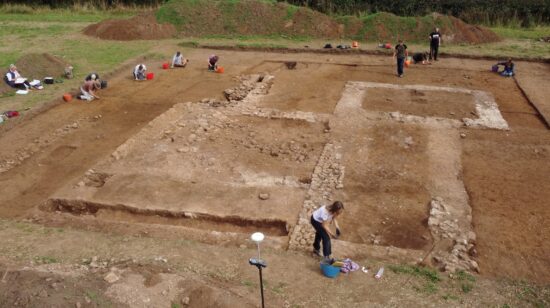
At Poulton, we’re lucky in the depth of the surviving archaeology, but it also caused confusion, as our drip gullies are actually as deep as ditches. This gave them the appearance of low barrows, and at first, that’s what we thought they were. But there were loads of Iron Age finds in them, and the radiocarbon dates came to the same conclusion. That all led us along a different interpretative path, confirmed by continued rebuilding in the same enclosure.
The thing about digging a roundhouse that’s different to excavating other types of site is…
Each type of structure requires a different form of excavation, but roundhouses have their own particular approach. The usual step is to excavate sections through the gulley, which surrounded the building, which is often one of the few things that survive from such a structure.
On account of the building materials used for the walls, it is only the postholes that usually survive. It is often quite hard to see the overall design of a roundhouse on the ground, but by careful mapping of the features we can put together an overall plan of the structure, and from there infer whether or not we have a roundhouse.
At Poulton, we have plenty of them – a settlement’s worth in fact – and there can be no better way to develop these essential skills than by joining us at Poulton and digging one for yourself.
Archaeology in your inbox?!
Want to join a dig? Learn more about archaeology? Join our email list for a monthly digest of our most popular stories, plus alerts for any digs, events, or courses you can join.
Join the list
Written by Kevin Cootes
Kevin Cootes is the Site Director of the Poulton Research Project - a multi-period site that's shaping up to be one of the most amazing Iron Age settlements in northern England. He loves field archaeology and ceramics, which is lucky when you consider that Poulton has an abundance of both. Running this site is a full-time job and then some, so takes up the majority of his time. In spite of this, he still manages to enjoy the occasional game of Poker and episode of Star Trek.




Comments (2)
Can you tell if a round feature on an aerial view is a roundhouse or a barrow? What if there are several together – does that increase the likelihood of them being houses?
Maybe a silly question, if the walls of the houses were made of clay, (wattle and daub, and in some cases the house burnt down, why is there not high levels of the burnt daub or clay that would be still in situ.? Regards Paul..