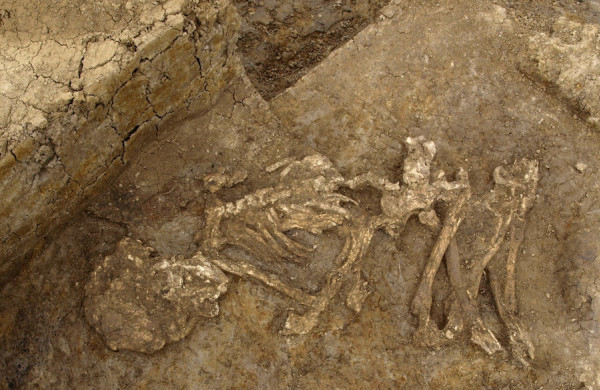
Skeletal remains from Neat’s Court in Kent, England. These bones show signs of low-level heat treatment, indicating that the body might have been mummified in an extremely dry environment or through smoking. Credit: Geoff Morley
It really is amazing what you can do with a microscope. A new study of ancient skeletons suggests that Bronze Age bodies were smoked over fire, kept in peat bogs and even brought out for special occasions.
The cold, wet and rainy climes of the British Isles might not seem like the ideal conditions in which to try and preserve the remains of your long-dead relatives and until now, there has been relatively little evidence to suggest that they even tried. But a new study suggests that just because the evidence isn’t visible to the naked eye, it doesn’t mean that Bronze Age Britons haven’t been mummifying their dead all along.
[Read more: Heart Burials and Other European Embalming Practices]
During the Bronze Age, burial practices were many and varied. There were cremations, burials, watery endings and even bodies just left to decompose. There are also bog bodies and occasionally a surprisingly well-preserved arm or leg, but unlike the embalmed bodies of the ancient Egyptians, or desiccated remains from Peru, bodies with lots of surviving soft tissue, suggesting people regularly and intentionally tried to preserve bodies, aren’t a characteristic feature of Bronze Age Britain.
Tom Booth, an archaeologist at the University of Sheffield, has conducted a remarkable study published in the journal Antiquity that suggests that just because soft flesh hasn’t survived for us to find, it doesn’t mean they weren’t trying.
In fact, he’s produced evidence that the bodies of some Bronze Age Britons may actually have been mummified by smoking them over fires or submerging them in peat bogs, making them leathery enough that they could be brought out on special occasions – at least for a while.
How to tell whether a body has been mummified
The researchers reexamined over 300 bodies from 25 different archaeological sites across the British Isles. Of the 34 individuals from the Bronze Age, 16 showed signs of mummification. But if the bodies they looked at weren’t embalmed, or wrapped up, and their flesh hadn’t survived, how could they tell?
When left to decay naturally, cells in the body break down. Bacteria digest soft tissues and eventually, they reach the skeleton, leaving behind microscopic tunnels as they eat into the bone.
But if the body has been mummified, preserved or treated in some way, the bones tend to have little or no bacterial tunneling. When Tom and his colleagues looked at the Bronze Age skeletons, 16 showed little or no sign of bacterial attack.
In fact, the level of bone preservation was so good it was comparable with known mummies from Ireland and Yemen. One of them in particular, a skeleton from Kent, also showed signs of low-level heat treatment. If this wasn’t a completely failed attempt at cremation, then perhaps this body had instead been gently smoked over a fire?
Bronze Age burial rites
So just because you don’t find soft tissue, it doesn’t mean bodies weren’t being mummified. And now we have a method to ascertain whether a dead body had conditions imposed upon it that prevented natural decomposition.
Surely there is still work to do to establish whether this was always intentional and, if they were, what methods people were using, but it nevertheless raises the possibility that in Bronze Age Britain, like in many other cultures around the world, the physical remains of the dead may have continued to play a visible role in society.
[Read more: How To Bury Your Dead Like an Ancient Bolivian]
Archaeology in your inbox?!
Want to join a dig? Learn more about archaeology? Join our email list for a monthly digest of our most popular stories, plus alerts for any digs, events, or courses you can join.
Join the list
Written by Maiya Pina-Dacier
Director of Engagement at DigVentures, Maiya digs with a trowel in one hand, and a Twitter feed in the other. She loves finding new ways to get people involved in archaeology - online and in the field.




There are no comments on this post yet. Be the first!