Mummification, embalming and the burial of organs separately from the body are all things we usually associate with ancient Egypt, but they were also practised much closer to home.
Though it’s technically true that “dead men tell no tales”, the preserved remains of two recently discovered individuals tell us a lot about Europe’s own embalming practices.
Meet Bishop Winstrup & Lady Brefeillac
Last week, the archaeology news was abuzz with the discovery of a fully-dressed and perfectly-preserved body of Lady Brefeillac – a 17th century French noblewoman. In turn, that sparked a resurgence of interest in another recent study into the mummified remains of Peder Winstrup, a former Bishop of Lund.
European embalming practices
Lady Brefeillac’s body was found buried in a lead coffin in a Dominican convent in Toulouse, along with 4 skeletons in additional lead coffins, and all showed signs of some pretty substantial embalming practices.
Archaeologists found saw marks on the rib cages and skulls, which suggests surgical removal of vital organs, whilst CT scans revealed that the Lady’s heart had also been removed with surgical precision.
This doesn’t mean she was buried without one though…
The practice of heart burial

Her body was accompanied by a unique heart-shaped reliquary inside which archaeologists discovered the preserved remains of a human heart. But whose was it? Luckily, an inscription identified it as her husband’s, Toussaint de Perrien, Knight of Brefeillac.
As it turns out, the separate interment of organs, particularly the heart, was a pretty popular burial practice in parts of 17th century Europe.
Hearts were a powerful spiritual symbol, and the deceased’s heart was often buried at a place of importance or spiritual significance to the deceased; in Brefeillac’s case, this was in his wife’s hands. How romantic!
Some took things even further, Richard the Lionheart famously willed that his body be buried at Fontevrault, his heart at Rouen, and his brain, blood and viscera in Charroux. Talk about spreading yourself a bit thin!
But it’s a different story in 17th century Scandinavia
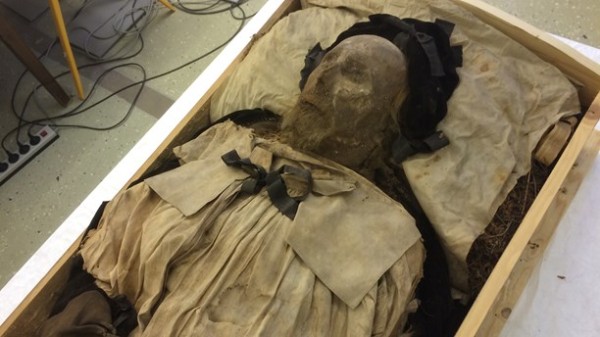
The body of the Bishop of Lund on a special preservative mattress
Recent results from an analysis of the mummified remains of Peder Winstrup, Bishop of Lund in 1679, reveal that his internal organs survive perfectly intact, suggesting that he had been subject to another kind of embalming process.
Post-mortem ‘body processing’ rituals differed regionally throughout Europe, and heart burial in particular had a strong association with the Catholic Reformation. The absence of this kind of ritual in this case could reflect the rise of more protestant practices in 17th century Sweden.
And that’s not all…
Burial practice aside, these two still have more to say. The mattress on which the bishop lies contained numerous insect and plant species. Preserved remains can reveal a great deal about the past environment, and the study of plant remains serves to further our understanding of their historical uses.
In this case researchers believe that the plants were specifically chosen for their natural preservation qualities and ability to keep nasty smells at bay.

Carrying out a CT scan of Lady Brefeillac
An opportunity to study disease
Analysis of Lady B’s body tissues also showed adhesions to her lungs, suggesting she suffered from tuberculosis at the time of her death.
Scientists are keen to gain samples from this uncontaminated tissue in order to study the DNA of the pathogen and observe how it has evolved over the past 350 years. The results could prove significant, not only for history and archaeology, but also for modern medicine.
It turns out the dead can be quite talkative…
Inrap is expected to reveal its findings from an autopsy on Lady Brefeillac’s body later this month. The examination of Bishop Windstrup by Lund University is still on going.
Archaeology in your inbox?!
Want to join a dig? Learn more about archaeology? Join our email list for a monthly digest of our most popular stories, plus alerts for any digs, events, or courses you can join.
Join the list
Written by Rosanna Ring
Rosanna is one of DigVentures' intrepid Community Archaeologists. She's busy turning Barrowed Time (our dig at Morecambe's Bronze Age burial mound) into a real seaside adventure, and getting the Pop-Up Museum on the Prom ready for you to visit!