What was it like to be a school child in ancient Egypt? To learn hieroglyphs? And to be disciplined for being naughty or getting them wrong?
At the archaeological site of Athribis, a team of Egyptologists has unearthed a rare glimpse into ancient school-life. And yes, as it turns out, even 2,000 years ago school children were made to write lines.
Here, among the ruins of an ancient settlement 40km north of Cairo, researchers have recovered over 18,000 ostraca – fragments of broken jars and vessels that were re-used by the town’s ancient inhabitants for writing on, much like scrap paper.
Inscribed with ink, ostraca were widely used in everyday life to jot down lists of names, accounts of temple offerings, medical records, and receipts of everyday items like bread.
But, say the archaeologists working at Athribis, a surprising number of these newly-discovered ostraca seem to come from the classrooms of an ancient school. Instead of lists or accounts, many show pictures, alphabets, teaching materials, and written exercises.
Among them, there are stick figures whose big heads, gangly limbs, and googly eyes have all the unmistakeable charm of a young child’s drawing:

A child's attempt to draw human and god-like figures
There are also teaching materials, including tables of months, numbers, arithmetic problems, grammar exercises, and even a copy of a ‘bird alphabet’ in Hieratic (an abridged or simplified form of hieroglyphs):
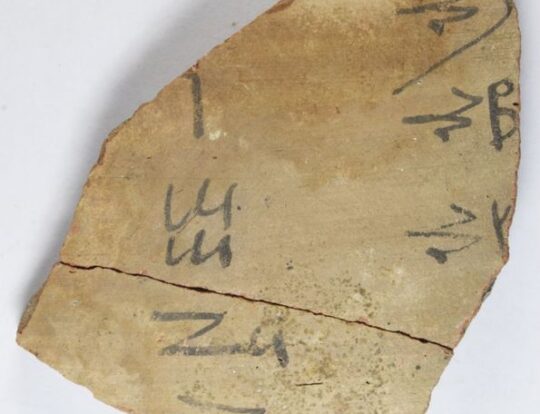
Excerpt of a 'bird alphabet'. Numbers 5-8 are on the left, and the names of birds (each beginning with the letter they represent) on the right. An equivalent in English might be something like: 5. E is for eagle, 6. F is for falcon, 7. G is for goose, 8. H is for Hawk and so on.
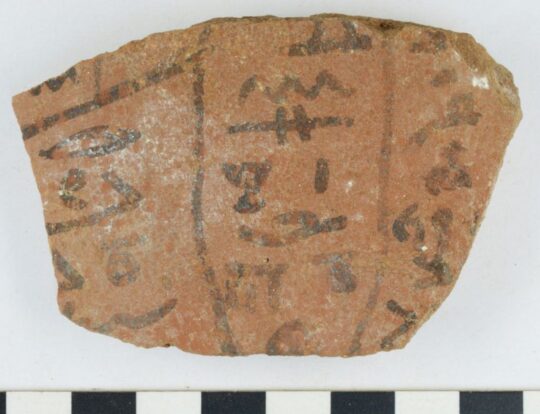
Fragment of a hieroglyphic inscription with information on local mythology, probably copied by a student from the neighboring temple
But perhaps most surprising of all, there are more than a hundred ostraca containing ‘lines’ – written exercises where children have been made to write the same things over and over again.
According to the researchers, many of these written exercises can be classified as punishments, suggesting that even far back as 2,000 years ago, ‘naughty’ children were being disciplined by writing lines just like Bart in the opening titles to The Simpsons:

"I must not eat my teacher's figs?"... Naughty children had to write lines, researchers say
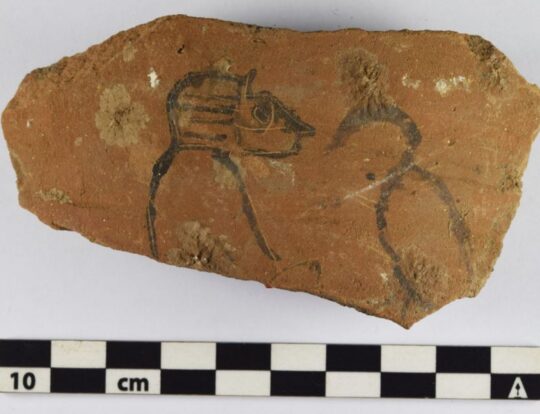
Practice makes perfect. A student draws a baboon and an ibis, the sacred animals of Thoth - the god of wisdom.
Such a large number of ostraca has only been found in Egypt once before, at the workers’ settlement of Deir el-Medineh near the Valley of the Kings in Luxor, which included notes about medicine and medical practices.
The ostraca of Athribis, on the other hand, can tell us more about what daily life was like nearly 200 kilometers to the north. As well as the school texts, researchers also found receipts, accounts of offerings at the nearby temple such as money, wine, castor oil, wheat and barley, and lists of who had bought how many loaves of bread:
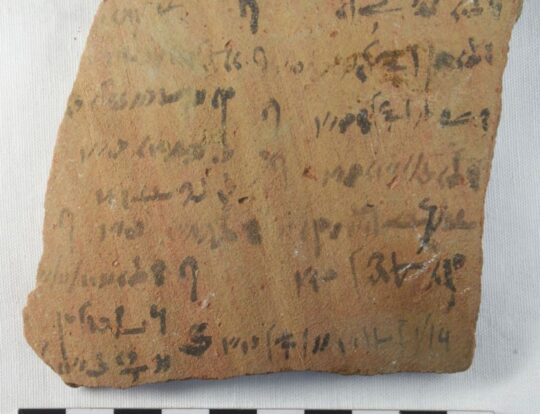
Receipt for bread in Demotic. The loaves are distributed in multiples of 5, and many of the buyers are women
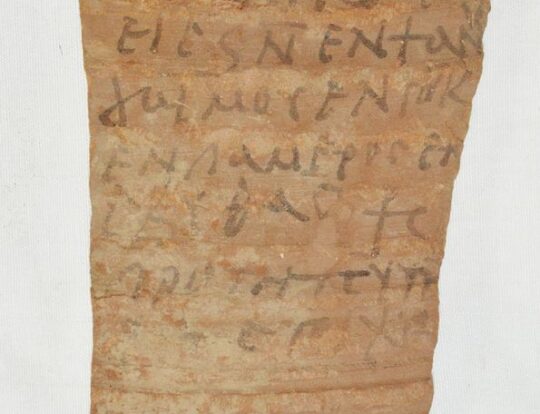
Coptic receipt, issued by a man called Tiberius
Most of the ostraca are inscribed in Demotic, the common administrative script in the Ptolemaic and Roman periods, with some also written in Greek, Hieratic, hieroglyphic or – more rarely – Coptic and Arabic script.
But even though Demotic was clearly the popular script among adults, the ostraca show that children were still being taught a simplified form of hieroglyphics – like the bird alphabet.
The ostraca were recovered during excavations led by Professor Christian Leitz at the University of Tübingen, in cooperation with Mohamed Abdelbadia from the Egyptian Ministry of Tourism and Antiquities, and analysis was coordinated by Sandra Lippert at the Centre national de la recherche scientifique (CNRS) in Paris.





There are no comments on this post yet. Be the first!