While excavating the ancient city of Germanicia in south eastern Turkey, archaeologists have unearthed a stunning mosaic depicting three women dancing to music at an open-air feast.
The mosaic, which measures 50 square meters and is thought to be around 1,500 years old, was discovered below a modern housing development in the city of Kahramanmaraş.
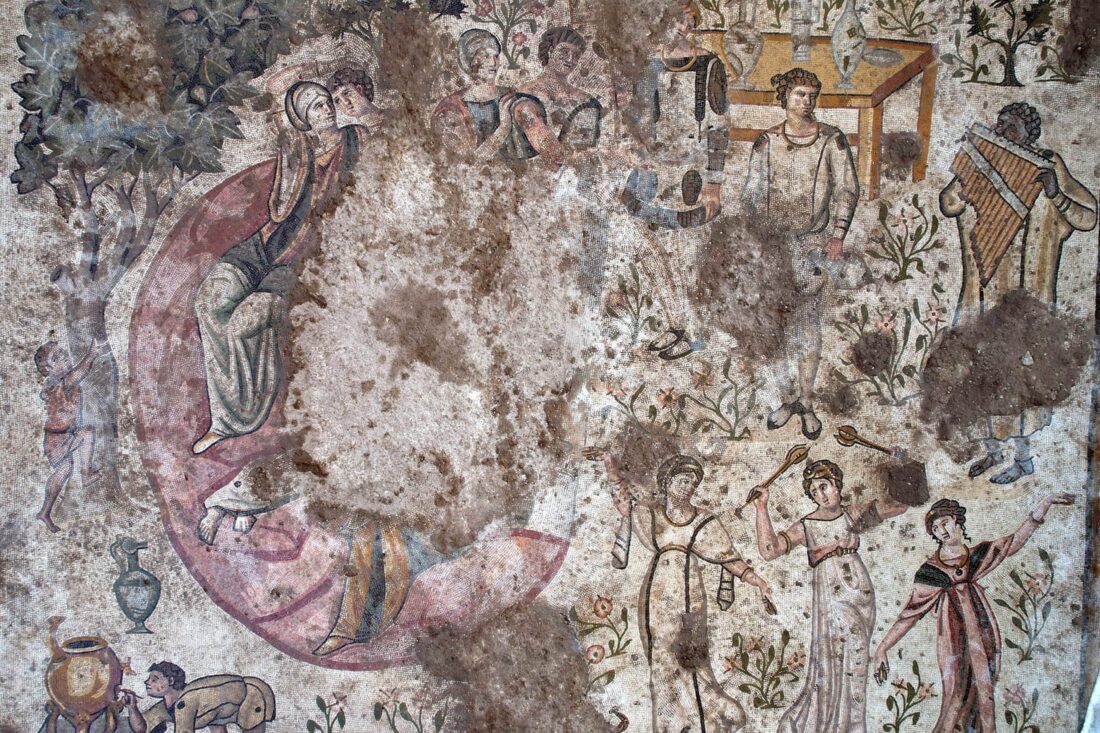
Full view of the mosaic depicting an open-air feast, with details such as women dancing to music, and a boy climbing a fig tree. What else can you spot? (DHA Photo)
“We think the [newly discovered] mosaic probably portrays an open-air banquet before the hunt was held” Safinaz Acıpayam, the director of Kahramanmaraş Museum, has told the Demirören news agency.
“There are two couples sitting in the middle center and there are three women dancing accompanied by music. There is also the figure of a barefoot little boy climbing a fig tree,” she continued.
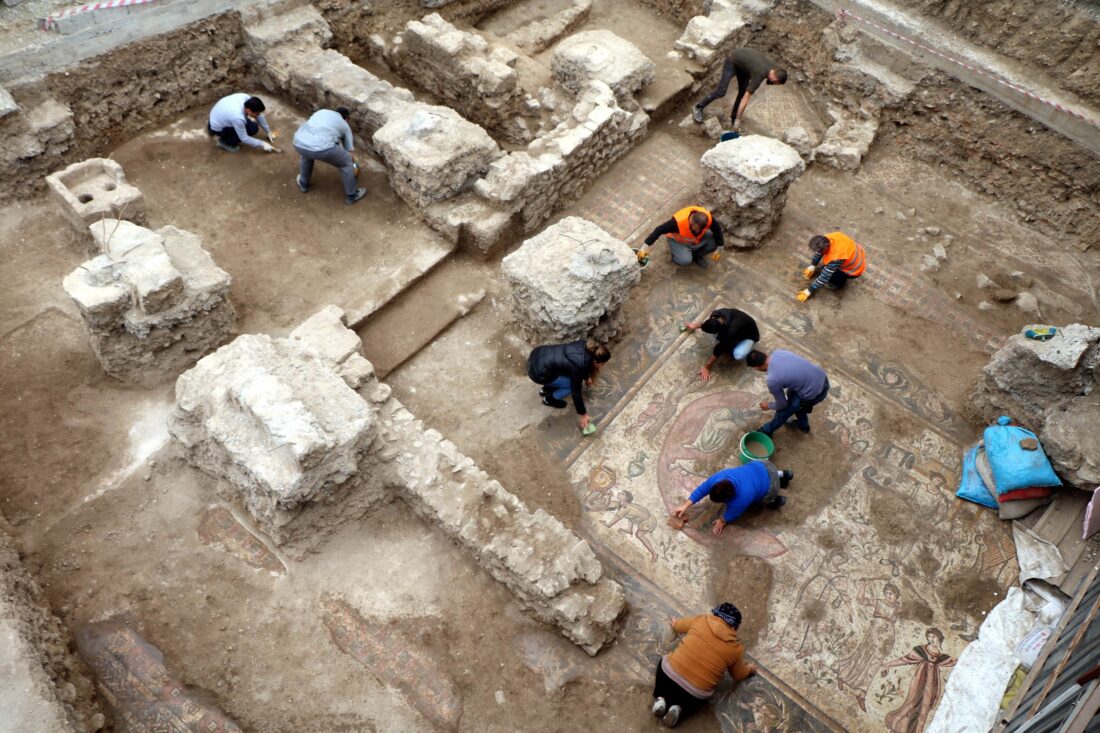
Several archeologists work to carefully unearth the mosaics found at the ancient city of Germanicia, Turkey. (DHA Photo)
But this is not the first mosaic to have been discovered here. In fact, archaeologists have been carefully unearthing the ruins of the once-great city of Germanicia in southern Turkey for nearly a decade, and believe it spans over a 140-hectare (345.95-acre) area. But how did it all end up below a modern suburb?
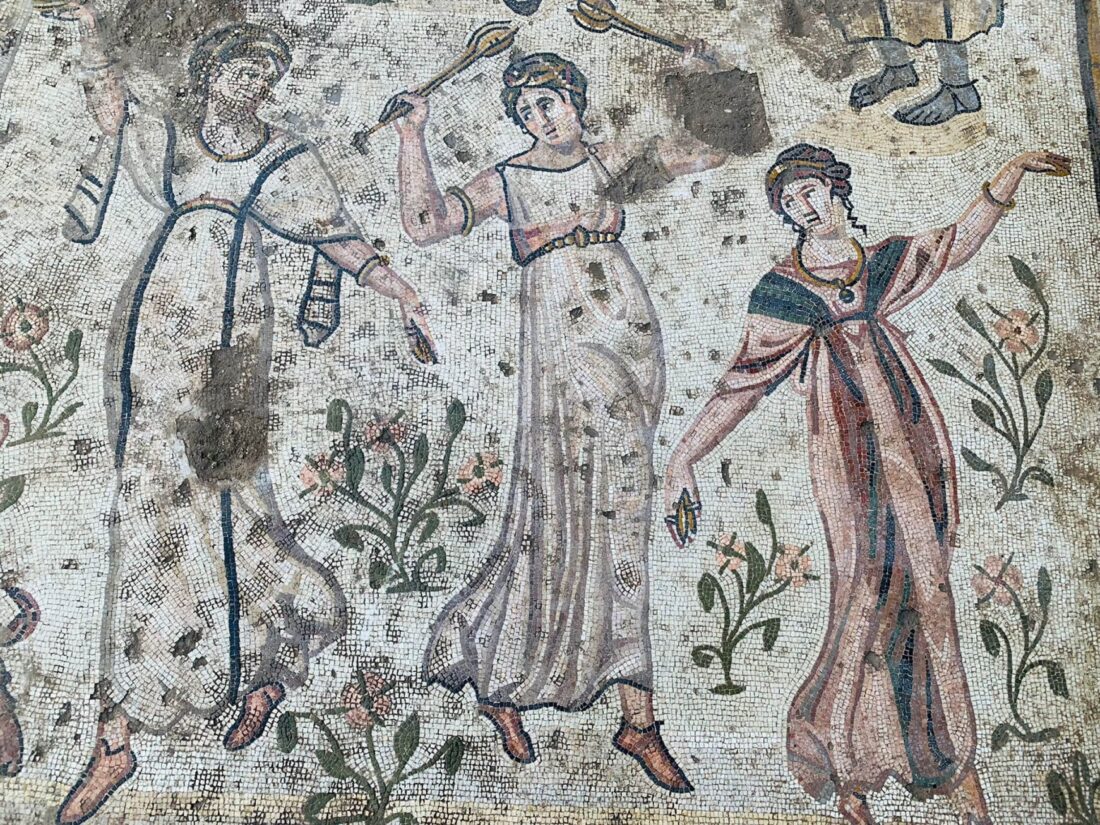
Detail of the mosaic showing three women dancing (DHA photo)
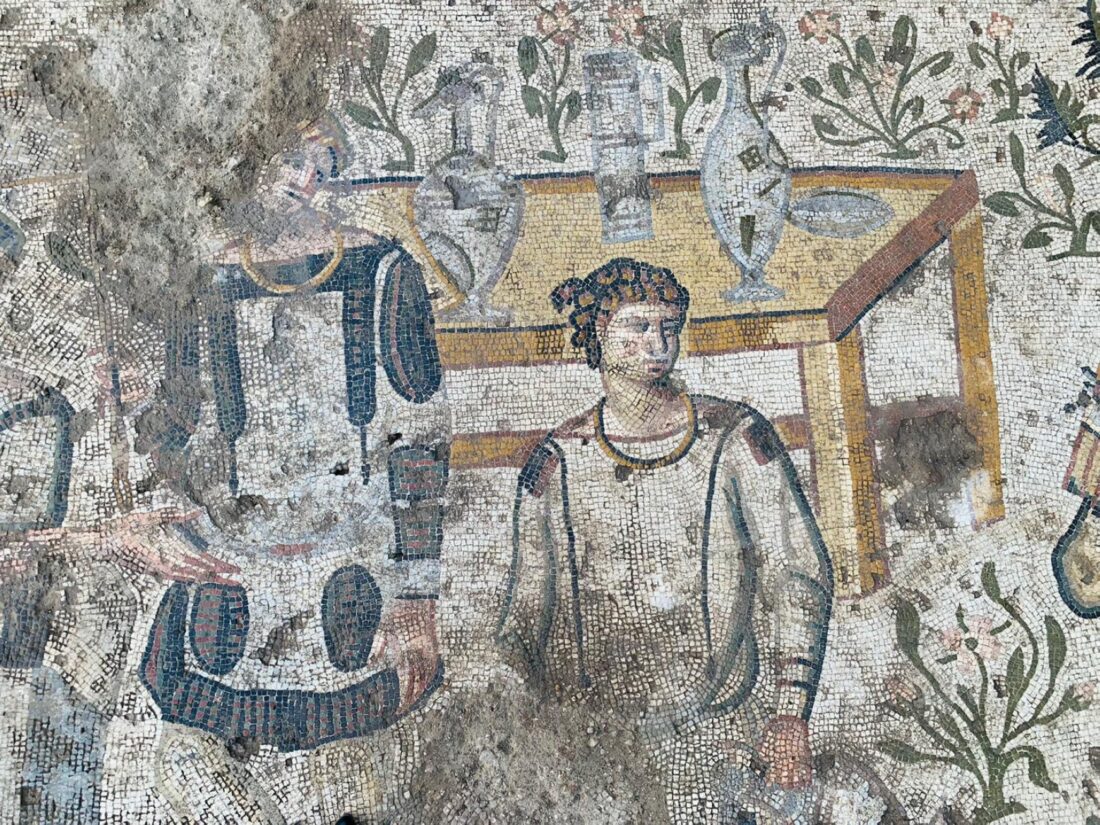
Revellers infront of a table laden with food and drink (DHA photo)
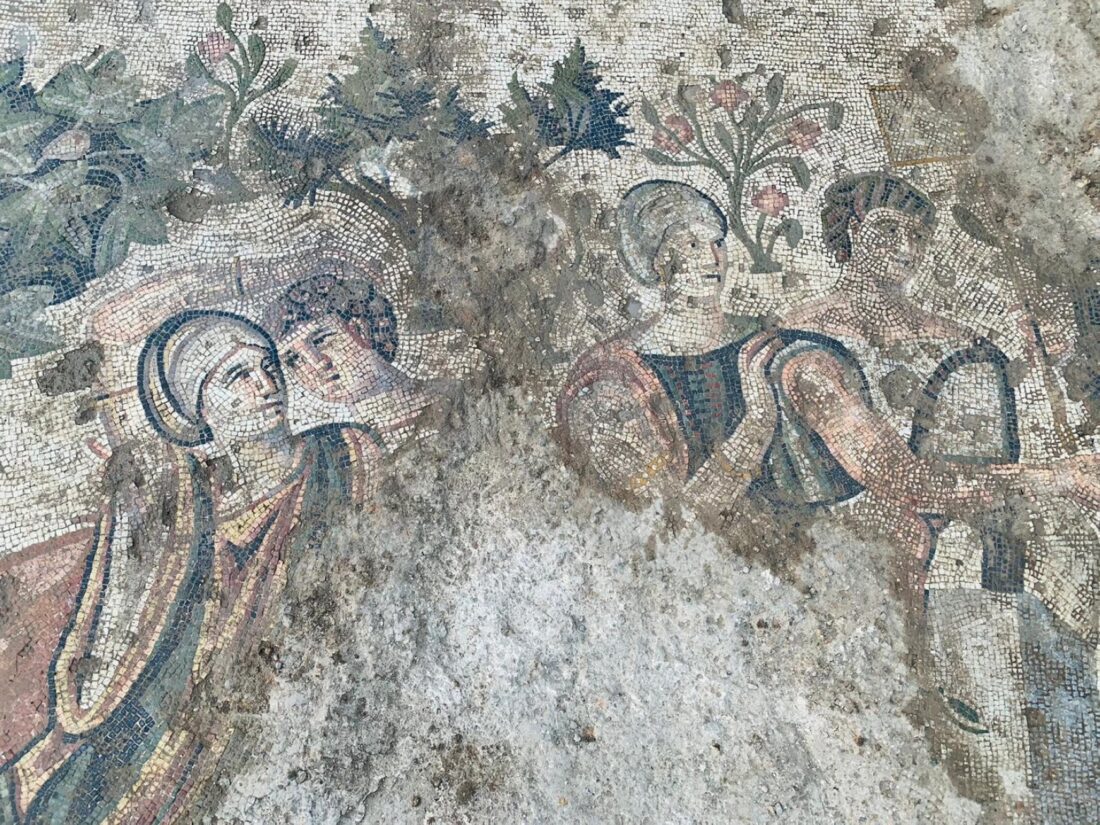
More details of the pre-hunt party (DHA photo)
Over the centuries, the city was ruled by Hittites, Urartians, Assyrians, Persians, Macedonians, and Seleucan kings, and was later conquered by the Romans who gave the city its final name Germanicia Caesarea – probably in honour of Emperor Gaius Caesar Augustus Germanicus.
Eventually finished off by landslides and fire, the city was buried below ground, and remained hidden for nearly 1,500 years.
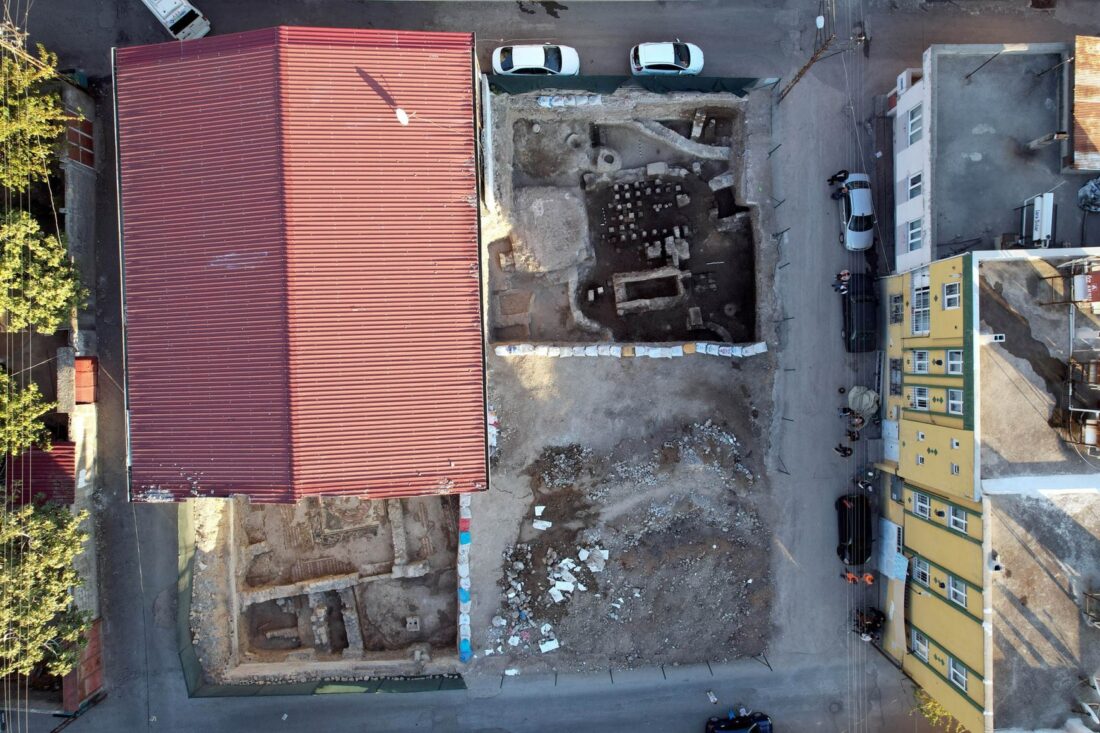
Aerial photo of the excavation area (DHA photo)
Though it is mentioned in historical sources, its location remained a mystery until the 21st century when, in 2007, an illegal excavation revelaed a glimpse of some spectacular mosaics below the foundation of a house in the modern city of Kahramanmaraş.
Alerted, the museum of Kahramanmaraş conducted a field study that revealed that still more magnificent mosaics lay beneath the surrounding development of modest one- and two-storey modern houses.
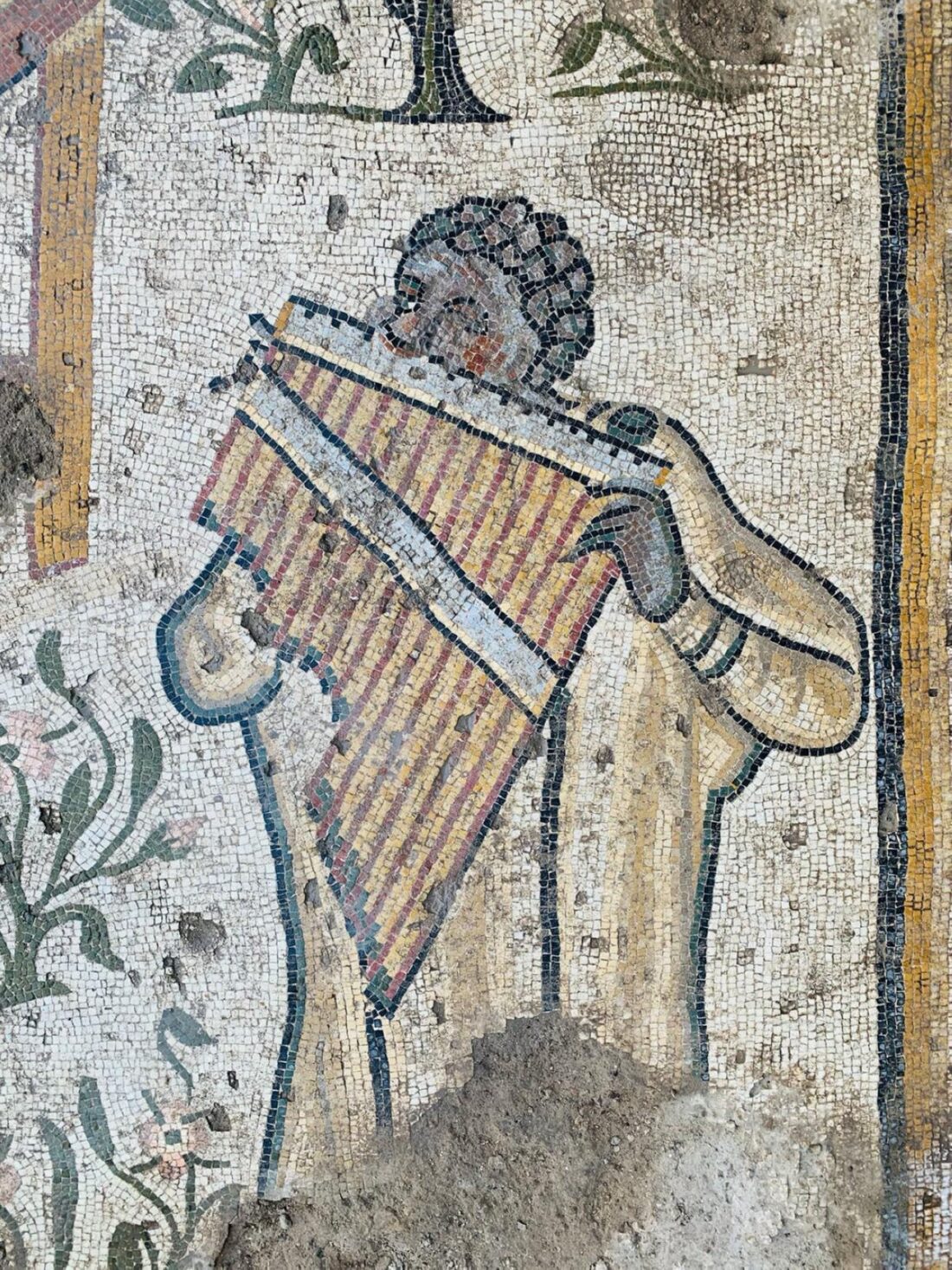
A musician plays for the women at the feast (DHA photo)
Since then, the Ministry of Culture and Tourism has reclaimed the land, and the museum has carried out intensive rescue excavations.
The team believe that the newly discovered mosaic continues a story depicted by two more panels that were uncovered in 2015, showing the scenes of a hunt, suggesting that the new mosaic may show a pre-hunt party.
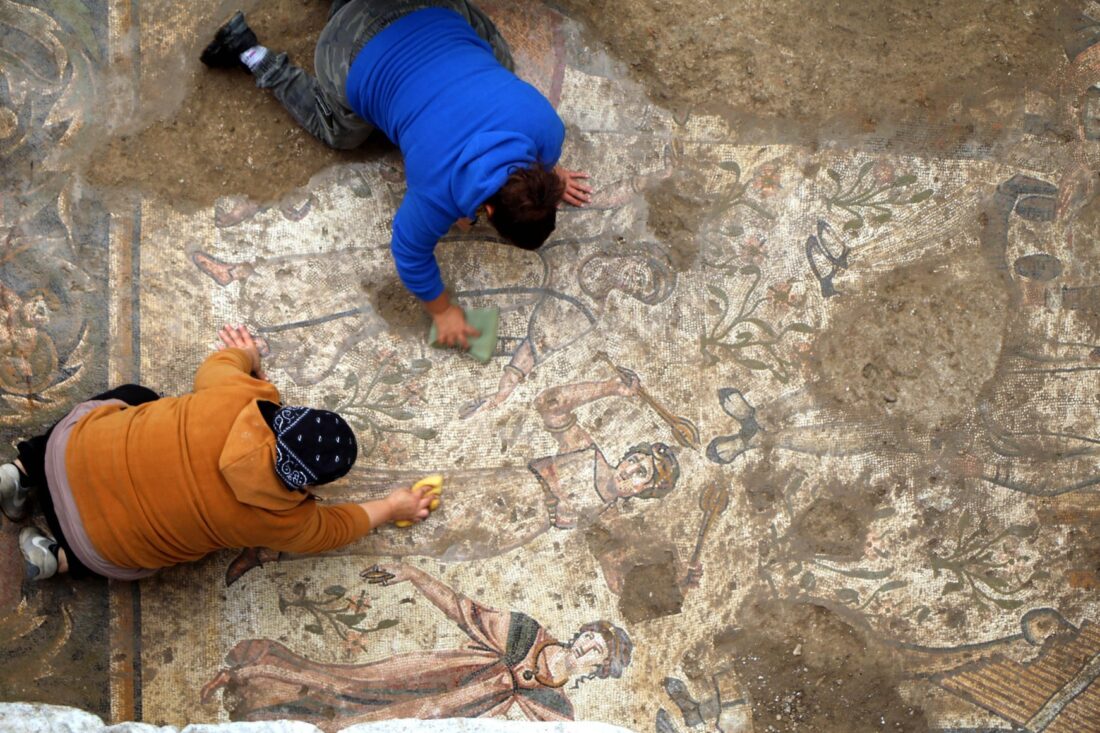
Details are slowly emerging from under the dirt as archeologists remove it, at the ancient city of Germanicia, Turkey, Jan. 31, 2022. Credit: DHA News
The team has just completed the seventh stage of archaeological excavations in the ancient city, during which the remains of 1,500-year-old architectural structures, baths and mosaics were found.
Kahramanmaraş Museum Director Safinaz Acıpayam stated that within the borders of the ancient city, archaeological remains have been identified in 35 different areas so far and archaeological digs in seven of these areas have been carried out under the presidency of the Kahramanmaraş Museum Directorate.
About 20 different mosaics have been revealed in total, and preliminary studies suggest that the mosaics belonged to Roman villas inhabited by the local elite and military leaders.
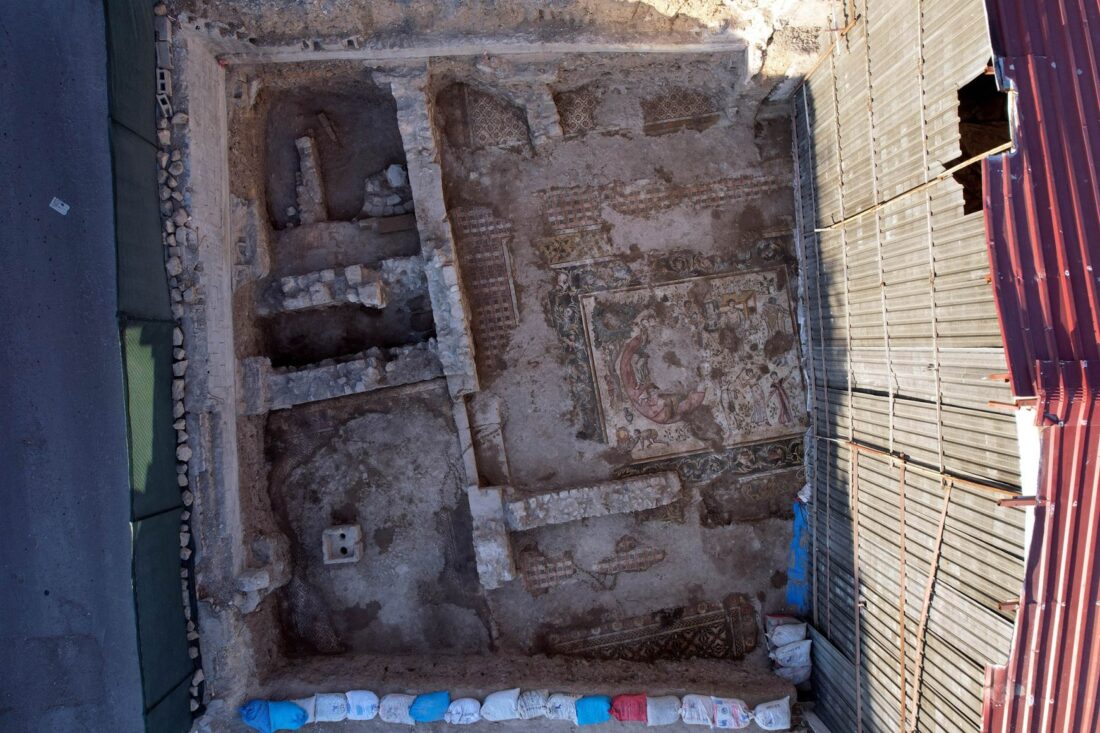
Aerial photo of the mosaic among the ruins of the ancient city of Germanicia (DHA photo)
The houses were built into the sides of the hill, which not only enabled their owners to keep a watchful eye over their property in the countryside below, but also ensured a cool mountain breeze during the hot summer months.
There are probably about 100 residences, each comprising several interconnecting rooms. The mosaics, which were laid over the ground-floor levels and are mostly intact, date to the Late Roman Period in the 4th-6th centuries AD.
The team plans to continue the excavations in the same area in 2022, and to open the area where the excavations were carried for display.
Other discoveries from the city are already on display Kahramanmaraş Museum, which includes a dedicated Mosaic Exhibition Hall, as well as displays covering the palaeolithic, neolithic, chalcolithic, Bronze, Iron, Hellenistic, Roman, Byzantine Ages.





There are no comments on this post yet. Be the first!