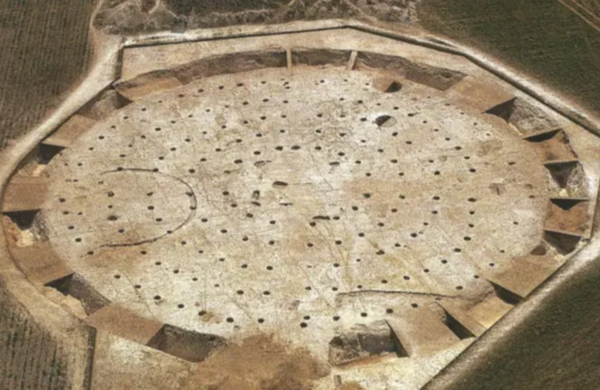
The Mount Pleasant site was originally excavated in 1970-1. 📸 Cardiff Uni
New dating evidence suggests that the Dorset monument didn’t take centuries to build. Instead, it may have been constucted within a few decades, amid a flurry of activity that took place around 2,500 BC – just before people arrived from what is now mainland Europe
Mount Pleasant in Dorset is one of the five so-called ‘mega henges’ known in southern England. Others include Durrington Walls and Avebury in Wiltshire. Like Stonehenge, they were all built at roughly the same time – around 5,000 years ago.
Now, a new study has found that the Mount Pleasant mega henge may have been built in as little as 35 years, rather than constructed over centuries as had previously been thought.
Spanning an area equivalent to nine football pitches, the site is absolutely huge, and included both a henge (a circular enclosure surrounded by bank and ditch), and a palisade (a fence made of huge tree trunks).
The site, which was originally excavated in 1970-1, is now little more than a ploughed field, but archaeologists at the time recovered an incredible array of artefacts, including antler picks, pieces of charcoal and human bone.
Thanks to new technology, a team of researchers from Cardiff University were able to date some of these items (which are held at the Dorset County Museum) using techniques that weren’t available in the 1970s.
As a result, they managed to get a total of 59 radiocarbon dates, which has provided a much clearer idea of the order in which each of the monument’s constituent parts were constructed, and when; first the henge, shortly followed by the timber palisade, then the surrounding ditch.
The research, which has been published in the Proceedings of the Prehistoric Society journal, concluded that the bulk of the site was all constructed within a relatively short timespan of 35 – 125 years, starting in the 26th century BC (4,600 – 4,500 years ago).
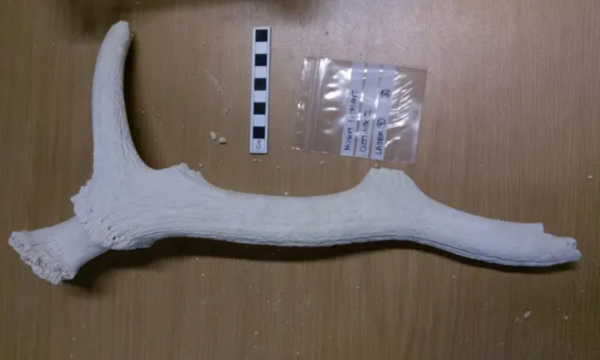
A pick made from antler. One of the artefacts that was radiocarbon dated. 📸 Cardiff University
The finding has led the team to put forward the theory that an intense burst of building activity took place at the end of the Neolithic period, with large, labour-intensive monuments being constructed across southern Britain around 2,500 BC – just before people arrived from what is now mainland Europe with other belief systems, ways of life and materials.
So was it some kind of ‘last hurrah’ by a population who sensed that fundamental change was in the air?
In an interview with The Guardian, lead researcher Sue Greaney (who actually joined our excavation at Oldbury Camp), the building of Mount Pleasant would have involved “a huge number of people – digging out the enormous ditches with simple tools like antler picks. This was right at the end of the stone age, just before people came from the continent with metal goods, new types of pottery, new styles of burial and so on”.
Read more: What is a henge?
“You could look at it as the last hurrah of the stone age. They could see the changes coming and decide to resist them – they may have been thinking: ‘We don’t need these changes. We’ll build bigger and better monuments to our gods. We’ll knuckle down and stick with what we know’.”
But that’s just one theory, says Greaney. “It may also be that the effort of building these monuments led to a rebellion or a collapse in belief that created a vacuum that allowed people to come in from the continent.”
She pointed out that part of a central stone monument appears to have been broken. “Was it destroyed during a time of unrest?”
Peter Marshall, of Historic England, said: “This research shows the importance of archaeological collections stored in museums. Even though the site was excavated 50 years ago, it has been possible to use utilise new scientific techniques to examine the material held in Dorchester.
“As archaeological practices evolve, the value of these museum collections and the importance of their long-term preservation cannot be underestimated.”
Archaeology in your inbox?!
Want to join a dig? Learn more about archaeology? Join our email list for a monthly digest of our most popular stories, plus alerts for any digs, events, or courses you can join.
Join the list
Written by Maiya Pina-Dacier
Director of Engagement at DigVentures, Maiya digs with a trowel in one hand, and a Twitter feed in the other. She loves finding new ways to get people involved in archaeology - online and in the field.




There are no comments on this post yet. Be the first!