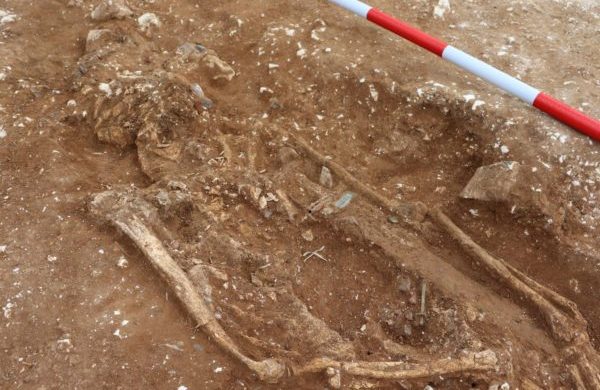
The discovery of a warrior burial in Berkshire could change historians’ understanding of early medieval Britain.
The individual, who dates back to the 6th century (AD 500s), is believed to be a high-status warlord, say archaeologists from Reading University.
Dubbed ‘the Marlow Warlord’, the individual was buried with an array of expensive luxuries and weapons, including spears, bronze and glass vessels, dress-fittings, shears and other implements.
Archaeologists also recovered the warrior’s sword, along with an exceptionally well-preserved scabbard made of wood and leather with decorative bronze fittings – making it one of the best – preserved sheathed swords known from the period. And at 6 foot tall, would have been a commanding figure.
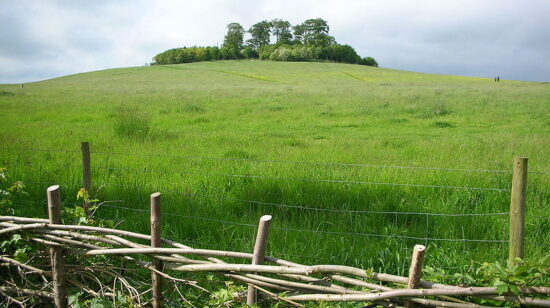
The burial, on a hilltop site with impressive views over the surrounding Thames valley, lay undisturbed for 1,400 years, until two metal detectorists, Sue and Mick Washington came across the site in 2018.
Sue, who along with other members, had visited the site several times previously, initially unearthed two bronze bowls. Realising the age and significance of the find, she stopped digging and the Club, in line with best practice, registered this discovery with the Portable Antiquities Scheme (PAS), who then organised a targeted excavation to recover the very fragile bronze vessels. In the process, they recovered a pair of iron spearheads which suggested that the context was likely to be an Anglo-Saxon era grave.
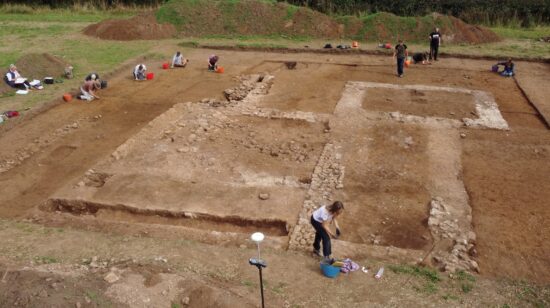
Recognising the importance of the burial and the need for more detailed archaeological investigation, a team led by the Department of Archaeology at the University of Reading carried out a full survey and excavation in August 2020, including geophysical survey, test excavations, and a full excavation of the grave site.
The burial was at a very shallow depth, making the excavation crucial to protect it from farming activity.
Dr Gabor Thomas, a specialist in early medieval archaeology at the University of Reading, said: “what we found exceeded all our expectations and provides new insights into this stretch of the Thames in the decades after the collapse of the Roman administration in Britain.
The early medieval or ‘Anglo-Saxon’ period was one of great change in England with significant levels of immigration from the continent and the formation of new identities and power structures in the vacuum created by the collapse of the Roman administration around 400 AD.
Around a century later – the period in which the Marlow Warlord lived – England was occupied by local tribal groupings, some of which expanded into Anglo-Saxon kingdoms, such as Wessex, Mercia and Kent.
“This the first burial of its kind found in the mid-Thames basin, which is often overlooked in favour of the Upper Thames and London. It suggests that the people living in this region may have been more important than historians previously suspected” said Gabor.
“This guy would have been tall and robust compared to other men at the time, and would have been an imposing figure even today. The nature of his burial and the site with views overlooking the Thames suggest he was a respected leader of a local tribe and had probably been a formidable warrior in his own right.”
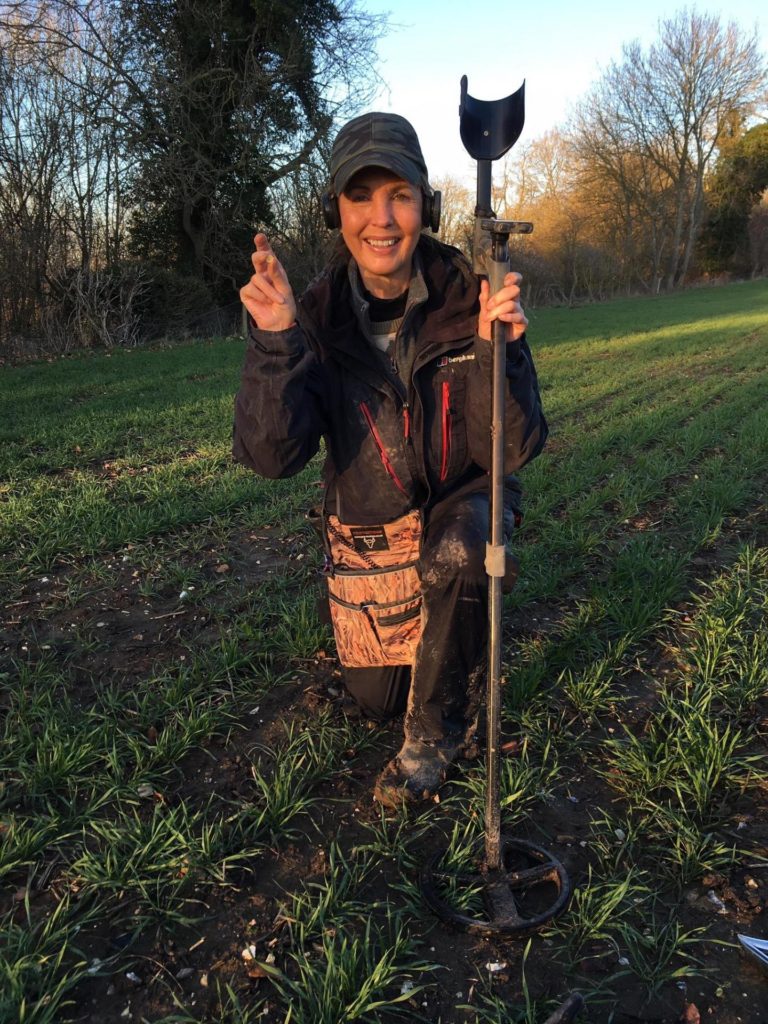
Sue Washington, whose actions lead to the discovery and excavation of the burial
The region of the mid-Thames between London and Oxford was previously thought to be a ‘borderland’ in this region, with powerful tribal groups on each side. This new discovery suggests that the area may have hosted important groups of its own.
It is likely that the area was later squeezed out or absorbed into the larger neighbouring proto-kingdoms of Kent, Wessex and Mercia.
Thanks to the metal detectorists’ actions, the bowls and spearheads are now being conserved by Pieta Greaves of Drakon Heritage and Conservation and, following Sue’s generous donation, are soon to go on display at Buckinghamshire Museum in Aylesbury.
Further analysis of the human remains will be carried out at the Department of Archaeology, University of Reading, to help determine the man’s age, health, diet and geographical origins.
The team are now hoping to raise funds to pay for further conservation work, to allow some of the finds to go on display to the public at the Buckinghamshire Museum.
Archaeology in your inbox?!
Want to join a dig? Learn more about archaeology? Join our email list for a monthly digest of our most popular stories, plus alerts for any digs, events, or courses you can join.
Join the list
Written by Maiya Pina-Dacier
Director of Engagement at DigVentures, Maiya digs with a trowel in one hand, and a Twitter feed in the other. She loves finding new ways to get people involved in archaeology - online and in the field.




There are no comments on this post yet. Be the first!