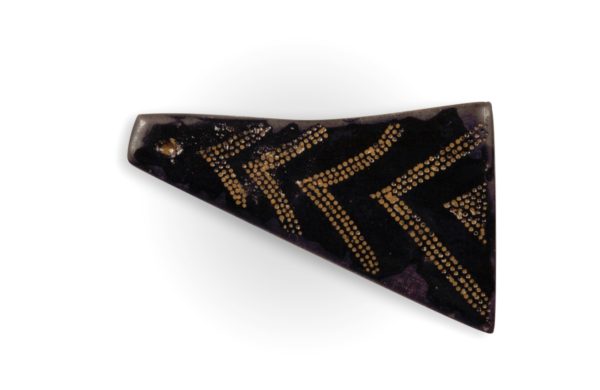
Archaeologists on the Isle of Man have found a 4000 year old necklace made of jet that probably came all the way from Yorkshire
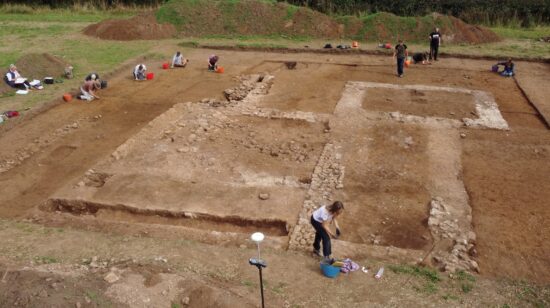
Archaeologists at Berk Farm on the Isle of Man have been excavating a series of Bronze Age burial mounds in an attempt to find out how they were built, and how ancient Manx burial practices developed in relation to those on surrounding islands.
A stone-lined grave contained the skeletal remains of someone buried around 4000 years ago, along with a necklace of jet beads.
The excavation team say the jet, which is an organic black gemstone formed from wood that’s been submerged in water, is likely to originate from Whitby, Yorkshire.
“These beads are a good indicator of long distance contact across the British Isles and so are particularly important for our understanding of Early Bronze Age trade and travel” said Dr Chris Fowler (Newcastle University).

Decorated jet spacer plate from bead necklace, showing diamond-shaped design. The bead is wet to keep it stable. The beads have not been cleaned and the orange colour is wet soil. Overall length 4cm.
“The fact that this burial was found undisturbed, with both the skeletal remains and associated artefacts in place is critical for our understanding of how Bronze Age people on the Isle of Man treated the dead” said Dr Emily Banfield (University of Leicester).
The project has involved extensive research of archaeological records held by Manx National Heritage, analysis of aerial photography and LiDAR data, field surveys at various Bronze Age burial sites around the Island and detailed study of prehistoric human remains in the Manx National Heritage collections.
“We know that 4000 years ago there were big changes in society – in day-to-day life, in technology and in burial practices. Those results will enable us to… promote a more detailed story of not only the Bronze Age in general, but specifically the Bronze Age on the Isle of Man” said Edmund Southworth, Director for Manx National Heritage.

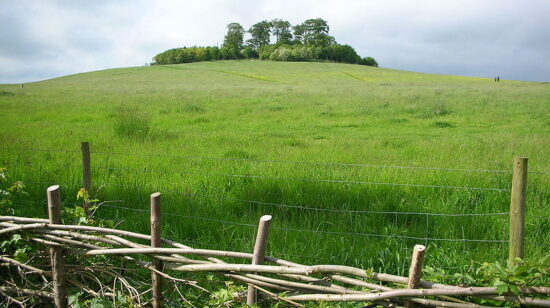
The Round Mounds site on the Isle of Man
Last season, excavation established that the artificial mound was used for hundreds of years. Pottery vessels and cremated human remains were uncovered, along with flint and stone tools.The excavation is part of the Round Mounds of the Isle of Man project run by Drs Crellin and Fowler, which is being supported by Manx National Heritage, Newcastle University, the University of Leicester, and the Isle of Man Steam Packet Company.
The team has been excavating the site for four years, offering organised site visits for local residents and special interest groups, as well as school workshops and excavation training.
Archaeology in your inbox?!
Want to join a dig? Learn more about archaeology? Join our email list for a monthly digest of our most popular stories, plus alerts for any digs, events, or courses you can join.
Join the list
Written by Maiya Pina-Dacier
Director of Engagement at DigVentures, Maiya digs with a trowel in one hand, and a Twitter feed in the other. She loves finding new ways to get people involved in archaeology - online and in the field.




Comments (1)
Fantastic find especially when considered along side similar finds In Scotland and England.