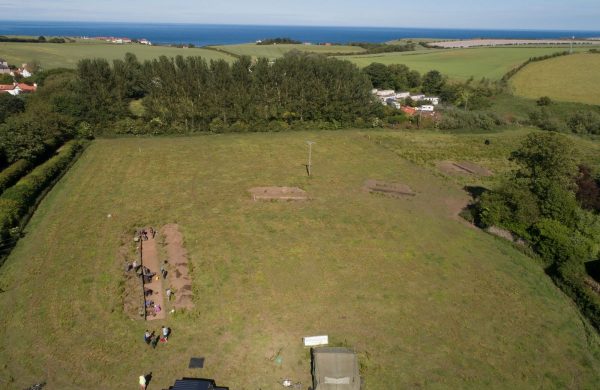
Aebbe (AD 615-668) was instrumental in the early spread of Christianity along the north east coast of Britain, and an example of a powerful Anglo Saxon woman who helped shape British history. Born a pagan princess, she became an abbess, established a monastery at Coldingham, and was later made a saint. For decades, archaeologists have tried to locate her monastery at Coldingham, which was destroyed by Viking raiders in AD 870.
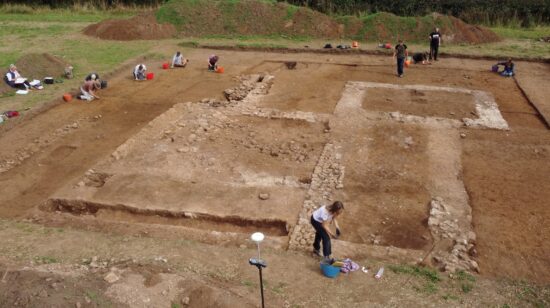
Now, excavations led by DigVentures have found traces of a vast, but narrow circular ditch, which is likely to be the ‘vallum’, the boundary surrounding Aebbe’s religious settlement.
“The section of boundary ditch we found links up with two other ditch sections, and together they seem to encircle Coldingham Priory, meaning that the heart of Aebbe’s monastery is somewhere underneath it,” said Manda Forster from DigVentures.
In the area just outside the boundary, where small-scale industries like metalworking or pottery production would usually have taken place, the team also uncovered a huge pile of butchered animal bones which radiocarbon dating has just confirmed date to AD 660 – 860.
“This is pretty much exactly when Aebbe’s monastery was in existence. Originally built around AD 640, it is said to have burned down shortly after her death, but was then rebuilt and thrived until it was destroyed once again by Viking raiders 200 years later” she added.
Previous attempts to find Aebbe’s monastery had followed traditional claims that it was probably on the headland, at a cliff-top location overlooking the sea, but no hard evidence consistent with an extensive, wealthy Anglo-Saxon monastery was ever found. This time, archaeologists looked further inland, to where Coldingham Priory is now located.
“We based our search on a geophysical survey which revealed the outlines of several possible archaeological features, plus a series of individual finds including fragments of an Anglo Saxon belt fitting and sculpture, all of which seemed to centre on the later medieval priory in the heart of the village – and it makes sense that the later Benedictine monastery was built on the site of its Anglo Saxon predecessor!” she said.
It wouldn’t have been possible to dig the whole site, so the team drew up a shortlist and took the bold step of asking their followers to help narrow down the choices. Nearly 700 people pored over maps and descriptions before giving their vote.
“We collaborated with the public on choosing where to dig, and they made a very smart decision, shunning some of the more glamorous suggestions we put forward in favour of a big, dark splodge on the map. We might not have excavated that particular spot if it hadn’t been their top choice, but it turned out that this is where we found the material that allowed us to get a very secure radiocarbon date” she said.
In total, the team excavated four different trenches, balancing the public’s choice with their own expertise.
“It is brilliant to finally be able to announce that we’ve found Aebbe’s monastery, and to confirm that part of it is probably underneath Coldingham Priory. Aebbe is an extraordinary figure – an example of a powerful Anglo Saxon woman who played a big part in establishing Christianity in the region during the 7th century. Now that we’ve got evidence to pinpoint exactly where her monastery was, we can help bring her story back to life,” she added.
The excavation was crowdfunded by DigVentures, with support from the National Lottery Heritage Fund and Friends of Coldingham Priory. You can read more about the discoveries at digventures.com
Notes to editors:
Images can be downloaded here. Credit to DigVentures / Aerial_Cam
Additional information about Aebbe, princess, abbess and saint
- Born a pagan, Aebbe was the daughter of a Northumbrian warlord. When her father was killed, she fled with her siblings to Dál Riata, a kingdom that extended across parts of western Scotland and north eastern Ireland. It was a hub of early Christianity, and the family quickly converted to Christianity.
- When her brother Oswald returned to Northumbria in AD 635 to reclaim the family throne, she joined him on a shared mission to convert the still largely pagan population.
- Oswald is widely celebrated for creating the famous monastery on Lindisfarne which, because of its astonishing wealth, became the first place to be raided by Vikings in Britain, now making it one of the most famous Anglo-Saxon sites in British history. Although Lindisfarne and Coldingham are two halves of the same story, Aebbe’s half of the story at Coldingham is much less well known.
- Aebbe would have been one of the most eligible brides in the kingdom, but she refused to marry. In fact, she is said to have prayed so hard not to be married to a particular prince who was pursuing her that water rose up and prevented him from reaching her for three whole days, by which time he’d given up.
- Instead, she established the monastery that helped her brother maintain control over the northernmost parts of his kingdom, holding a community of pagans and Christians together.
- She educated Queen Aetheldreda, who later went on to establish a monastery on the site that would become Ely Cathedral. She also negotiated the release of Bishop Wilfrid.
- Her monastery was home to both monks and nuns, and would also likely have been frequented by nobles. Like many of these double monasteries and other establishments run by women, later clerics like Bede painted it as place rife with feasting, drinking and other misconduct.
- Despite Bede’s account, Aebbe herself continues to be described as a wise, pious and holy woman, and she seems to have been held in extraordinarily high regard. She was even visited by Saint Cuthbert, Bishop of Lindisfarne, who is usually said to have avoided the company of women.
- It is here, at Coldingham, where the miracle of Saint Cuthbert getting his feet licked by otters after praying all night in the sea took place
- Aebbe’s monastery is said to have burned down shortly after her death, but was rebuilt after a brief period of abandonment.
- Aebbe’s monastery was finally destroyed in AD 870 by Viking raiders. The abbess at the time, Aebbe the Younger, is said to have ‘cut off her nose to spite her face’ and instructed her nuns to do the same in order to repulse their attackers
Additional information on the animal bone and radiocarbon dates:
- The excavation recovered hundreds of animal bones including cattle, horse pig, sheep/goat, domestic fowl and red deer, the animal bone spreads represent the disposal of carcasses after processing with the high value joints of meat consumed elsewhere within the complex. They were eating well!
- A piece of animal tooth has been radiocarbon dated to between 664 – 864 AD, indicating that the extensive animal bone spread recorded in Trench 8 is Anglo Saxon in date. We can now confidently say that substantial activity was taking place right in the centre of Coldingham at the time that Aebbe’s monastery existed.
About DigVentures
DigVentures crowdfunds archaeological excavations that anyone take part in, online or in the field. Over the last few years, they have crowdfunded in-depth investigations at a number of the UK’s most iconic sites, including the Bronze Age settlement at Flag Fen, the Anglo-Saxon monastery on Lindisfarne, and one of the earliest Roman settlements ever discovered in East Yorkshire. DigVentures is registered with the Chartered Institute for Archaeologists, and runs the UK’s only accredited fieldschool.
Archaeology in your inbox?!
Want to join a dig? Learn more about archaeology? Join our email list for a monthly digest of our most popular stories, plus alerts for any digs, events, or courses you can join.
Join the list
Written by Maiya Pina-Dacier
Director of Engagement at DigVentures, Maiya digs with a trowel in one hand, and a Twitter feed in the other. She loves finding new ways to get people involved in archaeology - online and in the field.




There are no comments on this post yet. Be the first!