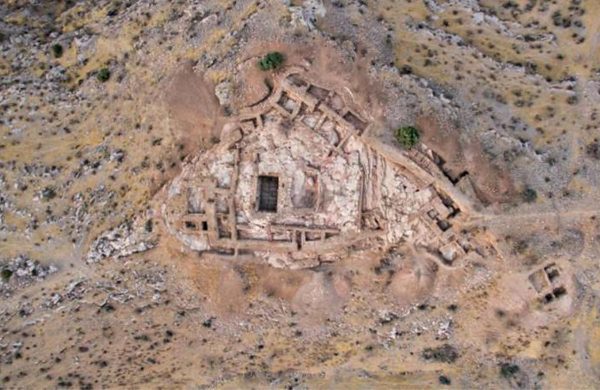
View of the Uzundara citadel from above. 📷 Nigora Dvurechenskaya et al.
This 2,000 year old fortress was the scene of a major assault
Scientists from Russia and Uzbekistan have unearthed a 2,000 year old fortress, revealing the story of its construction, occupation and eventual death in remarkable detail.
Located along what would once have been the northern border of ancient Bactria, a historical region that covered what is now Afghanistan, Uzbekistan, Tajikistan and parts of northern Pakistan, archaeologists say the Uzundura fortress was built to protect the province from nomadic raids.
During the excavations, the team were able to draw up a detailed architectural plan, and collect rich archaeological material, including a cache of over 200 arrowheads that had been fired during what appears to have been a major assault.
They learned that the fortress was constructed over a period of nearly a hundred years, between 300-200 BC, and inhabited for around 150 years before the assault took place
It consisted of a diamond-shaped main quadrangle and a triangular citadel surrounded by powerful double walls with an internal gallery about 9m wide, and 13 bastion-towers fortifying the outer walls.
Surveys also revealed a series of towers and walls, ranging in length from 100 meters to 3 kilometers, which blocked and controlled all possible enemy penetration routes through the surrounding canyons into the fertile valleys of Northern Bactria.
Outside the fortress, archaeologists found evidence of a marketplace where local residents brought goods needed by the garrison soldiers. By recording GPS co-ordinates for each item, the team managed to track a road from the marketplace to the entrance of the fortress.
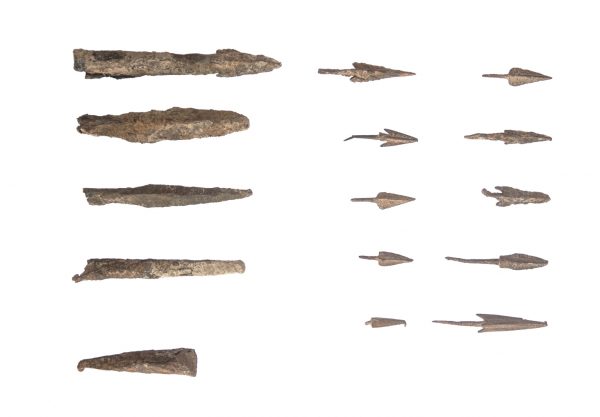
Finds of iron arrowheads and darts. There were also piles of stone cores for slings and pseudo-attic helmets found in the inside-wall room of the south-western fortress wall. 📷 Nigora Dvurechenskaya et al.
And that’s where they found evidence of the assault, including more than 200 arrowheads, slingshot and helmets.
According to their report, the team think the location of the proposed assault site to the east of the fortress provides a tell tale clue: they believe it shows where the attackers found a weak spot in its border defences and managed to break through.
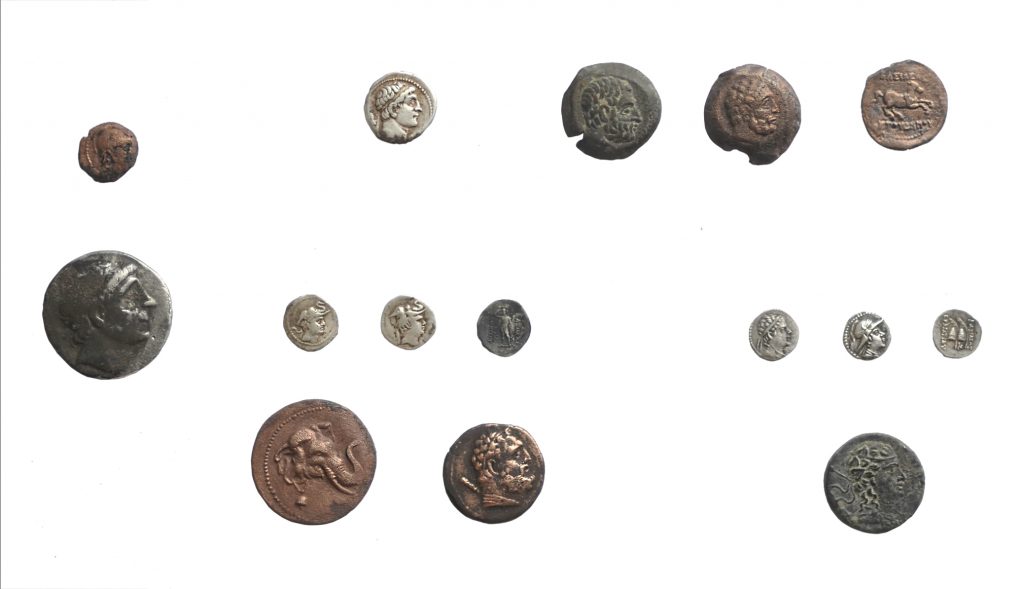
In 2018, after six field seasons, archaeologists completed excavation of the entire area of the citadel (phylacterion) of the fortress of Uzundar. In the process of research, three stratigraphic stages in the life of the fortress were singled out: 1 – the construction and the beginning of the fortress habitation, dated by the coins of Antiochus I; 2 – the period of large-scale redevelopment and repairs of the time of Eutidem I; 3 – the death of the fortress during the reign of Eukratis. 📷 Nigora Dvurechenskaya et al.
Inside a room along the south-western wall, archaeologists also found fragments of armour probably worn by the warriors, including armour-clad plates and two right-handed iron heads from helmets.
As well as weapons, they collected a large number of ceramics, and around 200 coins of different denominations, from silver drachmas to copper mites. Coins were found dating from the reign of Antiochus I, who ruled the Hellenic Seleucid Empire from 281-261 BC, right through to the last king of the Greco-Bactrian kingdom Heliocles, who ruled 145-130 BC.
Bactria had previously been annexed by the Achaemenid Empire. When Alexander the Great defeated the last Achaemenid king Darius III, the satrap (governor) of Bactria attempted to organise a national resistance, but was captured and handed over to Alexander. After Alexander’s death, Bactria became part of the Seleucid Empire, and then the Greco-Bactrian kingdom.
“Such a variety proves that Bactria at the very beginning of Seleucid kingdom formation of the was part of developed monetary circulation system. The materials of Uzundara allow us to study and reconstruct all spheres of life of the Seleucidian and Greco-Bactrian fortresses” said Nigora Dvurechenskaya, researcher at the Department of Classical Archeology, Head of the Bactrian detachment of the Central Asian Archaeological Expedition.
Archaeology in your inbox?!
Want to join a dig? Learn more about archaeology? Join our email list for a monthly digest of our most popular stories, plus alerts for any digs, events, or courses you can join.
Join the list
Written by Maiya Pina-Dacier
Director of Engagement at DigVentures, Maiya digs with a trowel in one hand, and a Twitter feed in the other. She loves finding new ways to get people involved in archaeology - online and in the field.




There are no comments on this post yet. Be the first!