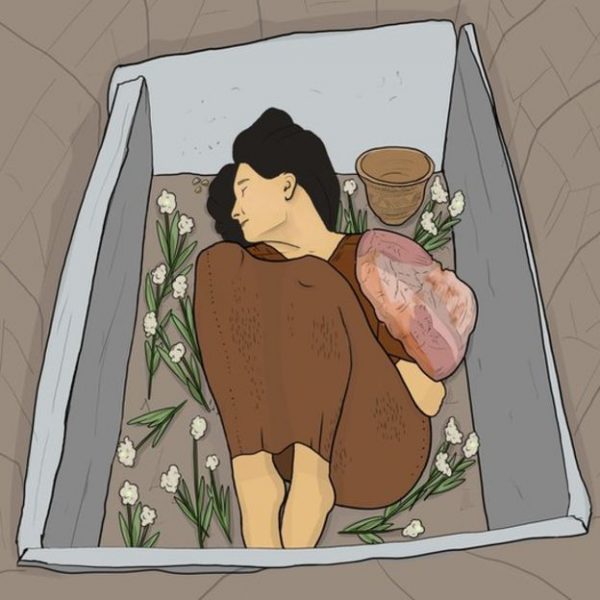
A reconstruction of the woman’s burial in a grave cut from solid rock. 📷 Maya Hoole.
Ancient DNA from a woman who died in Caithness, Scotland during the Early Bronze Age more than 4,250 years ago, suggests that she had brown eyes and hair, and may have been lactose intolerant.
Known as Ava, her bones were originally found in 1987 in a grave at Achavanich in Caithness, near what is now the A9 trunk road, between Latheron and Thurso.
Unlike other burials of the time, which are most commonly found underneath a cairn or dug into soil, hers was cut directly into solid rock.
She was found with a piece of decorated pottery, known as a Beaker, as well as a few other small items.
Originally depicted with red hair and blue eyes, the new research published in Proceedings of the Society of Antiquaries of Scotland suggests that she likely had brown eyes and hair.
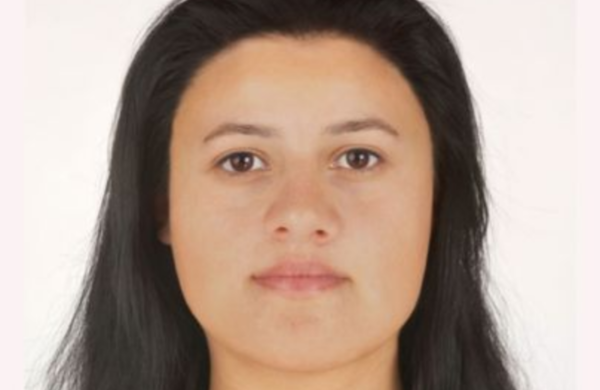
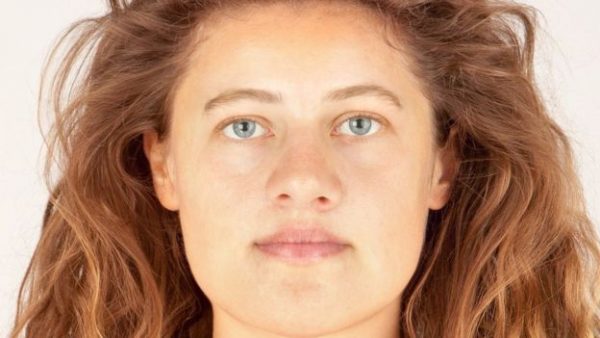
The new analysis of her genomic data has resulted in the making of a new facial reconstruction of Ava (above) by a forensic artist, Hew Morrison. The original reconstruction interpreted Ava with red hair and blue eyes.
The new research, led by archaeologist Maya Hoole, has also shown that her family had arrived in Britain from Europe a few generations before she was born. It also suggests that she may have been lactose intolerant, and lived longer ago than previously thought.
Hoole said the new ancient DNA evidence, gathered by experts at the Natural History Museum in London and Harvard Medical School, had revealed more accurately what Ava would have looked like.
“Archaeologists rarely recover evidence that indicates hair, eye or skin colour but these new revolutionary techniques allow us to see prehistoric people like we never have before” she told the BBC.
“The revelation that her ancestors were recent northern European migrants is exciting, especially as we know that she has no, or very few, genetic connections with the local Neolithic population who resided in Caithness before her” says Hoole.

A decorated beaker from Ava’s burial. 📷 Maya Hoole.
Archaeologists who studied the finds at the time established that she was part of a European group known as the Beaker people, whose culture spread across the European continent and into Britain during the Bronze Age.
Ava was between 18 and 25 when she died over 4,250 years ago, and lived in an area forested with hazel, pine, alder and birch trees.
The community farmed cattle, ate a meat rich diet, was likely using local flora for medicinal practices and were highly skilled at crafting tools and objects.
While the skeletal remains indicate that Ava was a healthy young woman who was likely involved in physical labour, there’s no evidence of what caused her death.
Nevertheless, the way she was buried suggests that extra effort was put into her grave, and that she must have been well respected and greatly cared about.
“I never dreamed we would be able to do and learn so much from Ava” Hoole added.

Ava’s skull 📷 Michael Sharpe
The new facial reconstruction was put together by Hew Morrison, a graduate of the University of Dundee, who had to take special care because the skull was so old and delicate.
Instead of making a plaster cast of the skull, Morrison had to stick to photography and measurements, using information from a database of modern European tissue depths that correlated with Ava’s age, sex and ancestry and drawing the shape of her head and facial features.
He was then able to revise the previous facial reconstruction to show that Ava probably had straight dark hair, brown eyes and a less-fair complexion.
“Whilst the overall shape of Ava’s face and facial features remained as they were previously, darkening her eyes, her skin tone and giving her totally new hair made her look very different to what I initially imagined when I received the DNA results” Morrison told the BBC.
H/T BBC.
Archaeology in your inbox?!
Want to join a dig? Learn more about archaeology? Join our email list for a monthly digest of our most popular stories, plus alerts for any digs, events, or courses you can join.
Join the list
Written by Maiya Pina-Dacier
Director of Engagement at DigVentures, Maiya digs with a trowel in one hand, and a Twitter feed in the other. She loves finding new ways to get people involved in archaeology - online and in the field.




Comments (3)
Fascinating stuff! Sometimes I wish I didn’t live on the other side of the planet, so I could see these things in person. The internet will have to do…
Question: – Given that Ava was buried in a rock-cut grave, why is the beaker broken into pieces?
Stories like this bring the past to the present. DNA has come a long way. Still, I question the conclusions without more of the evidence. Where was the sample taken? How close is the margin for error? Interesting.