
View of the tomb of Kaires from the pyramid of Neferirkare 📷 Czech Institute of Egyptology, Faculty of Arts, Charles University.
Archaeologists have found the remains of a tomb complex belonging to the ‘sole friend’ of an Egyptian pharaoh near a pyramid at Abusir in Egypt.
It’s lonely at the top – or so the popular saying goes, and this new discovery might just give us a glimpse into the heady mix of friendship and responsibility that went into being a priest in the highest echelons of ancient Egyptian society.
A team of archaeologists with the Czech Institute of Egyptology have spent a few weeks investigating a unique burial complex, which appears to belong to a priest and royal confidant called Kaires.
But he was no ordinary priest, and no ordinary confidant. Judging by the architecture of his tomb, and by some of the inscriptions found on a statue inside, this guy was exceptional.

Lower part of statue of Kaires 📷 Czech Institute of Egyptology, Faculty of Arts, Charles University
According to a statement from the investigating archaeologists, the inscriptions describe Kaires as ‘sole friend of the king’. And that’s not all.
They also call him ‘overseer of all the king’s works’, ‘keeper of the secret of the Morning House’ (a building where the pharaohs got dressed and ate breakfast), ‘foremost of the House of Life’ (an institution where Egyptians stored papyrus scrolls containing their knowledge and religious-philosophical treatises – like a library), ‘inspector of the priests serving in the pyramid complexes of kings Sahure and Neferirkare’, ‘priest of the goddess Hathor’, and ‘custodian of the two thrones (i.e. of southern and northern Egypt)’, and several other titles besides.
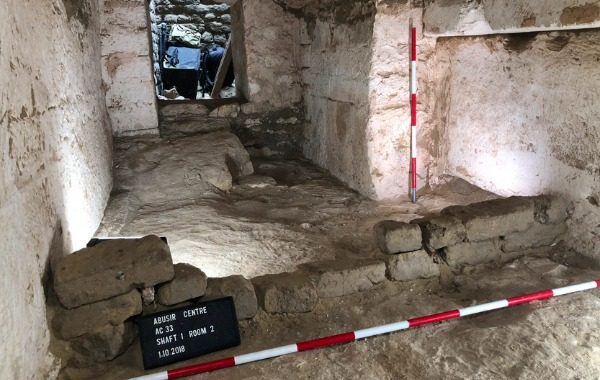
Burial chamber 📷 Czech Institute of Egyptology, Faculty of Arts, Charles University
Together, all these titles place Kaires at the level of a vizier (prime minister). But even so, say the investigating archaeologists, the architecture of his tomb still completely exceeds the contemporary customs even for someone of Kaires’ political status.
His tomb was built right in the heart of a pyramid field belonging to the 5th Dynasty of the Egyptian Old Kingdom (2,500 – 2,400 BC) in an area where only members of the royal family and the highest state dignitaries of the time were buried.
It covers over 500 m2, and includes several rooms for the funerary cult, and for priests to purify themselves in before entering. The burial chamber, which was built as an open pit, was then sealed after the sarcophagus had been lowered into it with several giant limestone blocks, each weighing a whopping 8–9 tons.
And for anyone who might still have their doubts about his ‘special-ness’ to the pharoah, the tomb builders had another trick up their sleeve: they paved Kaires’ chapel with basalt blocks – a material whose use was otherwise the exclusive privilege of kings.

Complete granite statue of Kaires 📷 Czech Institute of Egyptology, Faculty of Arts, Charles University
Although the burial chamber was looted in the past, the granite statue of Kaires somehow miraculously survived in its original position, complete with remnants of colourful paints, and the titles detailing Kaires’ remarkable career.
So what made Kaires so very special? Why was he buried in a way that far exceeded anyone else of similar status? Was it his career? His friendship? And exactly which pharoah’s ‘sole friend’ was he? Although it’s not entirely clear, the investigating archaeologists suggest it may have been Neferirkare; the tomb is a stone’s throw from his pyramid, and one of the inscriptions refers to Kaires being ‘inspector of the priests serving in the pyramid complexes belonging to Neferirkare and his predecessor, Sahure’.
Friend, confidant, and handler of pretty much everything you could want as king… Frankly, Kaires sounds like an absolute diamond, and if we were a pharoah we’d probably want him as our BFF too.
Archaeology in your inbox?!
Want to join a dig? Learn more about archaeology? Join our email list for a monthly digest of our most popular stories, plus alerts for any digs, events, or courses you can join.
Join the list
Written by Maiya Pina-Dacier
Director of Engagement at DigVentures, Maiya digs with a trowel in one hand, and a Twitter feed in the other. She loves finding new ways to get people involved in archaeology - online and in the field.
Read more from Maiya Pina-Dacier +





Comments (1)
What a remarkable find and history. I love archeology and the things we learn from the past.