
Circular rotating fish-hooks found with the burial. (Photograph by Sofía Samper Carro.)
Archaeologists in Indonesia have found the earliest-known example of people burying fishing implements with the dead.
The discovery represents the earliest-known example of fishhooks being placed in a burial as grave goods, according to a new report in the journal Antiquity. The discovery was made in 2014, when archaeologists from Australian National University were excavating a site at the Tron Bon Lei rockshelter on the island of Alor in Indonesia.
Here, the team found an adult skeleton buried with five fish hooks, each made from sea snail shell and placed just below the chin. In the same place, archaeologists also found a perforated bivalve shell which had been smoothed, polished and dyed red. Although the skeleton is only partially complete, it appears to be female, while radiocarbon dating of charcoal from the grave, and of one of the shells, suggests that the burial took place around 12,000 years ago.
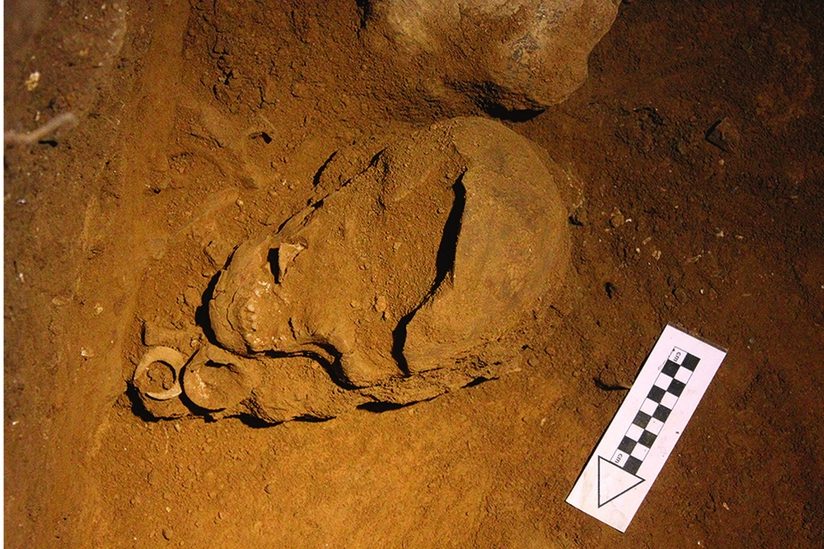
Tron Bon Lei cranium, photographed during excavation. Fish-hook A and perforated bivalve to the north of the mandible. (Photograph by Sofía Samper Carro.)
Archaeologists have found fish-hooks at other sites around the world, including a 23,000 year old example from Japan (the oldest fish-hook found in any context), and a 9,000 year old example from Siberia made from slate, which been the oldest fish-hook found in a burial context until now.
Of the five fish-hooks found at the Tron Bon Lei burial, one of them still bears striations from where its maker may have tried to remove the outer layer of shell, to reveal the shinier inner layer which may have been more tempting to fish. And while one was a familiar J-shape, the rest are circular rotating hooks, similar to designs found on prehistoric sites as far afield as Japan, Australia, Oman, California, Chile, Mexico and Oceania. However, as the study’s authors point out, this does not necessarily indicate cultural contact between these regions, simply that multiple societies came up with similar designs because it was such an effective one.
According to the study, the role of fishing in the afterlife among Pleistocene maritime cultures has hardly been explored, probably because ‘burials of this age are rare in coastal contexts, with most Pleistocene coastal sites having been submerged by sea-level rise following the end of the Last Glacial phase’.
Fishing was undoubtedly important to the prehistoric people of Alor, and this probable female burial is, for now, the earliest example we have of the dead taking their fishing equipment with them into the afterlife.
Archaeology in your inbox?!
Want to join a dig? Learn more about archaeology? Join our email list for a monthly digest of our most popular stories, plus alerts for any digs, events, or courses you can join.
Join the list
Written by Maiya Pina-Dacier
Director of Engagement at DigVentures, Maiya digs with a trowel in one hand, and a Twitter feed in the other. She loves finding new ways to get people involved in archaeology - online and in the field.





There are no comments on this post yet. Be the first!