
The famous Easter Island statues once wore big stone ‘hats’ called pukoa. Now, archaeologists have used 3D modelling to reveal that they were once covered with rock art.
Pretty much anyone will recognise the monumental statues that grace the skyline of Rapa Nui (Easter Island). Now quite weather-beaten and worn, the internet was surprised to discover a few years ago that the bodies of the Rapa Nui statues were covered with tattoo-like designs. Now, a study published in Advances in Archaeological Practice reveals that the pukoa that once topped these huge statues were also highly decorated.
The cylindrical stone hats are made from a volcanic rock known as ‘red scoria’. Weighing multiple tons, they were placed on the heads of the moai during prehistoric times, consistent with the Polynesian traditions of honoring their ancestors.
The study examined 70 pukoa from across the island, and found that even though the stones were pretty weathered, they were still able to reveal some of the decorations that originally adorned their surfaces.
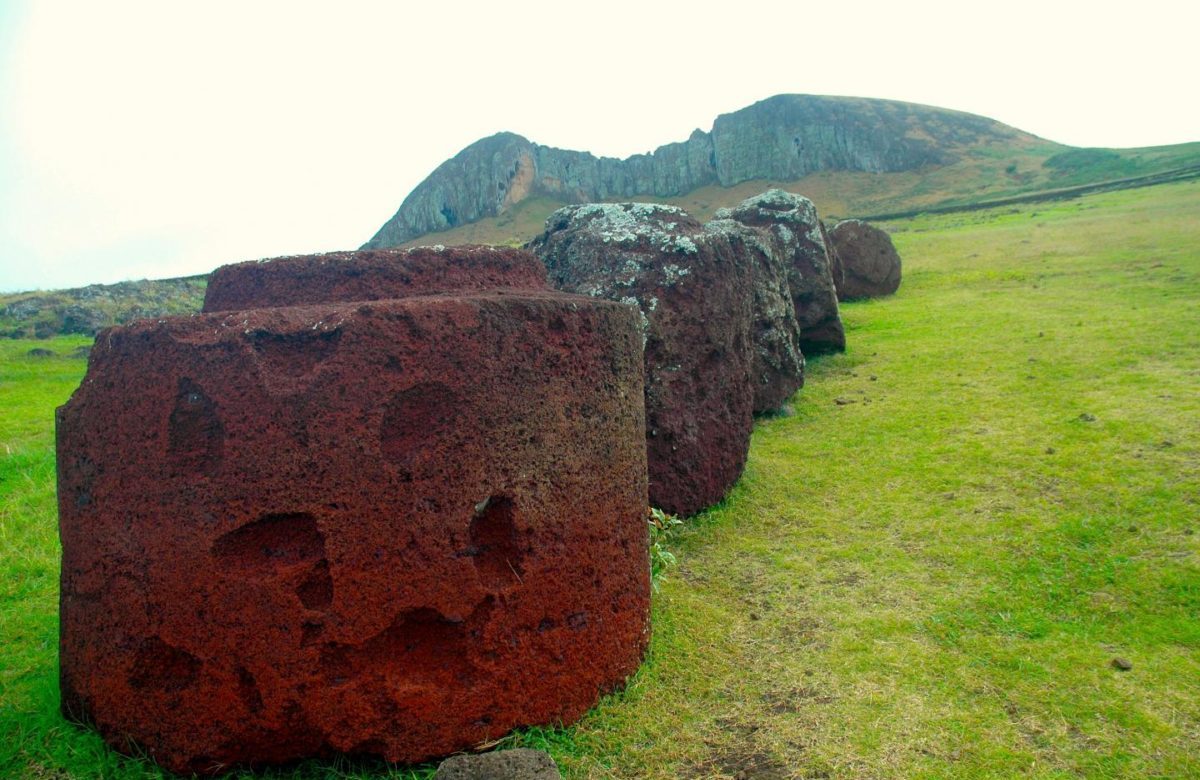
A row of pukaos. Photo: Hixon et al.
To do this, the research team, which included Carl Lipo, a professor of anthropology at New York’s Binghamton University, used photogrammetry – a technique that we’ve been using at DigVentures for the last few years – to produce 3D computer models of the artefacts from photographs.
The team was able to study the eroded surfaces in greater detail and discover that there are far more drawings carved into the hats than was previously thought.
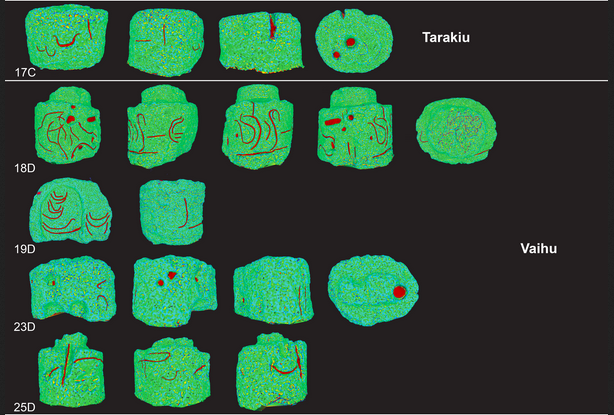
Examples of some of the decorations revealed by studying the hats with photogrammetry. Photo: Hixon et al.
That in itself is remarkable proof of what archaeologists can do with photogrammetry. But the team have also added that they believe the findings can help to change how we think about Rapa Nui’s ancient inhabitants.
Rapa Nui is often held up as an example of what happens when humans over-use their natural resources, and its people are often accused of ecocide. But over the last few years, archaeologists (including Carl Lipo) have started to argue that this is wrong, and that the state of the now uninhabited island has much more to do with the impact of European slavers than anything else.
“Every time we look at the archaeological record of the island, we are surprised by what we find. There is much more to be learned from this remarkable place — important answers that shed light on the abilities of our ancestors, as well as potential ideas for contemporary society about what it takes to survive on a tiny and remote island,” said Lipo in a press release.
While Easter Island is famous, the archaeological record of the island is not well-documented, says Lipo. He believes that scientists can learn a great deal from the pukao by examining this new information.
“The moai construction and pukao placement were key parts to the success of the island… In our analysis of the archaeological records, we see evidence that demonstrates the prehistoric communities repeatedly worked together to build monuments. The action of cooperation had a benefit to the community by enabling sharing of information and resources.”
And on that lovely and co-operative note, we wish you all a merry midwinter.
Archaeology in your inbox?!
Want to join a dig? Learn more about archaeology? Join our email list for a monthly digest of our most popular stories, plus alerts for any digs, events, or courses you can join.
Join the list
Written by Maiya Pina-Dacier
Director of Engagement at DigVentures, Maiya digs with a trowel in one hand, and a Twitter feed in the other. She loves finding new ways to get people involved in archaeology - online and in the field.




There are no comments on this post yet. Be the first!