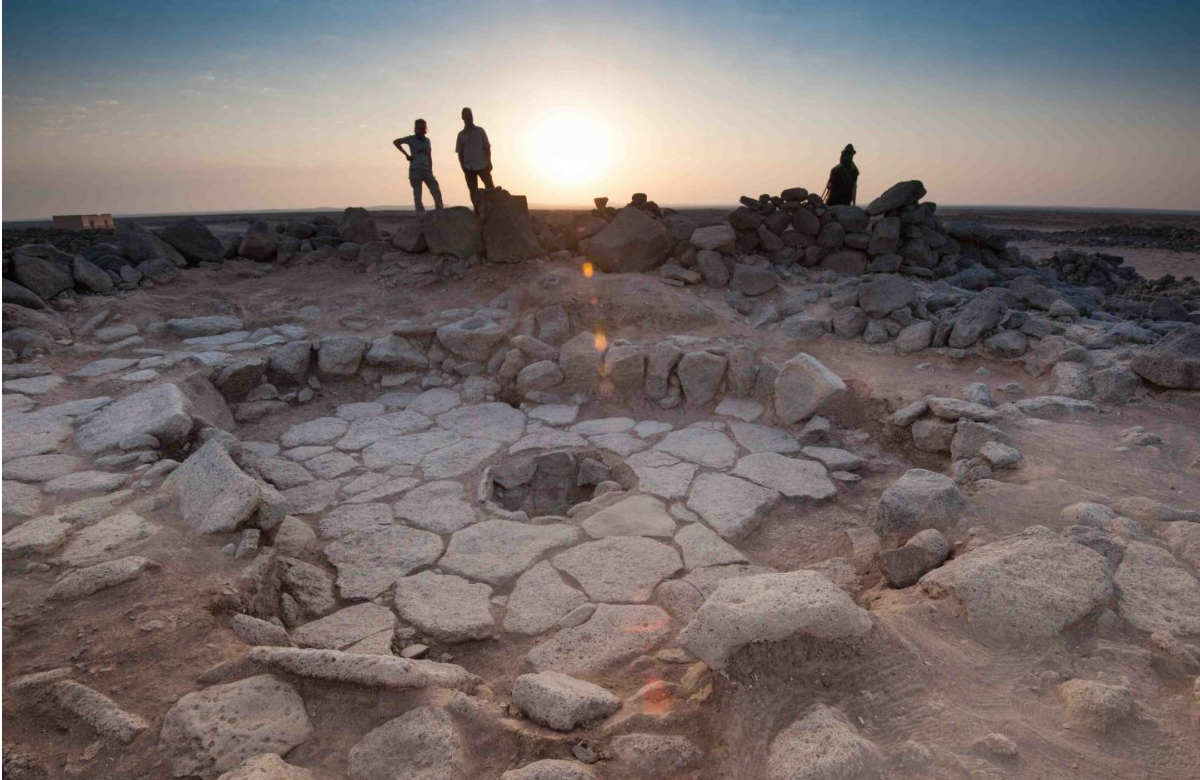
Professor Elisabetta Boaretto and Dr. Tobias Richter at Shubayqa, Jordan, with a Natufian hearth in the foreground. Credit: The Weizmann Institute of Science
Archaeologists excavating in Jordan have got some incredibly accurate new dates that challenge old ideas about where and when hunter-gatherers started to settle.
Around 15,000 years ago, the Natufian culture appeared in the Levant, a region of the eastern Mediterranean in what is today’s Middle East. Their culture straddled the boundaries between nomadic hunter-gatherer and settled agricultural lifestyles; they weren’t farmers, but they were sedentary.
They were some of the first people to build permanent houses and tend to edible plants – innovations that were later crucial to the emergence of agriculture during the Neolithic era. Evidence of their culture is spread over modern-day Israel, Jordan, Lebanon and Syria around 14,500 – 11,500 years ago, but where and when did it originate?
Until now, the prevailing theory is that it spread outwards from a ‘core region’, centred on the Mount Carmel and Galilee area, but a new study published in Scientific Reports challenges this idea.
Between 2012-2014, archaeologists excavating a 15,000 year old site in Jordan called Shubayqa 1, uncovered a well-preserved Natufian site. Here, they found lots of charred plant remains – rare in other Natufian sites in the region. They then took the remains to a lab specialising in Accelerator Mass Spectroscopy (AMS) dating to find out how old they were. The results showed that they were pretty much the same as the earliest dates from the ‘core region’; ergo the origins of Natufian culture were more widely spread than researchers had assumed.
The lab, known as the Dangoor Research Accelerator Mass Spectrometry (D-REAMS) lab, is one of the few in the world that says it can analyse even the smallest organic remains and extract dates that are accurate to within 50 years.
Led by Professor Elizabeth Boaretto and Dr Tobias Richter, scientists from the Weizmann Institute of Science and archaeologists from the University of Copenhagen, the team focused on samples from short-lived plant parts – like seeds or twigs – to make sure the dates were as accurate as possible. Together, they analysed samples from over 20 different layers at Shubayqa 1, making it one of the best and most accurately dated Natufian sites anywhere.
The newly obtained dates show people were living at Shubayqa 1 so soon after the earliest dated settlement in northern Israel that they were more or less contemporary. In short, the Natufians either expanded extremely rapidly, or they didn’t come from a single core region to begin with.
Previous research had linked the emergence of Natufian culture to the rich habitat of the Mediterranean woodland zone but, says Richter, these early dates from Shubayqa 1 suggest that people were also living quite comfortably in the Natufian style further east in more open parkland steppes, and more or less simultaneously.
Boaretto says that the ‘core area’ theory may have come about partly because the Mt. Carmel sites have been the best preserved and studied… until now.
As well as challenging the idea that Natufian culture began in one settlement and spread outwards, the study suggests that the hunter-gatherers who lived 15,000 to 12,000 years ago were ingenious and resourceful. Shubayqa’s hunter-gatherers were exploiting club rush tubers, and lots of other wild plants and animals, including birds and gazelle. People living in the Natufian style learned to make use of numerous plants and animals, and to tend them in a way that led to early settlement – whether they were in Mediterranean woodland, or further east.
The authors say that this supports a view in which there were many pathways to agriculture and that the ‘Neolithic way of life’ was a highly variable and complex process that “cannot be explained on the basis of single-cause models.”
Archaeology in your inbox?!
Want to join a dig? Learn more about archaeology? Join our email list for a monthly digest of our most popular stories, plus alerts for any digs, events, or courses you can join.
Join the list
Written by Maiya Pina-Dacier
Director of Engagement at DigVentures, Maiya digs with a trowel in one hand, and a Twitter feed in the other. She loves finding new ways to get people involved in archaeology - online and in the field.




There are no comments on this post yet. Be the first!