
Examples of sun and field stones. The bottom right stone is interpreted as depicting an enclosed field. Photo: Bornholms Museum.
Why did Stone Age people carve images of the sun, fields, and spider webs onto small, flat stones?
Danish archaeologists have found over 300 small carved stones, covered with motifs made by Neolithic people 5,000 years ago. Much like the carved stone balls found in North East Scotland, archaeologists don’t really know what they are, but the fact that each one is as unique as it is detailed makes trying to guess their meaning pretty irresistible.
According to an article in Science Nordic, most of the stones are round, with lines inscribed on their surface radiating out from the centre, which could resemble the sun, or spider webs. It’s not the first time that Danish archaeologists have found these ‘sun stones’, this latest cache contains some new designs; stones that are more square, with lines that the archaeologists think could resemble fields of grain.
But is that what they actually represent? And what were they used for? That, says Lars Larsson, a professor emeritus at the University of Lund in Sweden, is the million dollar question.
While the archaeologists don’t claim to have a clear explanation for the stones, they do seem happy to make some educated guesses.
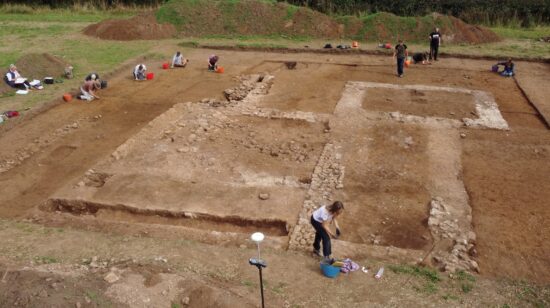
The stones were found at Vasagård – a huge Stone Age site on the Danish island of Bornholm, where archaeologists have also found the remains of a number of small, temple-like structures enclosed by a gigantic palisade fence, which have been dated to 3,500 BC. The site also has a tomb system, with a dolmen and passage grave, and an entrance that aligns with the summer solstice.
Excavations have revealed that, over time, the structures were renewed again and again, and that it would have taken many tons of wood to maintain such a huge monument. Altogether, it’s the most north-eastern site of this kind in Europe.
But what were the carved stones used for? Saying ‘it’s ritual’ doesn’t actually tell us much. What kind of ritual? And how can archaeologists figure it out?
According to Finn Ole Sonne Nielsen, the lead archaeologist at Bornholm Museum, who collaborated with the National Museum of Denmark, Aarhus University, and the University of Copenhagen on the excavation, there are a few clues that might be able to help.
Many of the stones are very worn, as though someone had walked around with them in their pocket. They have also been burnt and broken, before being deposited. And both types of ‘sun’ and ‘field’ stones were found close to each other, and may have been used together.
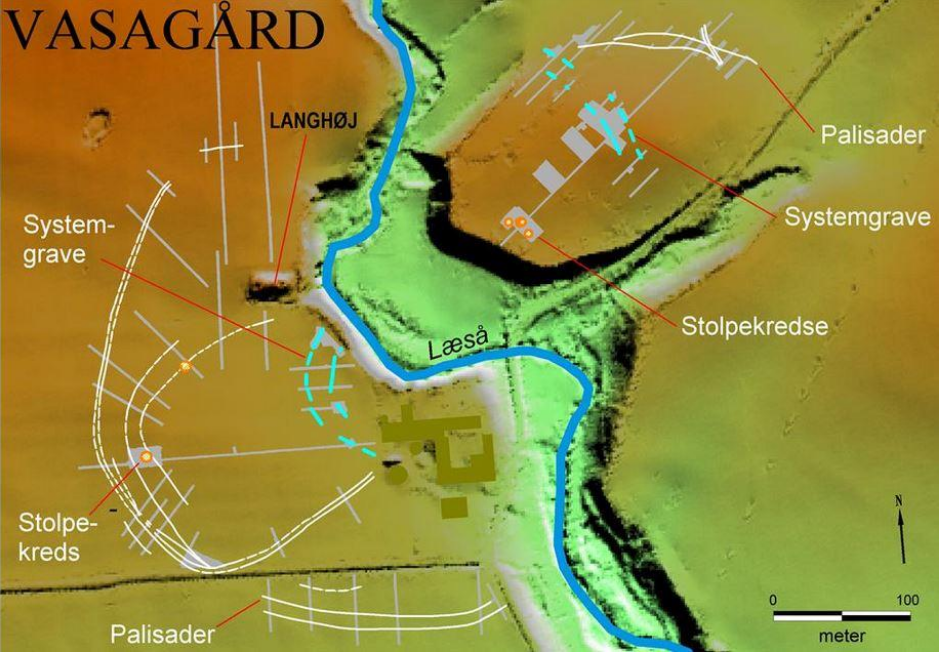
Map of Vasagard, including its grave systems and palisades. Photo: Bornholms Museum via videnskab.dk
Larsson adds that fire was very important to these people, as they burnt many items, including axes. It’s possible, he postulates, that the burning wasn’t a destructive act, but one to do with transition. Given its location, it may be a transition to do with life and death.
That’s one theory, but Flemming Kaul from the National Museum of Denmark has another. The ‘field stones’, he says, bear something resembling a plant covered with some kind of shade, alongside what look like fields of grain. He suggests that they might represent something protective… maybe the stones were part of some religious, ritual or magical activity around harvest time or solstice?
In situations like this, it’s certainly fun to speculate, and the newly discovered ‘field stones’ open up lots of new possibilities for interpretation. Will archaeologists ever crack the puzzle of Vasagård? We’d love to hear your ideas!
Archaeology in your inbox?!
Want to join a dig? Learn more about archaeology? Join our email list for a monthly digest of our most popular stories, plus alerts for any digs, events, or courses you can join.
Join the list
Written by Maiya Pina-Dacier
Director of Engagement at DigVentures, Maiya digs with a trowel in one hand, and a Twitter feed in the other. She loves finding new ways to get people involved in archaeology - online and in the field.




Comments (5)
This might sound silly but the first thing I thought as I was reading this interesting article, was, could these stones be monetary coins???
Is it Spiders Web or tree rings and rays??
Looks like Ogham writing on one
Maybe they were pieces for a board game.
Just read this article for the first time, and I`m immediately drawn to the `gaming` idea from Emilee. Why not? A game using images they would be familiar with, ie; the Sun, or webs, crops, etc. Perhaps the straight-lined pieces represent wood/timber? The top left stone could almost be water; a stream or river token? An early version of “Settlers of Catan” or “Carcassonne”?!?