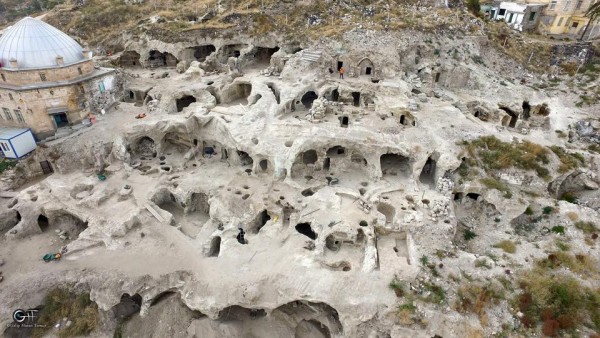
This sprawling subterranean retreat could have sheltered up to 20,000 people.
For the last two years, archaeologists have been exploring the remains of a subterranean city that’s so vast it could have housed well over 20,000 people.
Two years ago, demolition workers in Nevşehir, Turkey, were making way for a new housing development. Among the ruins of the old neighbourhood, they discovered something incredible; entrances to a network of underground tunnels. Archaeologists were called in, and investigations began.
By 2014, the team of archaeologists had revealed that those tunnels led into what could only be described as a multilevel settlement, with underground living spaces, meeting rooms, staircases, kitchens, wineries, and chapels, all fed by a complex network of wells, water channels and air shafts. And now, the team announced in Hurriyet Daily News, they think their discovery is set to “rewrite urban history.”
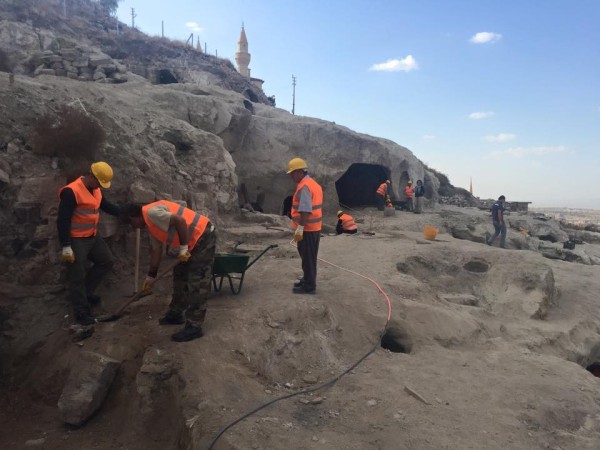
Archaeologists working at the site near Nevshehir, via Facebook
The world’s biggest underground city
Of course, this is not the first underground city to be discovered. Not only does Cappadocia have a number of other impressive sites carved into its landscape, including the 11th and 12th century churches at Goreme, and even a Roman castle at Uchisar, there are in fact dozens of underground cities, some of which have tunnels linking them together.
The most famous of these cities is Derinkuyu. It extends over 60m underground and is large enough to house an estimated 20,000 people. But now, geophysicists from Nevşehir University reckon the newly discovered city could be up to a third bigger than Derinkuyu.
Results from their latest survey have revealed tunnels stretching out over 7km and plunging to depths of 113m. In total, they think it covers over five million square feet.
But how old is it? And was it settled permanently?

Inside one the underground tunnels inside Derinkuyu
Because the cities are carved straight into the natural rock, it’s difficult to work out their age using traditional dating methods. As such, they present a fun and fascinating riddle, with plenty of room for speculation. Were they first built by the Hittites, or the Phrygians? Can their origins be traced back even further than that? Or is the truth simply that they are much more recent?
According to the Turkish Department of Culture, people may have started carving them as early as 800 BC, expanding them over the centuries to produce increasingly extensive, and self-sufficient, underground communities, but so far, most of the artefacts found inside indicate that they were in use from Byzantine through Ottoman times.
The settlement’s inhabitants could block the access tunnels, and seal themselves in with enough livestock and supplies to survive even the most brutal siege. These were, after all, turbulent times when thousands of people sought refuge underground from the Arab-Byzantine wars raging overhead.
Regardless of who built it, new discoveries about this ancient underground city below a modern housing development are ones we’re looking forward to hearing much more about.
Archaeology in your inbox?!
Want to join a dig? Learn more about archaeology? Join our email list for a monthly digest of our most popular stories, plus alerts for any digs, events, or courses you can join.
Join the list
Written by Maiya Pina-Dacier
Director of Engagement at DigVentures, Maiya digs with a trowel in one hand, and a Twitter feed in the other. She loves finding new ways to get people involved in archaeology - online and in the field.




There are no comments on this post yet. Be the first!