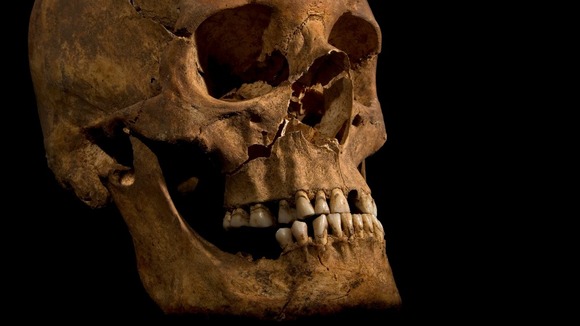
New study gives a blow-by-blow account of Richard III’s death and the injuries inflicted on his body in the Battle of Bosworth Field 529 years ago. Results suggest he had lost his helmet and was killed by two blows to his bare head.
When King Richard III died in the Battle of Bosworth Field on Aug 22, 1485, he became the last English monarch to be killed in battle.
Now, a new analysis by forensic scientists at University of Leicester suggest he was killed in a sustained attack by one or more assailants, had lost his helmet and died after receiving two fatal blows to his bare head.
The team used CT scans of his skeleton to carefully analyse injured bones and determine which of the wounds might have proved fatal to reveal exactly how it happened.
The team identified 11 skeletal injuries in total – nine to the head and two to the pelvis, all of which were clearly received close to the time of death.
Such concentrated and contemporary injuries suggest he was killed in a rapid and sustained attack by one or more assailants and none of the wounds to the skull is consistent with someone wearing a helmet, suggesting Richard’s had been removed – forcibly or otherwise.
The team also analysed tool marks on bone to identify the medieval weapons potentially responsible for his injuries.
Sarah Hainsworth, study author and Professor of Materials Engineering at the University of Leicester explains, “Richard’s injuries represent a sustained attack or an attack by several assailants with weapons from the later medieval period.
The wounds to the skull suggest that he was not wearing a helmet, and the absence of defensive wounds on his arms and hands indicate that he was otherwise still armoured at the time of his death.”
According to Professor Guy Rutty, study co-author, from the East Midlands Pathology Unit at the University of Leicester, “The most likely injuries to have caused the King’s death are the two to the [underside] of the skull—a large sharp force trauma possibly from a sword or staff weapon, such as a halberd or bill, and a penetrating injury from the tip of an edged weapon”
The investigators also suggested that the injuries to the post-cranial skeleton, including the potentially fatal one to the pelvis, might have been inflicted after Richard’s death, on the basis that had he been alive he would have been wearing a specific type of armour worn in the late 15th century that would have prevented such wounds.
Commenting on the research, Dr Heather Bonney from the Natural History Museum in London, UK, says “[it’s] a compelling account, giving tantalising glimpses into the validity of the historic accounts of his death, which were heavily edited by the Tudors in the following 200 years. Wherever his remains are again laid to rest, I am sure that Richard III will continue to divide opinion fiercely for centuries to come.”
Source: The Lancet and University of Leicester
Archaeology in your inbox?!
Want to join a dig? Learn more about archaeology? Join our email list for a monthly digest of our most popular stories, plus alerts for any digs, events, or courses you can join.
Join the list
Written by Maiya Pina-Dacier
Director of Engagement at DigVentures, Maiya digs with a trowel in one hand, and a Twitter feed in the other. She loves finding new ways to get people involved in archaeology - online and in the field.






Comments (1)
It would indicate that it is far more important, as far as history goes, to die important, than to be a killer of important people.