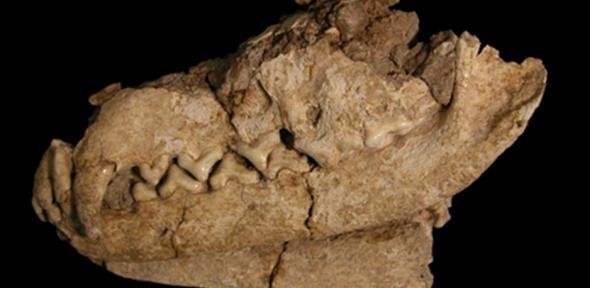
Burial of man and fox suggests early humans may have kept foxes as pets, predating any comparable example of dog domestication by 4,000 years.
The 16,500 year-old grave, which contains the remains of a fox buried alongside a human, was uncovered by researchers from the Leverhulme Centre for Human Evolutionary Studies, University of Cambridge.
Analysis suggests that the grave was later reopened and the human’s body moved to an adjacent grave, along with that of the fox. The University of Cambridge-led team believes the link between the two may therefore have been significant and that it may have been a pet who was then buried to accompany its master, or mistress, to the afterlife.
The cemetery, at Uyun-al-Hammam, in northern Jordan, is about 16,500 years old. According to the team, this makes the grave 4,000 years older than the earliest known human-dog burial and suggests that long before we began to hunt using dogs, our ancestors may have been keeping foxes as pets.
The relationship, however, was probably short-lived and it is unlikely that foxes were ever fully domesticated – despite an early head start, their position as a friendly household pet may have fallen by the wayside as humans took to the more companionable dog in later millennia.
The discovery was made when the team spotted a connection between two adjacent graves. In the first, they identified the remains of two adults, probably a man and a woman. The man had been buried earlier than the woman, and alongside him were the skull and humerus of a fox, as well as other grave goods.
When researches opened the second grave, they found human remains that may have belonged to the same man, and the skeleton of a fox that was missing its skull and right humerus.
The movement of the body parts is believed to be highly significant. If the human body is the same in both cases, then only the fox, and none of the other grave goods, were considered worth moving, strongly suggesting that the fox had some sort of special relationship to the human.
Although comparable cases are rare and many of the next earliest involve dogs, such as the body of a woman in Israel who was found buried with her hand resting on a puppy, they are about 4,000 years younger than Uyun-al-Hammam.
Studies carried out on foxes suggest that they can be brought under human control, but they are skittish and timid by nature, making the process difficult. The researchers suggest that it is perhaps for this reason that dogs, and not foxes, ultimately became ‘man’s best friend’.
Archaeology in your inbox?!
Want to join a dig? Learn more about archaeology? Join our email list for a monthly digest of our most popular stories, plus alerts for any digs, events, or courses you can join.
Join the list
Written by Maiya Pina-Dacier
Director of Engagement at DigVentures, Maiya digs with a trowel in one hand, and a Twitter feed in the other. She loves finding new ways to get people involved in archaeology - online and in the field.






There are no comments on this post yet. Be the first!