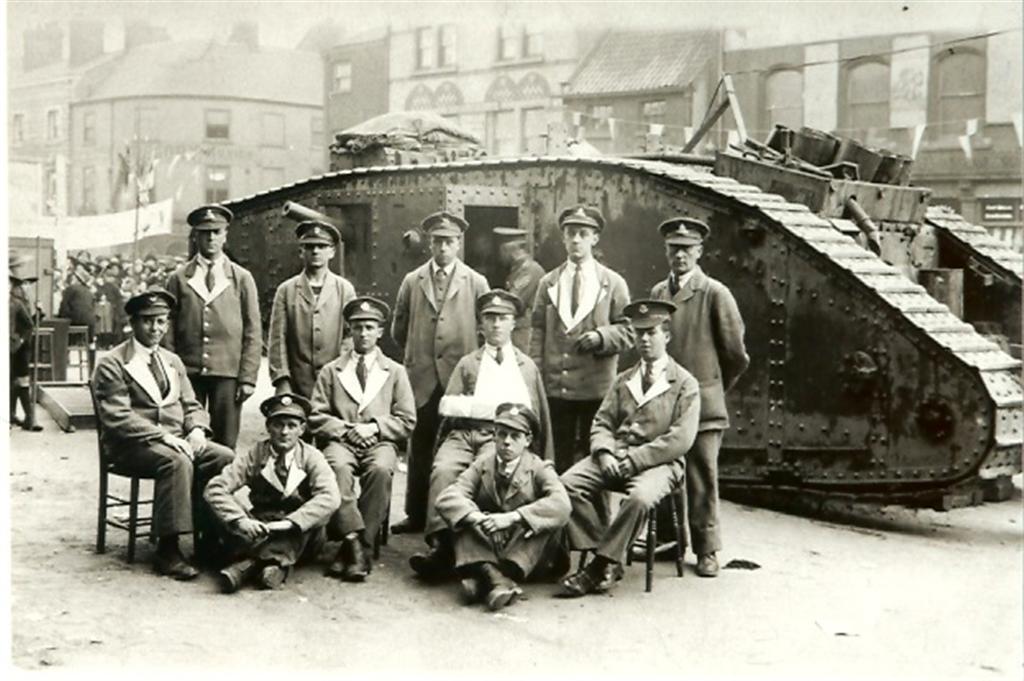
Egbert the tank with local VIPs during Doncaster’s Tank Week
When we think of modern warfare, the image of a tank is easy for most of us to picture. But how did these machines – so symbolic of modern warfare – originate?
For this week’s #WorldWarWednesday post, guest columnist and conflict archaeologist Sarah Ashbridge looks at the lumbering landships that turned into one of WWI’s most effective new weapons.
The first tanks were known as “landships”, in contrast to the existing battleship. Largely pioneered by the British Navy, innovative ideas were applied to farming vehicles, which then created a new contraption, able to cross almost any terrain with ease. In 1914 many armies including the Germans, British and French already made use of armoured fighting vehicles, however these vehicles were useless on the Western Front.
World War One had created a new type of combat: trench warfare, which made previous techniques, such as the use of cavalry, useless. The first landship to use a caterpillar track was designed in 1915 by Lieutenant W Wilson, and named “Little Willie” (Little Willie can still be seen at the Bovington Tank Museum). Though this vehicle was designed to travel through mud, it was not able to progress through the churned up landscape of the front line. And so “Big Willie” was developed.
Big Willie was first used by the British Army on 15 September 1916 at the Battle of Flers, followed by a less successful appearance at the Battle of the Somme, where 36 tanks attacked en masse. Though the tanks still needed quite a lot of development, it was of great assistance to the soldiers fighting from the trenches, bringing mobility to the Western Front.
Penny for the Tank Bank?
During WW1, the National War Savings Committee came up with a great fundraising opportunity: The Tank Bank. Six Mark IV tanks, (named Julian, Old Bill, Nelson, Drake, Egbert and Iron Ration) toured the country, visiting towns and cities across England, Scotland and Wales, gathering huge crowds of people, desperate to see this new “wonder weapon” – a far cry from today’s endless reality TV star tours!
Spectators could purchase bonds or a War Savings Certificate, and would queue up outside their local tank to have their bonds signed by the glamorous young women seated inside them. This practise became so popular that in 1917, Tank 141, known as Egbert, was brought over from France, fresh from the Battle of Cambrai, and put on display in Trafalgar Square.
An edge was added to this exciting attraction, with the announcement of a competition: the town or city that invested the most money per capita would win Egbert to call their own. This competition did more than just raise well-needed war funds, it helped to create a buzz of patriotism, which would be turned against those who opposed the war.
West Hartlepool won the competition, raising £31 9s 1d per capita between 1st October 1919 and 18th January 1919 – the equivalent of around £1300 in 2009. Egbert arrived at his new home in April 1919, where he remained until 1937 when he was scrapped as a ‘relic of barbarism’.
Have you always wanted to try archaeology? Now is your chance!
Archaeology in your inbox?!
Want to join a dig? Learn more about archaeology? Join our email list for a monthly digest of our most popular stories, plus alerts for any digs, events, or courses you can join.
Join the list
Written by Sarah Ashbridge
Office monkey by day, forensic archaeologist by night, Sarah Ashbridge is a jack-of-all-trades and the master of one: the forensic identification the War Dead. She trained originally as an Egyptologist, but interests in the history of death and burial saw her make the step into archaeology, completing an MSc in Forensic Archaeology and Crime Scene Investigation at the University of Bradford. Armed with an ever-increasing library of books, a handful of illustration pens and a brand new trowel, Sarah writes our regular #WWWednesday column, working towards her PhD in Forensic Archaeology.




Comments (4)
Hi,
Re: Bank Tanks WW1. ‘Egbert’ is reported in an Eastbourne newspaper to have appeared at a Bank Tank event in July 1918. However, the number on the side is 142 which was the number of the tank ‘Iron Rations’. Any ideas?
Hi Paul,
I’m not quite sure that I understand your question? 142 is indeed the number for ‘Iron Rations’, and 141 for ‘Egbert’. The six tanks each visited different towns in order to reach a wide audience. Please let me know if you require any additional information.
Best,
Sarah
There were SEVEN tank banks. 142 was a late addition in 1918
Thanks. Do you know the name of the one we’re missing?