History
The founding of Heruteu and the rise of Hilda
 In AD 640, a double monastery was established in Herutue by St Aidan, Apostle, Saint and King of Northumbria. This monastery was initially under the leadership of the Abbess Hieu.
Under the guidance of St Aidan, Hilda was appointed the second abbess of Heruteu Abbey, organising the monastery from AD 649 to 657.
After a decade at Heruteu, she moved on to establish a new monastery at what is now Whitby Abbey. This is where Hilda would die in AD 680 at the age of 66.
Hilda and her flock
St Hilda is important to the history of the Christian faith, not only in the local region but across the world.
She was known as a wise leader, from whom many sought advice. She was particularly concerned for the wellbeing and education of those in her care, often encouraging and nurturing their talents.
It was Hilda’s monastery which hosted the Synod of Whitby in 664, a committee to resolve the differences between the Roman and Irish traditions of the faith.
The synod decided that the Roman traditions would be the prevailing practice, resulting in many monks of the Irish tradition returning to Ireland in protest.
However, Hilda, a strong adherent to the Irish traditions, continued her work at Whitby and remained faithful to the people of Northumbria.
St Hilda’s Church
The church that was named after Hilda was built on the Hartlepool headland in the late 12th century.
Discovery of Anglo-Saxon buildings in the 1960s confirmed that the church had been built on the site of the monastic complex, linking Old Hartlepool with other historic sites of importance, such as Whitby, Iona, and Lindisfarne.
The original monastery was likely destroyed in the 9th century by raiding Vikings who were targeting the religious sites along the northeast coast, most notably the Holy Island of Lindisfarne.
It is generally believed that the building of St Hilda’s church was initiated by Robert de Brus IV, the great grandson of Robert de Brus, 1st Lord of Annandale who was one of the knights arriving from France with William the Conqueror in 1066.

Credit: Tees Archaeology, Hartlepool Borough Council and The Headland History Group supported by the Heritage Lottery Fund, designed by Graham Hodgson
The Finds and Fabric of St Hilda’s
The church is Grade I listed and on Historic England’s Heritage At Risk register. Described by architectural Historian Clifton-Taylor as ‘architectural gem’ and ’a glory of Early English architecture in its earliest and purest phase’, the church and its location are still of immense importance today. The church boasts many of its original 12th and13th century architectural elements.
Modified and enlarged over the centuries, St Hilda’s church is known for its imposing ‘flying buttresses’ supporting the tower. Its image is often used as a representation of Hartlepool, especially by the local authority.
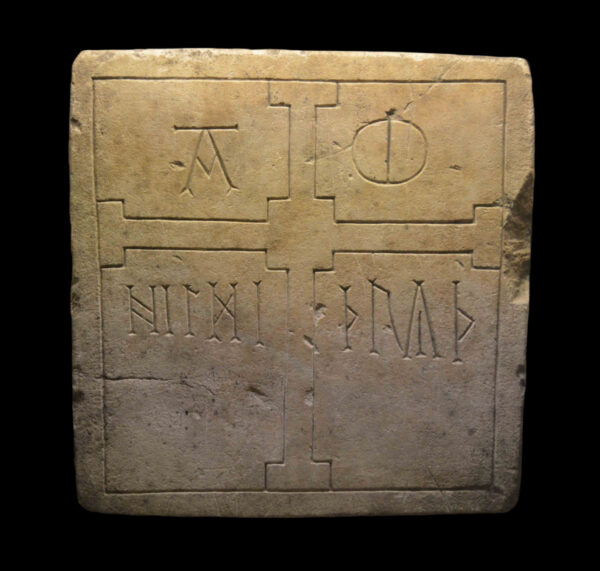
The Hildthryth namestone on display at St Hilda’s Church
Often overshadowed by the Northumbrian Christian heritage heavyweights of Whitby, Jarrow and Lindisfarne, the archaeological finds at Hartlepool Headland deserve greater attention.
During the 19th and early 20th centuries, building work uncovered burials, some of which contained namestones. These enigmatic artefacts are important heritage assets unique to the North-East and are extremely significant for Anglo-Saxon Northumbria.
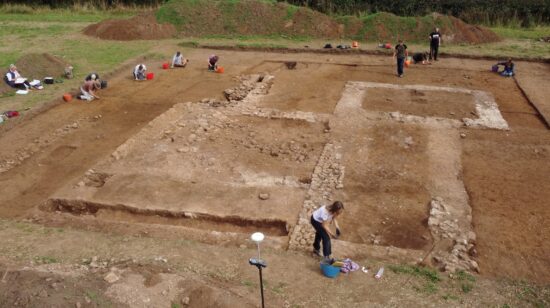
During the 1980s, a large area of the Headland was excavated, revealing structures relating to the Anglo-Saxon double monastery of Heruteu.
In 2000, Time Team (season 7, episode 12) featured St Hilda’s and the Headland, as they discovered the foundations of the earlier monastic site in the grounds of the church. Human remains were found in a garden thought to have been the monastic cemetery. This female skeleton, likely a nun, was interred in the sanctuary of the church on the feast of St Hilda that year.