Project Background
From Iron Age chariot burials, to square ‘round barrows’ and abandoned medieval villages, East Yorkshire is home to some truly surprising archaeology.
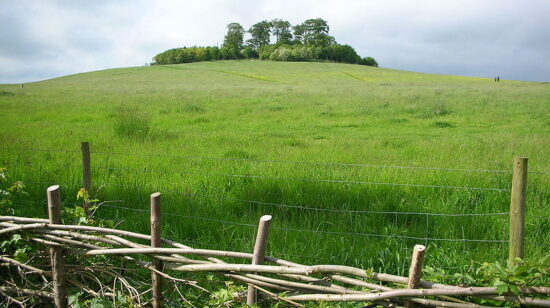
Located close to the Yorkshire Wolds – an area known for some remarkable archaeological discoveries dating back 6,000 years from the Neolithic right through to the late middle ages, Elmswell Farm also sits within the Hull Valley – an area that’s famous for having a distinctive ‘Arras’ Iron Age culture who buried their dead in square, rather than the typical round, barrows.
Elmswell Farm
Elmswell, Driffield, East Yorkshire, YO25 3EL
Over the years, Elmswell Farm has produced an embarrassment of archaeological riches: Roman coins, Anglo-Saxon burials, Bronze Age weapons and even a cache of stone tools. But perhaps the most impressive is a series of cropmarks spotted from the air, so distinctive that they can only be one thing: an entire medieval village.
John Fenton has tended Elmswell Farm, near Driffield in the East Riding of Yorkshire, for a lifetime. Over the years, an extraordinary number of artefacts – from flint tools to Roman coins and Bronze Age burials – have turned up in his fields and he’s done a marvelous job of keeping them safe, even going so far as to build a small museum.
The discoveries started back in the 1870s, when John Mortimer began excavating some of the many prehistoric burial mounds in the area. In one, he found an early Bronze Age person buried with a hawk, some amber beads, a copper dagger and a gold-decorated wrist-guard. Later, he discovered that this mound also concealed a further 46 Anglo-Saxon burials.
Then, in the 1930s, the Roman finds came tumbling in. Among them were 37 coins (one of which was Iceni), plenty of pottery and, in the neighbouring field, clear evidence of a Roman ladder settlement that had been occupied from the late Iron Age to the early Anglo-Saxon period.
As if that wasn’t enough for one farm, aerial photos taken by the RAF revealed the outline of another settlement – this time a deserted medieval village that’s so well preserved you can still see its crofts, tofts and well-established holloways (paths worn into the ground through time).
Today, John’s farm sits right on top of all this, and he’s convinced that the archaeology needs all the attention it can get, sooner rather than later. We agree! Elmswell Farm has all the ingredients to become one of East Yorkshire’s most important and well-known sites.
Medieval Settlement
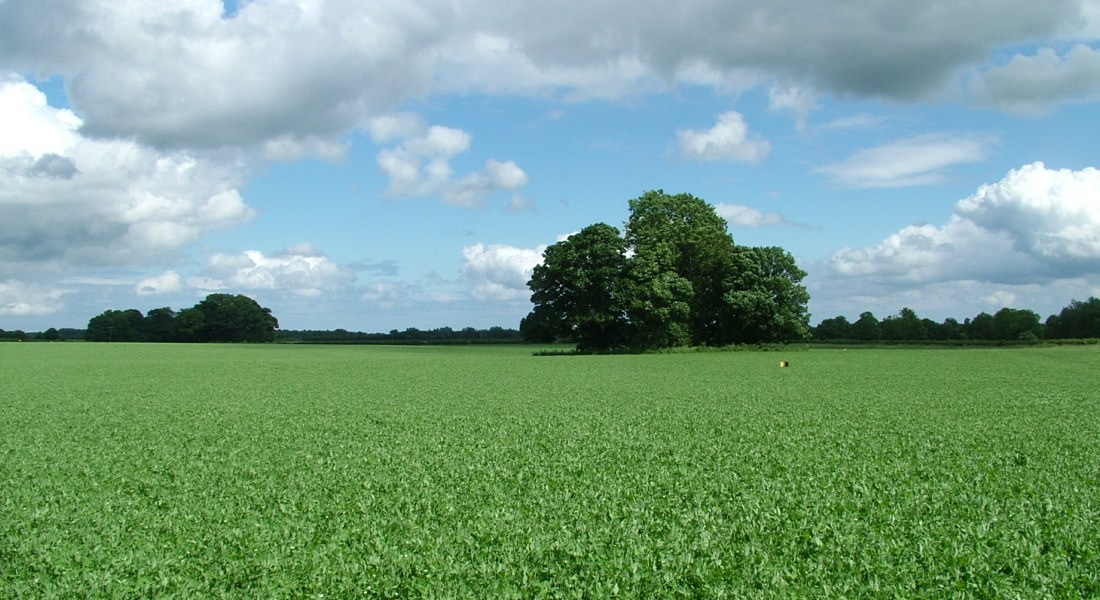
There are around 2,000 abandoned medieval villages in England, and each one has its own unique story to tell. At Elmswell Farm, aerial photos taken by the RAF revealed the clear outline of a village, complete with crofts, tofts, and holloways (paths worn into the ground through time).
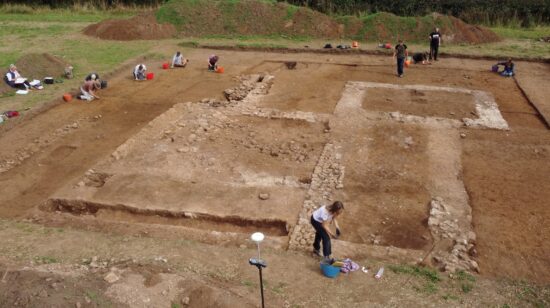
In 2017, DigVentures’ crowdfunded excavation took an exploratory look at the medieval remains, proving that they’re full of evidence that can help us chart the ebb and flow of life at this well-preserved village.
With help from our crowdfunders, we charted the location of several buildings, unearthed plenty of pottery, and recovered other fragments of daily life, like a chalk spindle whorl.
Anglo-Saxon Connections
Open the pages of the Anglo-Saxon Chronicle, and you’ll find a reference for the year AD 705 that suggests that the nearby village of Driffield was once the site of a rare eighth century Northumbrian palace. The Chronicle indicates that King Aldfrith, who ruled Northumbria after the death of his brother, Ecgfrith in 685 AD, possessed a palace at Driffield, hinting at the area’s past royal importance.
On the site of Elmswell Farm itself, there’s also the Roman ladder settlement, which includes a 4th century villa, and which seems to have been inhabited from the late Iron Age, right through the Roman period and into the early Anglo-Saxon occupation.
What’s more, it offers the potential to study the transitionary periods – particularly the post-Roman population. Did the Roman settlement continue to be inhabited once the Roman occupation had ended? What was life like for those that stayed?
Roman Settlement
In the 1930s, the Roman finds came tumbling in. Among them were 37 coins (one of which as Iceni), plenty of pottery, mortared stone walls and floors, and, in the neighbouring field, clear evidence of a Roman ladder settlement, which includes a 4th century villa.
These excavations seem to suggest that settlement was inhabited from the late Iron Age, right through the Roman period and into the early Anglo-Saxon occupation.
Over the last few years, two metal detectorists working with the Portable Antiquities Scheme have continued to unearth incredible finds, including hundreds of high status Roman pottery sherds and even some Roman tesserae, all of which hint that with further archaeological excavation, there’s plenty more evidence to be unearthed.

Half a Roman bowl, unearthed by our DigClub teenagers in 2021

An ornate (and complete) bone pin used for fastening Roman hairdos
Iron Age Settlement
The Romans weren’t the first to populate this settlement; there are some strong indicators that the Iron Age people lived here before them.
Excavations at the Roman ladder settlement in the 1930s indicated that the settlement might not have been entirely, well, Roman.
Small pieces of evidence suggest that its first inhabitants may have arrived during the late Iron Age, setting down their foundations before the Romans arrived. Occupation may then simply have continued, with the settlement expanding along with its new population, and the culture that went with it.
For archaeologists, the possibility of studying this transitional period, is a big deal. How did the local population respond to the arrival of the Romans?
But its not just the ladder settlement that suggests Elmswell Farm might be able to address this question; the surrounding area is teeming with Iron Age life, from the square barrows of the Arras culture at Pocklington, to the woman buried with an impressive Iron Age chariot at Wetwang.
How far back can we go?
There’s even older evidence going all the way back to the Bronze Age, and even the Mesolithic. One day, you could help us excavate it.
Our aim at Elmswell Farm is to produce a timeline spanning the site’s history, filling in blanks left where previous generations of archaeologists have been unable to join the dots between one period and another.
So far, we’ve been focussing on the medieval settlement and why it was abandoned. This year, we’ll start exploring what we can learn about the transitional periods between Iron Age and Roman, and Roman and Anglo-Saxon life at the ladder settlement
We also want to characterise the extent of Roman settlement on the farm; we know there’s a ladder settlement, but there are also traces of other Roman activity around the site; tesserae, roof tiles, and a few champion discoveries that we’re not quite ready to disclose publicly yet…
But that’s not all. In the future, we hope we might be able to extend the excavation into areas that can help us examine Yorkshire life even further back in time. Will we be able to unearth evidence of Yorkshire’s Bronze Age inhabitants? Can we trace them all the way to the Mesolithic?
Everything we’ve seen at Elmswell Farm so far suggests that yes, we can. We can see the site’s potential, and we hope you can too!
Dig Updates
Follow the latest archaeology action from Elmswell Farm as it happens.